
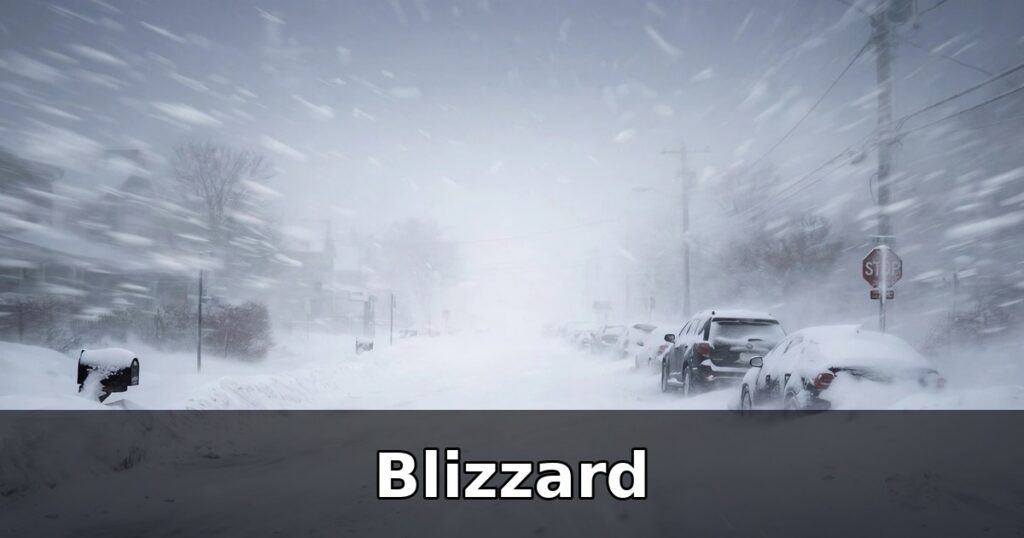
What Is the Difference Between a Blizzard and an Ordinary Snowstorm?
Key points
- A blizzard is defined by wind and visibility, not snowfall: sustained wind or frequent gusts of at least 35 mph (56 km/h), with visibility at or below 1/4 mile (400 m) for at least 3 hours.
- A snowstorm is a general term for a storm that drops a lot of snow. It has no wind or visibility threshold.
- A blizzard can happen without any new snow falling, when wind picks up snow already on the ground. That is called a ground blizzard.
- The Blizzard of 1978 dropped 27.1 inches on Boston and 27.6 inches on Providence, killed about 100 people, and closed Massachusetts roads for about a week.
When snow is falling hard and the wind is howling, people reach for the strongest word they know. On television and on social media, almost every big winter storm gets called a blizzard. Most of them are not blizzards. That is not a matter of opinion or of how bad the storm felt. In the United States, “blizzard” has a precise technical definition, and most snowstorms — including some very destructive ones — do not meet it.
The distinction matters for more than accuracy. The definition exists because wind and visibility, not snowfall alone, decide whether people can travel, whether emergency vehicles can move, and whether a storm becomes a life-threatening event. A storm that drops two feet of snow in calm air is a serious problem. The same snowfall with a 50 mph wind is a different kind of disaster.
The definition: wind, visibility and time
The United States National Weather Service defines a blizzard by three conditions, all of which must hold at the same time. First, the wind: sustained winds or frequent gusts of 35 mph (56 km/h) or more. Second, the visibility: falling or blowing snow must reduce visibility to 1/4 mile (400 metres) or less. Third, the duration: those conditions must last for at least 3 hours.
Notice what is missing from the definition: snowfall amount. A blizzard does not require any particular depth of snow. A storm that drops only a few inches can be a blizzard if the wind is strong enough and the visibility low enough for long enough. And a storm that drops three feet of snow in light wind is not a blizzard, however much snow it leaves behind.
The reason is that the danger of a blizzard is not the depth of the snow but the loss of orientation and movement. At visibility below a quarter of a mile, a driver cannot see the road, the edge of the road, or the vehicle ahead. At wind speeds above 35 mph, snow is driven horizontally, drifts form in minutes, and exposed skin cools rapidly. Three hours is the threshold at which those conditions stop being a squall and become a sustained emergency.
A blizzard without snowfall: the ground blizzard
The strangest consequence of the definition is that a blizzard can happen on a clear, sunny day. When strong wind picks up snow that is already lying on the ground and drives it across roads and fields, visibility can fall below a quarter of a mile even though no new snow is falling. Meteorologists call this a ground blizzard.
Ground blizzards are common on the open plains, where there is little to break the wind and deep snow lies exposed. A driver can set out under a blue sky and drive into a whiteout a few miles down the road, where the wind is funnelling snow across an open stretch. The danger is greater precisely because the weather looks fine at the starting point.
What a snowstorm is
A snowstorm, by contrast, is a general term. In the usage of the World Meteorological Organization, it means a storm that produces a significant amount of snow. There is no wind threshold, no visibility threshold and no duration threshold. Any storm that drops a lot of snow qualifies.
That makes “snowstorm” the broader category and “blizzard” the narrower one. Every blizzard that involves falling snow is also a snowstorm, but most snowstorms are not blizzards. A slow-moving storm that drops two feet of snow over two days in light wind is a major snowstorm. It will close schools, collapse roofs and strand cars. It is not a blizzard, and calling it one confuses the nature of the threat.
The confusion is understandable, because the two kinds of storm often arrive together. The same low-pressure system that produces heavy snow can also produce strong winds, and when it does, a snowstorm becomes a blizzard. But the wind is what makes the difference, and it is the wind that the definition is trying to capture.
| Feature | Blizzard (NWS) | Ordinary snowstorm |
|---|---|---|
| Wind | Sustained or frequent gusts 35 mph (56 km/h) or more | No threshold |
| Visibility | 1/4 mile (400 m) or less in falling or blowing snow | No threshold |
| Duration | At least 3 hours | No threshold |
| Snowfall amount | Not part of the definition | Significant snow, by general usage |
| New snow required? | No — a ground blizzard needs only blowing snow | Yes, by definition |
Warnings: what the numbers trigger
The National Weather Service issues winter storm warnings on separate criteria, and those criteria vary by region. In general, a winter storm warning is issued for snow of 6 inches or more, sleet of 2 inches or more, or ice of 1/4 inch or more. The thresholds differ from place to place, because six inches of snow is a routine event in Buffalo and a crisis in Atlanta.
A blizzard warning is a step beyond a winter storm warning. It is issued when the wind and visibility criteria are expected to be met, and it tells the public that travel will be impossible, not merely difficult. The distinction is deliberate: a winter storm warning says to prepare for a lot of snow; a blizzard warning says to stay off the roads.
That advice is not bureaucratic caution. In a blizzard, a car that leaves the road can be buried by drifting snow in minutes, and a driver who leaves the car can become disoriented within steps of it.
The Blizzard of 1978
The storm that fixed the word “blizzard” in the American imagination struck New England from 5 to 7 February 1978. It dropped 27.1 inches of snow on Boston, then a record for the city, and 27.6 inches on Providence, Rhode Island, a state record. Snowdrifts reached 15 feet in places.
The human cost was severe. About 100 people were killed and about 4,500 were injured. Damage was estimated at $520 million in 1978 dollars. Fourteen of the deaths were from carbon monoxide poisoning, in cars buried in snow on Interstate 95 and Route 128 outside Boston, where drivers kept their engines running for warmth while the exhaust was blocked.
The storm shut down the region. Massachusetts banned car travel for about a week — one of the longest driving bans in American history — and the National Guard was called out to clear roads and rescue stranded drivers. The ban worked: it kept the roads clear for snowploughs and kept more people from becoming stranded. It also became the model for later travel bans in major winter storms.
Winter Storm Jonas, 2016
A more recent example came in January 2016, when Winter Storm Jonas struck the eastern United States. It dropped two to three feet of snow along the East Coast, with more than two feet in New York City. Twelve states and Washington, D.C., declared states of emergency.
The wind was the feature that made Jonas a blizzard in many places. The strongest gust recorded was 85 mph on Assateague Island in Virginia. Fifty-five people died in the storm. Jonas was a reminder that a modern city, with modern forecasting and modern equipment, can still be overwhelmed when heavy snow and blizzard-force wind arrive together.
| Storm | Snowfall | Deaths | Notable impact |
|---|---|---|---|
| Blizzard of 1978 (5–7 Feb) | Boston 27.1 in; Providence 27.6 in; drifts 15 ft | About 100 | Massachusetts driving ban about a week; 14 deaths from carbon monoxide in buried cars |
| Winter Storm Jonas (Jan 2016) | 2–3 ft on the East Coast; over 2 ft in New York City | 55 | Emergencies in 12 states and D.C.; gust 85 mph on Assateague Island, Virginia |
What the research says
The standard reference for Northeast snowstorms is Northeast Snowstorms by Paul Kocin and Louis Uccellini, published by the American Meteorological Society in 2004. The book documents the structure of the storms that produce the region’s heaviest snow, including the 1978 blizzard, and it remains the reference that forecasters and researchers turn to when a new storm resembles an old one.
Kocin and Uccellini’s work shows why the blizzard definition is written the way it is. The storms that produce the worst impacts are not simply the ones with the most snow. They are the ones in which a strong pressure gradient drives sustained wind across a deep snowpack, reducing visibility for hours at a time. The definition captures that combination directly, rather than using snowfall as a proxy for it.
The book also documents the pattern that made 1978 so destructive: a storm that stalled off the coast, feeding moisture into New England for days, while strong winds drove the snow horizontally. The snowfall totals were historic, but it was the wind, the duration and the whiteout that turned a heavy snowstorm into a disaster that closed a state for a week.
Environmental impact
The damage from a blizzard does not end when the snow stops. Deep drifts can bury livestock, and animals that survive the storm may be cut off from food and water for days. Power lines brought down by wind and by the weight of snow and ice can leave homes without heat in the coldest weather of the year.
When the snow finally melts, the water has to go somewhere. A deep snowpack melting rapidly in spring can flood rivers and low-lying land, especially if rain falls on the snow. The flood that follows a blizzard can be as destructive as the storm itself, and it arrives when attention has already moved on.
The 1978 storm illustrated both effects. The drifts buried cars, houses and livestock across New England, and the sheer volume of snow took weeks to clear and melt. The cost was counted not only in the $520 million of immediate damage but in the weeks of disruption that followed.
What should change: lessons from 1978
Travel bans work. The Massachusetts ban of 1978 is the clearest evidence. Keeping cars off the roads let ploughs work, kept emergency vehicles moving, and prevented more drivers from becoming stranded. Modern blizzard warnings carry the same message, and the lesson of 1978 is to issue the ban early, before the roads fill with stranded cars.
Never run an engine in a buried car. Fourteen people died of carbon monoxide poisoning in 1978 because their exhaust pipes were blocked by snow. The rule is simple: if a car is buried, clear the exhaust pipe before running the engine, and open a window slightly for ventilation. A car that looks like shelter can become a trap.
Carry a winter survival kit. A blanket, a shovel, food, water, a charged phone and a warning light can make the difference between a long wait and a fatal one. The kit matters most in a blizzard, where rescue may take hours and the car itself may be invisible under a drift.
The wind makes the blizzard
A snowstorm is measured in inches. A blizzard is measured in miles per hour, in fractions of a mile of visibility, and in hours. That is the whole difference, and it is a large one. The storm of 1978 was a blizzard because its wind drove 27 inches of snow into a whiteout that lasted for days. A storm that drops the same snow in calm air would be a major snowstorm — and it would not be a blizzard at all.
Raina





댓글 0
첫 댓글을 남겨보세요.