
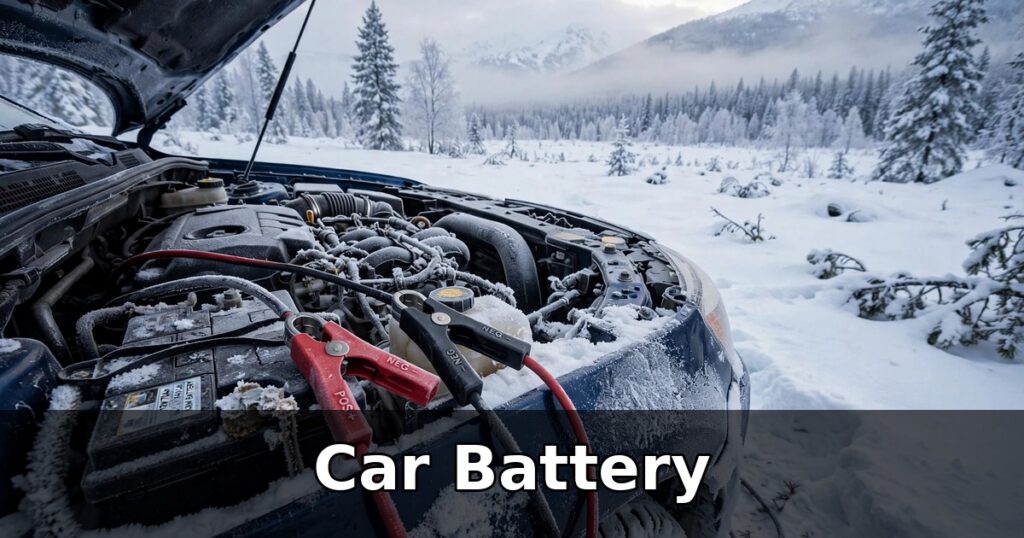
How to Keep Your Car Battery Alive Through a Freezing Winter
Key points
- A battery loses about 35% of its strength at 32°F and about 60% at 0°F, according to AAA — while the engine needs about 30% more power to start at freezing.
- A healthy, fully charged battery reads about 12.6 volts at rest. Below 12.2 volts, it is seriously discharged.
- Most car batteries last three to five years. AAA advises testing any battery older than three years before winter.
- A fully charged battery does not freeze until about −75°F, but a discharged battery can freeze at 15°F.
- Short trips under 10 miles in freezing weather may not put back the charge a cold start takes out.
Every winter, the same scene repeats in driveways across the cold parts of North America: a car that started without complaint all autumn turns over slowly on the first hard frost, clicks once, and goes silent. The driver had no warning. The battery gave none.
Cold does not usually kill a healthy battery; it exposes the weak one already there. Winter attacks from both sides at once, taking power away from the battery at the exact moment the engine demands more of it. Testing for that squeeze before the first freeze is what keeps a car starting all winter.
Why cold hits a battery twice
A car battery is a chemical device, not a fuel tank. Inside a standard lead-acid battery, lead plates sit in sulfuric acid and water; the reaction between plates and acid produces current, and the alternator runs it in reverse to recharge. Chemical reactions slow as temperature falls, so in freezing weather the reaction inside the battery moves sluggishly and the battery cannot deliver current as fast. The energy is still stored — but the battery cannot release it quickly enough to spin a cold starter motor.
At the same time, the engine becomes harder to turn: oil thickens in the cold, so the moving parts drag and the starter must fight that drag on every revolution. AAA estimates a vehicle needs about 30% more power to start at 32°F, and in severe cold the engine can demand up to twice the usual current. Less power available, more power demanded: that is the whole winter battery problem in one sentence.
How much power the cold takes away
| Temperature | Battery strength lost (AAA) | Extra power the engine needs |
|---|---|---|
| 80°F (27°C) | Full strength | Normal starting power |
| 32°F (0°C) | About 35% | About 30% more |
| 0°F (−18°C) | About 60% | Up to twice the normal current |
The numbers explain why a battery that seems fine in mild weather fails on the coldest morning of the year: at 32°F it has already lost roughly a third of its strength, and at 0°F well over half. Some AAA guidance puts the loss near zero at up to 50% rather than 60% — the exact figure varies with battery type and test method — but every version points the same way.
Age makes the loss worse. A new battery can absorb a 35% cut and still crank the engine; a four-year-old battery that has already lost a quarter of its capacity to age cannot. That is why AAA calls dead batteries the leading reason for roadside assistance calls during winter storms. The failure looks sudden, but the decline behind it took years.
Test it before the first freeze
The only reliable way to know a battery’s condition is to test it — in autumn, before the first hard freeze. A battery that starts the car on a mild October afternoon proves nothing; it needs testing under load, the way a cold morning tests it.
The simplest check is a multimeter across the terminals with the engine off, the car parked for a few hours. A healthy, fully charged battery reads about 12.6 volts; around 12.4 is roughly three-quarters charged and getting weak; at 12.2 the battery is about half charged, and below 12.0 it is discharged. Interstate Batteries considers a battery dead at 11.9 volts or below. With the engine running, the reading should rise to roughly 13.7 to 14.7 volts, showing the alternator is charging.
| Resting voltage | State of charge | What it means |
|---|---|---|
| 12.6 V or higher | About 100% | Healthy and fully charged |
| 12.4 V | About 75% | Getting weak — charge and retest |
| 12.2 V | About 50% | Seriously discharged |
| Below 12.0 V | Near empty | Recharge before testing further |
| 11.9 V or below | Dead | Needs replacement or professional testing |
Voltage alone can mislead, though. A battery can show a healthy 12.6 volts at rest and still collapse the instant the starter demands current, because voltage measures charge, not the ability to deliver power under strain. The better test measures cold cranking amps, or CCA — the number printed on the battery label, and the rating that matters most in winter.
CCA is defined by the Battery Council International: the current a new, fully charged battery can deliver for 30 seconds at 0°F while staying at or above 7.2 volts. A conductance tester compares the battery’s measured CCA with the rating on its label. A battery testing well below its rated CCA is a winter risk even if it starts the car perfectly today. As a rule of thumb, a battery below about 70% of its rated CCA should be replaced before winter, not after it fails. Many auto parts stores run this test free.
Age is the other half of the decision. AAA puts average battery life at three to five years and recommends testing any battery older than three years. Consumer Reports, citing AAA data, found batteries last 58 months or more in the coldest northern United States but less than 41 months in the hottest southern regions — a reminder that heat, not cold, sets the clock. A battery past four years that tests soft should be replaced on a mild autumn afternoon, not nursed through one more winter.
The freeze risk nobody expects
A car battery can freeze, and the damage is usually permanent. Whether it freezes depends less on the weather than on the state of charge: as a battery discharges, the sulfuric acid in its electrolyte is consumed and the liquid inside becomes closer to plain water, which freezes at 32°F. Concentrated acid does not.
| Battery condition | Approximate freezing point |
|---|---|
| Fully charged | About −75°F (−59°C) |
| Discharged | About 15°F (−9°C) |
| Fully discharged | About 32°F (0°C) |
Interstate Batteries states that a fully charged battery will not freeze until about 75°F below zero, but a discharged battery can freeze at 15°F, and a fully discharged one at or around the freezing point of water. When the liquid inside freezes it expands, warping the lead plates and cracking the plastic case. A frozen battery cannot be repaired.
This is why a car left parked for weeks in winter is at risk even if the battery was fine when it was parked. Small drains — the clock, the alarm, the computer memory — draw it down a little every day, and a battery that slowly discharges in a cold garage can cross from safe to freezable without anyone noticing. A battery that might be frozen should never be charged or jump-started; have it inspected by a professional, because a frozen battery can rupture.
What the research says
The cold-weather figures here trace back to a small number of sources that agree on the shape of the problem even when exact numbers differ slightly. The AAA Automotive Research Center’s testing is the basis for the 35% loss at 32°F, the 60% loss at 0°F, and the finding that the engine needs about 30% more power to start at freezing. AAA’s roadside data shows dead batteries are the leading cause of winter breakdown calls.
The CCA rating is a laboratory standard, not a marketing number: the Battery Council International test chills a battery to 0°F and measures the current it can sustain for 30 seconds while holding at least 7.2 volts. It exists because warm-weather performance says little about cold-weather performance. When buying a replacement, the CCA rating should meet or exceed the manufacturer’s specification — a compact car may need only 400 to 500 CCA, while a truck or SUV can require 700 or more.
AAA gives three to five years as the typical lifespan; Consumer Reports’ regional breakdown — 58 months or more in the far north, under 41 months in the far south — shows heat is the main ageing factor. Cold regions get longer battery life on average, and then lose it all on one freezing morning.
What is still uncertain
The exact strength-loss figures vary by source. AAA’s research centre reports about 35% lost at 32°F and about 60% at 0°F; other AAA publications put the loss near zero at up to 50%. The difference reflects battery types, ages and test methods, not a dispute about the direction. Every version agrees the loss is large.
Voltage readings shift with temperature. The standard chart assumes a battery near 77°F, and in freezing conditions the resting reading drops slightly on its own, so a cold reading can look worse than the battery really is. Treat an overnight cold reading as a rough guide, not a verdict — one more reason to use a CCA test rather than a voltmeter alone.
No test predicts the exact morning a battery will fail. A battery can pass in October and fail in January if a charging fault develops or a drain appears. Testing lowers the odds of a surprise; it does not remove them. Test early, retest if starting grows sluggish, and carry jumper cables or a portable jump starter as insurance.
What should change: a winter routine that works
Test in autumn, replace on your schedule. Test the battery and charging system before the first freeze, and replace a battery older than three years that tests below about 70% of its rated CCA. A planned replacement is a chore. An unplanned one is a crisis.
Drive long enough to recharge. Starting the engine in the cold takes a large gulp of charge, and the alternator needs time to put it back. Short trips under 5 miles in normal temperatures — and under 10 miles in freezing temperatures — may not fully recharge the battery, according to vehicle manufacturer guidance.
Turn things off before starting. Headlights, heated seats, the defroster and the blower all draw power the starter needs — switch them off before turning the key.
Keep the terminals clean and tight. White or greenish crust on the terminals adds resistance between battery and starter — resistance that matters most when current demand is highest. Clean terminals and snug connections cost nothing and recover power corrosion was stealing.
Park under cover when possible. A garage a few degrees warmer than the open air slows the chemical slump. For cars parked outside in extreme cold, a battery blanket or block heater, plugged in a few hours before starting, warms the battery and thins the oil.
Use a maintainer for a car that sits. A vehicle parked for weeks should be connected to a battery maintainer, which holds the battery at full charge without overcharging it. A fully charged battery resists freezing to about −75°F; a slowly discharging one can freeze at 15°F.
A battery that survives winter is a battery prepared in autumn
A car battery does not fail because winter is unfair. It fails because cold takes a third of its strength at freezing and well over half at zero, while the engine asks for a third more power — and the battery was already old, half discharged, or quietly corroded. None of those is hard to find in October. All are miserable to discover in January. Test the battery, read the voltage, check the CCA, and replace it before the cold does the deciding.
Raina





댓글 0
첫 댓글을 남겨보세요.