
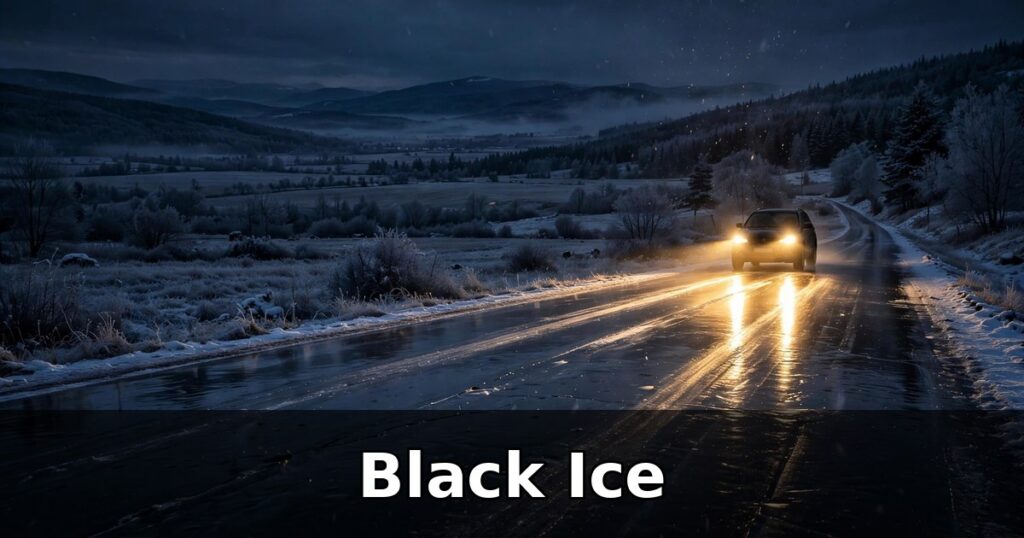
How to Drive on Black Ice: What to Do When the Road Turns Invisible
Key points
- About 1,300 people are killed each year in the United States in crashes on snowy, slushy, or icy pavement (Federal Highway Administration).
- Black ice is a thin, transparent layer of ice that looks like a wet road, so the danger is invisible.
- It is the road surface temperature that matters, not the air temperature: black ice can form even when the air is slightly above freezing.
- On ice, stopping distance can be up to 10 times longer than on dry pavement, so following distance should stretch to 8 to 10 seconds.
Most winter driving hazards announce themselves: snow covers the road, slush sprays up from the tires. Black ice does none of these things. It is a thin sheet of clear ice that takes on the colour of the pavement beneath it, so the road ahead looks wet — or simply dark — when it is in fact frozen.
That invisibility is what makes it dangerous. A driver who can see snow slows down; a driver who sees what looks like a damp road keeps driving at normal speed, and by the time the tires go quiet and the steering goes light, the car is already on the ice.
What black ice is: the science
Black ice is a thin layer of ice that freezes slowly, without trapped air bubbles, so it stays clear instead of turning white like snow or frost. Because it is transparent, the dark asphalt beneath shows through — which is why it looks black.
It forms whenever moisture meets a road surface at or below freezing: rain falling on a cold road, snow that melted during the day and refroze overnight, fog or dew condensing on cold pavement, or freezing rain. In each case the result is the same — a smooth, clear sheet with almost no texture for a tire to grip.
The critical temperature is the temperature of the road surface, not the air. Pavement loses heat to a clear night sky faster than the air above it cools, so the road can be at or below freezing — 0°C (32°F) — while a thermometer a few feet up still reads a degree or two above freezing. This is why a forecast of temperatures “just above freezing” is no guarantee of a safe road. Ice is also most slippery near the freezing point, when a microscopically thin film of water forms on its surface and lets a tire slide with almost no resistance.
Where and when it forms
| Location | Why it freezes first | When to watch |
|---|---|---|
| Bridges and overpasses | Cold air surrounds the deck from above and below | Before the rest of the road |
| Shaded stretches | No sun reaches the pavement to warm it | All day in deep winter |
Black ice is most common in the early morning, after overnight cold has worked on a road wet from the previous day’s melt, and in the evening, as the temperature falls after sunset. The freeze-thaw cycle of late winter and early spring is the peak season: days warm enough to melt snow, nights cold enough to freeze the meltwater by dawn.
Bridges deserve special attention. The road on either side sits on earth, which stores heat; a bridge deck sits on air, which carries heat away from both faces. A bridge can be frozen solid while the road leading to it is merely wet — which is why the sign says “bridge freezes before road.” On the road, the clues are a glossy patch where the rest looks dry, no spray from the car ahead, and tyre noise suddenly going quiet.
Before you drive: preparation that actually helps
Tyres matter more than drivetrain. Winter tyres stay flexible below about 45°F (7°C); all-season tyres stiffen and lose grip in the cold even on dry roads. On packed snow, winter tyres stop in roughly 35% less distance than all-season tyres. Look for the Three-Peak Mountain Snowflake symbol, which certifies the tyre for severe snow service. All-wheel drive helps a car accelerate on ice, not stop or turn.
Check the tread and the tank. Worn tyres lose their ability to clear water and bite into snow, so check the tread: the U.S. coin test uses a quarter, and the U.K. recommendation is at least 3 mm of tread for winter. Keep at least half a tank of fuel, so a closed road or a long queue does not leave the car idling on empty.
Clear the whole car and skip cruise control. Snow left on the roof slides onto the windscreen under braking, and snow on the lights makes the car invisible to others. Do not use cruise control on wet or icy roads: if the tyres hit ice, the system can try to maintain speed by accelerating, which can spin the car.
On the road: speed and space
| Surface | Stopping distance from 60 mph | vs dry road | Following distance |
|---|---|---|---|
| Dry pavement | About 140 feet | — | 3 seconds |
| Wet pavement | Roughly double | About 2× | 4–5 seconds |
| Packed snow | 300 to 450 feet | About 2–3× | 5–6 seconds |
| Black ice | Can exceed 1,400 feet | Up to 10× | 8–10 seconds |
Fourteen hundred feet is more than four American football fields. No driver can judge that distance by eye, which is why the following-distance rule matters more than the number: three seconds on dry pavement, five to six on packed snow, and eight to ten seconds on ice. To count it, pick a fixed point and count the seconds until your car reaches it.
Speed reduction follows the same logic. The commercial-driver guideline is simple: reduce speed by about a third on wet roads, by at least half on packed snow, and to a crawl — or stop driving entirely — on ice. From a 60 mph baseline, that means roughly 40 mph on wet roads, 30 mph or less on packed snow, and single digits on glare ice. Posted limits assume ideal conditions; on ice, the posted limit is a number for a different day.
There is one more rule that experienced winter drivers treat as absolute: do only one thing at a time. Brake in a straight line, take the foot off the brake before turning the wheel, and accelerate only after the wheels are straight again. A tyre on ice has grip for one job — slowing, turning, or speeding up — and asking for two at once is how cars slide straight through a corner they could have taken slowly.
When the car starts to slide
The first reaction is usually the wrong one. A hard stamp on the brake locks the wheels on ice, and a locked wheel has even less grip than a rolling one: the car keeps sliding where it was already going, and the steering stops working. The correct response is counterintuitive, and it has to be rehearsed before it is needed.
Ease off the accelerator first. Lifting off gently transfers weight forward and lets the tyres regain grip; lifting off abruptly can unsettle the car further. Do not brake hard. With anti-lock brakes, press firmly and steadily and let the system pulse. Without them, pump the brake gently rather than holding it down.
Steer where you want to go. If the rear slides left, steer gently left — into the skid — until the car straightens, then straighten the wheel. Look at the empty road ahead, not at the ditch or the car in front: drivers steer toward whatever they are looking at. Small, smooth corrections are the rule; large ones start a second skid, often the one that ends in a spin. If the car will not stop, aim for the softest option: a snowbank beats a guardrail, and a guardrail beats oncoming traffic.
What the research says
The scale of the problem is documented by the Federal Highway Administration, which reports about 1,300 people killed and more than 116,000 injured each year in the United States in crashes on snowy, slushy, or icy pavement. Snowy and icy pavement is a factor in roughly 24% of all weather-related crashes. The National Weather Service calls winter storms “deceptive killers” because most of the deaths are indirect: traffic crashes on the ice they leave behind.
The stopping-distance figures have a research basis as well. Stopping on ice can take up to ten times the dry-road distance, highway guidance in several countries agrees, and AAA recommends eight to ten seconds of following distance on snow or ice. Winter tyres stop in roughly 35% less distance on packed snow than all-season tyres, according to standardised tyre safety testing.
What is still uncertain
No forecast can promise a specific stretch of road is safe. Forecasts predict air temperature, and road weather stations cover only a few thousand points across a country. Between those points, a shaded hollow or a bridge deck can be frozen while the forecast says the temperature is above freezing. The forecast is a guide to the risk, not a clearance.
Road treatment has limits. Salt lowers the freezing point of water, but its effectiveness falls as temperatures drop well below freezing and it needs traffic to work it into the ice. A freshly salted road can still be icy, and a salted road can refreeze once the treatment wears off.
Driver assistance systems do not change the physics. Anti-lock brakes, traction control, and stability control help a driver use the grip that exists. None of them creates grip that is not there. On black ice, the grip available is a small fraction of what it is on dry pavement, and no system in the car can repeal that. There is also no reliable way to see black ice from inside a moving car: thermal cameras and road sensors exist, but ordinary cars do not carry them.
What this means
The decision that matters most is made before the car moves. If the conditions are right for black ice the safest choice is to delay the trip, take a main road that is treated and trafficked. Every year the statistics include drivers who knew the roads were icy and drove anyway. Most of those trips were not necessary.
Speed is the one variable fully under the driver’s control. The road, the temperature, and the ice cannot be changed. Speed can: halving speed quarters the kinetic energy to lose in a crash. Following distance is the cheapest safety device in the car: it costs nothing, and on ice it decides whether you stop behind the car ahead or hit it.
What should change
Treat bridges and shaded stretches as icy until proven otherwise. The habit is a routine: slow down before every bridge and shaded dip when the temperature is near freezing, whether the road looks icy or not. Slowing down for a dry bridge costs a few seconds. Not slowing down for a frozen one can cost the car.
Put winter tyres on before the first freeze, not after the first slide. A car on winter tyres still slides on black ice but it slides from a shorter distance and at a lower speed, and it recovers sooner. And learn the skid response before it is needed: ease off, do not brake hard, steer into the skid, look where you want to go. Rehearsing them mentally — ideally practising in an empty, snow-covered car park at low speed — is what makes them available in the three seconds when they count.
The road you cannot see
Black ice is dangerous for three reasons that compound each other: it cannot be seen, it forms in conditions drivers routinely underestimate, and it removes almost all of the grip a car depends on. The defence is a set of habits — expecting ice where it forms first, leaving eight to ten seconds of space, slowing down before the bridge, and knowing what to do when the car starts to slide. None of them is difficult. All of them have to be in place before the tyres go quiet.
Raina





댓글 0
첫 댓글을 남겨보세요.