
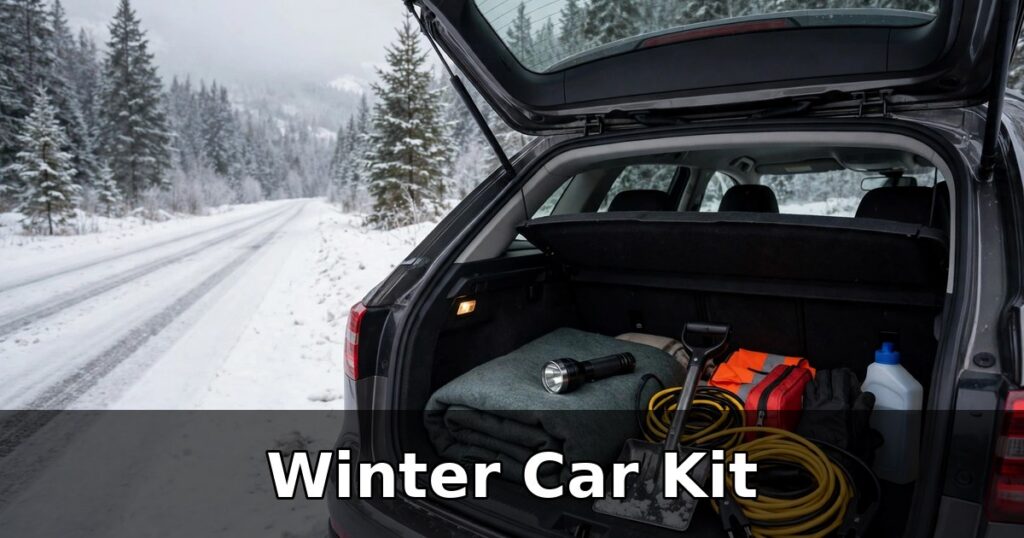
What to Pack in a Winter Car Emergency Kit
A winter car emergency kit is insurance against a situation that is uncommon but entirely foreseeable: a vehicle that stops, slides off the road, or is trapped in a storm, in cold weather, far from help, with the occupants inside it. The kit does not need to be large, expensive, or complicated. It needs to contain the means to stay warm, to be seen, to call for help, and to wait safely until help arrives. The lists published by the American Red Cross, the National Weather Service, the Federal Emergency Management Agency's Ready programme, and the National Highway Traffic Safety Administration agree closely on the contents, and the differences among them are a matter of emphasis rather than substance.
Key points
- Stay with the vehicle. A car is shelter, and it is far easier for rescuers to find than a person on foot in wind-driven snow.
- Run the engine and heater for about 10 minutes each hour, with a window opened slightly, and clear snow from the exhaust pipe before each run.
- Pack warmth for every person who normally travels in the vehicle: a blanket or sleeping bag, extra hat, mittens, boots, and dry socks.
- Carry enough food and water for at least a day: a litre of water per person, plus energy bars, dried fruit, nuts, and crackers.
- A complete kit can be bought for under 100 dollars, and many households already own most of it.
A winter car emergency kit is insurance against a situation that is uncommon but entirely foreseeable: a vehicle that stops, slides off the road, or is trapped in a storm, in cold weather, far from help, with the occupants inside it. The kit does not need to be large, expensive, or complicated. It needs to contain the means to stay warm, to be seen, to call for help, and to wait safely until help arrives. The lists published by the American Red Cross, the National Weather Service, the Federal Emergency Management Agency’s Ready programme, and the National Highway Traffic Safety Administration agree closely on the contents.
Warmth first: blankets, clothing, and heat
Warmth is the first priority of any winter car kit, because cold is the most immediate threat to a stranded motorist. The core item is a warm blanket or a sleeping bag, and the American Red Cross lists a blanket among the essential items to keep in a car, while the Colorado Department of Transportation, the American Red Cross, and the American Automobile Association jointly recommend a survival blanket or a sleeping bag. A wool blanket is the traditional choice, because wool retains insulating value when damp, but a synthetic sleeping bag, a fleece blanket, or a set of emergency foil blankets all serve the same purpose. The kit should contain enough covering for every person who normally travels in the vehicle.
Extra clothing is the second element of warmth, and it is the item most often omitted. The Red Cross recommends an extra set of mittens or gloves, a warm hat, and boots, and the Ready programme lists warm clothes among the essentials. A change of dry socks is a small addition with a large effect, because feet that are wet from snow lose heat rapidly, and dry socks restore insulation that wet socks have lost. A warm hat matters out of proportion to its size, and a scarf or a balaclava protects the face. These items should be packed in a waterproof bag or a sealed plastic container, so that they remain dry even if the trunk leaks.
Getting unstuck: shovel, traction, and jump-starting
The second category of kit contents is the equipment for freeing a stuck vehicle. A small folding shovel is the most important item in this category, and it appears on every published list. A shovel clears snow from around the tyres, from the exhaust pipe, and from the doors, and a vehicle that is stuck in a drift can often be freed with a few minutes of digging. A full-size shovel is more effective than a folding one, but a folding shovel fits in a trunk alongside the rest of the kit.
Traction aids are the second element. The Red Cross recommends sand or kitty litter for traction, and the Ready programme lists sand among the essentials. A bag of coarse sand, or a bag of non-clumping cat litter, spread under the driving wheels, provides the grip that a tyre cannot find on ice. A set of traction mats, the rigid plastic or metal plates designed to be wedged under a tyre, serves the same purpose and can be reused. A tow strap or a tow chain, also on the Red Cross list, allows another vehicle to pull a stuck car free.
Jumper cables, or a portable jump starter, address the commonest winter breakdown: a battery that has lost its charge in the cold. Cold reduces the power a battery can deliver, and it increases the power an engine needs to start, so a battery that is adequate in October can fail in January. The Red Cross lists booster cables among the essential items. A portable jump starter, a small lithium battery pack with clamps, is an alternative that does not require a second vehicle, although it must be kept charged, and its charge falls in cold weather. A spare tyre, a jack, and a lug wrench belong in every vehicle regardless of season.
Light, signal, and communication
A stranded vehicle must be visible, and the kit must contain the means to make it so. A flashlight with extra batteries is on every published list, and the Red Cross recommends a crank-powered or battery-operated flashlight with spare batteries. A flashlight lights the work of digging out or changing a tyre, signals to passing traffic, and provides light inside the vehicle after dark. A headlamp is a useful alternative, because it leaves both hands free. Batteries lose capacity in the cold, so spare batteries should be kept in the kit and checked at the start of each winter.
Communication is the third element of this category. A mobile phone is the primary means of calling for help, and a car charger or a portable power bank keeps it working when the vehicle battery is dead. The phone should be kept charged, and the number of a roadside assistance service, if one is held, should be stored in it. A battery-powered or crank-powered radio provides weather information and emergency broadcasts when the mobile network is unavailable. A paper map and a compass are a low-technology backup for navigation if the phone fails, and an emergency contact card is useful if the phone is lost or its battery dies.
Food, water, and first aid
Food and water are the third category, and they are the items most likely to be needed during a long wait. The Red Cross recommends bottled water and high-energy foods, and the Ready programme lists bottled water and non-perishable snacks. The quantities should be sufficient for at least a day: a litre of water per person, and enough food for several meals. Energy bars, dried fruit, nuts, and crackers are suitable, because they are compact, they do not spoil, and they can be eaten without preparation. Canned food is less suitable, because it is heavy and requires a can opener.
Water presents a special problem in winter, because it freezes. The Canadian Red Cross recommends carrying water in bottles filled to about three-quarters, to allow for expansion as the water freezes, and notes that a bottle of frozen water can be thawed against the body or beside a heat source. An insulated container slows freezing but does not prevent it, and the water should be rotated through the winter, because a bottle that has frozen and thawed repeatedly can develop leaks.
A first aid kit is the final essential in this category, and it appears on every published list. A basic kit should contain adhesive bandages, sterile gauze, adhesive tape, antiseptic wipes, scissors, tweezers, disposable gloves, and any essential medications taken by the regular occupants of the vehicle. The Red Cross recommends a first aid kit and its manual, and the Colorado Department of Transportation adds essential medications. The kit should be checked at the start of each winter, and any expired items should be replaced. A small fire extinguisher, rated A-B-C and of about five pounds, is also on the Red Cross list.
If stranded: what to do while waiting
| Rule | What to do |
|---|---|
| Stay with the vehicle | Do not leave to look for help unless help is visible within about 100 yards (OSHA). A person who leaves a vehicle in wind-driven snow can quickly become disoriented (NWS). |
| Run the heater in intervals | Run the engine and heater for about 10 minutes each hour, with a window opened slightly for fresh air (NWS, CDC, OSHA). |
| Keep the exhaust clear | Clear snow from the exhaust pipe before the engine is started, and check it again before each run. Never run the engine for long periods with the windows up or in an enclosed space (NHTSA). |
| Watch for carbon monoxide | Headache, confusion, nausea, or unusual sleepiness while the engine is running: turn the engine off, increase ventilation, and call emergency services. Carbon monoxide is colourless and odourless. |
| Make the vehicle visible | Tie a bright cloth to the antenna or a door handle, turn the dome light on at night, leave hazard lights on while the battery lasts, and raise the hood after the snow stops — the recognised signal of a vehicle in distress. |
| Do not overexert | Avoid overexertion: shovelling in deep snow in extreme cold places a heavy strain on the heart (NHTSA). |
The contents of the kit matter only if the occupants know how to use them, and the procedure for a stranding is as standardised as the kit itself. The first rule, stated by the National Weather Service, the National Highway Traffic Safety Administration, the Centers for Disease Control and Prevention, and the Federal Emergency Management Agency, is to stay with the vehicle. A car is shelter, and it is far easier for rescuers to find than a person on foot. The National Weather Service warns that a person who leaves a vehicle in wind-driven snow can quickly become disoriented, and the Occupational Safety and Health Administration advises not leaving to look for help unless help is visible within about 100 yards.
The second rule concerns heat. The engine and heater should be run for about 10 minutes each hour, according to the National Weather Service, the Centers for Disease Control and Prevention, and the Occupational Safety and Health Administration, with a window opened slightly for fresh air. The interval is a compromise: running the engine continuously wastes fuel and risks carbon monoxide poisoning, while not running it at all allows the interior temperature to fall to the outdoor temperature. Between runs, the occupants should remain wrapped in blankets and extra clothing, and should keep moving their arms and legs to maintain circulation.
Carbon monoxide is the most serious hidden danger in a snowbound car. A tailpipe buried in snow can push exhaust, including carbon monoxide, back into the cabin, and carbon monoxide is colourless and odourless, so it cannot be detected without an alarm. Before the engine is started, snow must be cleared from the exhaust pipe, and the pipe must be checked again before each run. If anyone inside develops a headache, confusion, nausea, or unusual sleepiness while the engine is running, the engine should be turned off, ventilation should be increased, and emergency services should be called.
Preparing the car before winter
A kit is a response to a breakdown, and the best response is to reduce the chance of a breakdown. The National Highway Traffic Safety Administration and the National Weather Service both publish a pre-winter checklist, and its items are straightforward. The battery should be tested, because cold reduces its capacity, and a battery more than three years old should be tested annually. The tyres should be checked for tread depth and inflation, because cold reduces tyre pressure, and winter tyres, where they are used, should be fitted before the first snowfall. The cooling system should be checked, and the antifreeze should be rated for the coldest temperatures expected. The exhaust system should be inspected annually, as the Centers for Disease Control and Prevention advises, because a small leak can let carbon monoxide build up inside the car.
Raina





댓글 0
첫 댓글을 남겨보세요.