
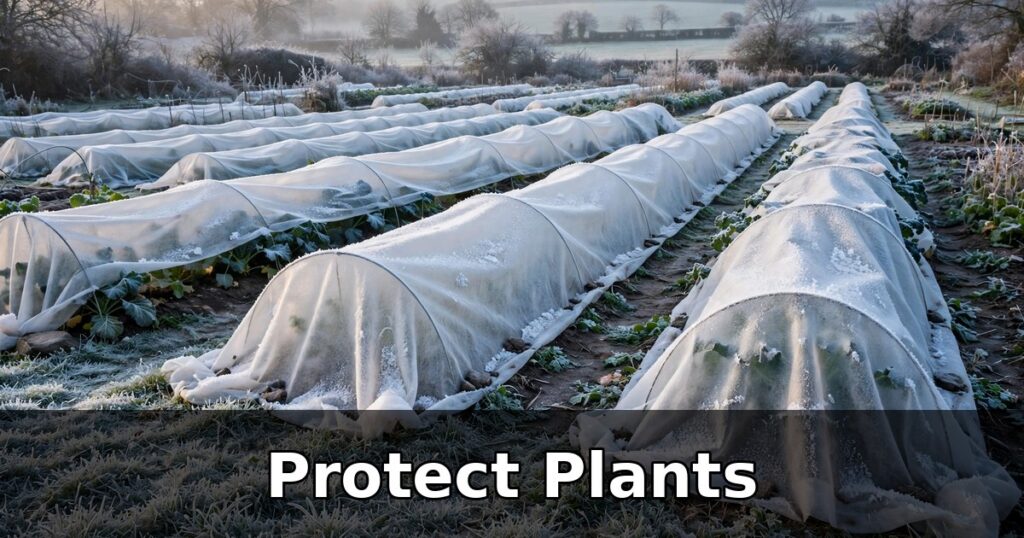
How to Protect Outdoor Plants from a Sudden Frost
A frost forecast can arrive with little warning: a clear autumn evening, a calm night, and a morning of white-coated leaves. For a gardener, the difference between a minor scare and a season-ending loss often comes down to a few hours of preparation the evening before. Frost protection is not a matter of luck or of expensive equipment. It rests on a small set of physical principles, the heat stored in the soil, the insulating value of a cover, and the cold tolerance of each species, and on acting before the temperature falls rather than after the damage is done.
Key points
- A frost advisory is issued when temperatures near 36°F are expected, and frost can form even when the official low is 35°F.
- A light freeze is 29–32°F for a short period. A hard, killing freeze is 28°F or below for an extended period, and covers alone are generally no longer enough.
- Tender crops can show leaf damage from as warm as 33°F. Hardy crops withstand heavy frost below 28°F and need no protection from a routine autumn freeze.
- A heavy-weight cover adds 6–10°F of protection; a bedsheet adds 3–5°F. A cover traps soil heat — it cannot generate heat.
- Water the soil in the late afternoon, cover before sunset, and remove the cover in the morning once temperatures rise above freezing.
A frost forecast can arrive with little warning: a clear autumn evening, a calm night, and a morning of white-coated leaves. For a gardener, the difference between a minor scare and a season-ending loss often comes down to a few hours of preparation the evening before. Frost protection rests on a small set of physical principles, the heat stored in the soil, the insulating value of a cover, and the cold tolerance of each species, and on acting before the temperature falls rather than after the damage is done.
The stakes are highest in the shoulder seasons, when warm-season crops are still producing and tender ornamentals are still in bloom. A single night at 30°F can end a tomato harvest, blacken basil, and kill a container of geraniums, while the same night leaves kale, carrots, and established shrubs untouched. A sound frost plan begins with knowing which plants are vulnerable, which temperatures matter, and which methods actually add warmth.
Frost, freeze, and hard freeze
The first step is to use the terms precisely. Frost is the formation of ice crystals on surfaces, and it can occur on a clear, still night even when the air temperature a few feet above the ground remains a degree or two above freezing. Cold air is denser than warm air, so it settles into low spots, and surfaces exposed to a clear sky lose heat by radiating it upward. The National Weather Service issues a frost advisory when temperatures near 36°F are expected, which is why frost can appear on a lawn or a car roof while the official low for the night is 35°F.
A freeze is a different event. It occurs when the air temperature falls to 32°F or below, and ice forms inside plant cells rather than merely on the surface. Water inside a cell expands as it freezes, rupturing cell walls, and the damaged tissue turns dark and limp as it thaws. A light freeze, with temperatures between 29 and 32°F for a short period, damages tender growth while leaving hardier plants and the roots of most perennials intact. A hard freeze occurs when temperatures fall to 28°F or below and remain there for an extended period, and covers alone are generally no longer sufficient protection.
Which plants are at risk
| Group | Tolerance | Examples | What to do |
|---|---|---|---|
| Tender | Damaged from about 33°F; killed by the first frost | Tomatoes, peppers, eggplant, basil, beans, squash, cucumbers, melons, sweet potatoes, most summer flowers | Cover or pick before the cold arrives; act on a forecast in the mid-30s |
| Semi-hardy | Tolerates a light frost of 28–32°F for a limited time | Lettuce, carrots, beets, cauliflower, celery | Harvest or protect when temperatures in the mid to upper 20s are forecast |
| Hardy | Withstands heavy frost below 28°F | Spinach, onions, garlic, leeks, broccoli, kale, cabbage, collards, Brussels sprouts, turnips, radishes, mustard greens | No protection needed from a routine autumn freeze |
Not all plants need protection, and protecting the wrong ones wastes time and material on the night when both are scarce. The most vulnerable group is the tender warm-season vegetables and annuals. Many of them begin to show leaf damage at temperatures as warm as 33°F, according to Alabama Cooperative Extension and Utah State University Extension. For these crops, the trigger to act is a forecast in the mid-30s, because damage begins before the official freezing point is reached.
The semi-hardy group tolerates a light frost of 28 to 32°F for a limited time. Oregon State University Extension places lettuce, carrots, beets, cauliflower, celery, and similar crops in this category, and Purdue University Extension advises harvesting or protecting them when temperatures in the mid to upper 20s are forecast. In these crops, the tops may die back while the roots survive. The hardy group withstands heavy frost below 28°F: spinach, onions, garlic, leeks, broccoli, kale, cabbage, collards, Brussels sprouts, turnips, radishes, and mustard greens. Cold slows these plants rather than killing them.
Fruit trees and citrus deserve separate attention. University of California Master Gardeners in Sacramento County publish damage thresholds for citrus: limes are damaged at 29°F, lemons and grapefruit at 26°F, Meyer lemons at 22°F, and oranges and mandarins at still lower temperatures. The fruit is generally more vulnerable than the wood, and a freeze that damages the crop may leave the tree itself alive. Young trees are more vulnerable than mature ones, and newly planted trees of any species benefit from protection during their first winter.
How covers work — and how much they help
A cover protects a plant by trapping the heat that the soil releases during the night. The earth absorbs solar energy during the day and radiates it slowly after dark, and a cover creates a small pocket of air in which that rising warmth accumulates. The mechanism is simple, and its limits follow from it: a cover cannot generate heat, and it can only hold in what the soil supplies. On a night when the soil is cold, a cover provides less protection than on a night after a sunny day.
| Cover material | Protection added | Source |
|---|---|---|
| Lightweight row cover | About 2°F | University of New Hampshire Extension |
| Heavy-weight cover | 6–10°F | University of New Hampshire Extension |
| Row cover, range by weight | 2–8°F; heavyweight 4–8°F | University of Wisconsin-Madison Extension |
| Bedsheet, laid loosely | 3–5°F | Alabama Cooperative Extension |
Breathable fabric is the best choice: a frost blanket or floating row cover, or a household substitute such as an old bedsheet or a blanket. The weight of the fabric determines the protection. A light sheet is adequate for a forecast low of 30°F, while a forecast low in the mid-20s calls for the heaviest cover available, and even that may not be enough below 28°F. Plastic is the exception, and extension services advise against it: it does not breathe, moisture condenses on its underside, and leaves that touch it freeze against it. If plastic is the only material available, support it on stakes or hoops so it does not touch the foliage, and remove it the following morning. Burlap is a serviceable alternative for shrubs and small trees.
Installation matters as much as material. The cover should reach all the way to the ground on every side, because the heat being trapped comes from the soil, and any gap at the base lets the warm air escape. Edges should be weighted with stones, bricks, or soil. The fabric should be supported on stakes, hoops, or a frame wherever possible, so it does not rest directly on the foliage; wet fabric pressed against a leaf freezes the leaf with it. Put covers in place before sunset, while the soil is still warm. In the morning, remove the cover once the temperature has risen above freezing. Frost cloth can remain for several days, but household sheets and blankets should be removed daily.
Water, mulch, and soil heat
Water is one of the most effective and least appreciated tools of frost protection, because moist soil holds far more heat than dry soil. Watering the garden thoroughly in the late afternoon, before a forecast frost, raises the temperature of the root zone and increases the supply of heat that a cover can trap. The watering should be done early enough for the foliage to dry before nightfall, because wet leaves freeze more readily than dry ones, and the water should be applied to the soil rather than sprayed over the plants.
Mulch protects roots rather than leaves. A layer of straw, shredded leaves, wood chips, or compost, spread 2 to 4 inches deep around the base of a plant, insulates the soil and slows the loss of heat from the root zone. The effect is most valuable for perennials, bulbs, and newly planted shrubs, whose survival depends on the roots. Mulch should be applied after the soil has cooled in late autumn rather than in early autumn, because a thick layer applied too early can delay the dormancy that prepares a plant for winter. Around the trunks of young trees, mulch should be kept a few inches away from the bark to discourage rodents and rot.
Containers require a different approach. A potted plant should be moved to a sheltered location, a garage, a porch, or against the warm wall of a house, before the cold arrives. Purdue University Extension advises moving containers holding tender ornamental plants inside a garage at night, and grouping containers together adds protection, because the pots shelter one another from the wind. If a container is too heavy to move, wrapping the pot in burlap, bubble wrap, or an old blanket insulates the roots, and raising the pot off the ground reduces heat loss to a cold patio or deck.
Cold frames, cloches, and other structures
For gardeners who face repeated frosts, a semi-permanent structure is more reliable than a nightly cover. A cold frame is a bottomless box with a transparent lid, set over a bed, which traps solar heat during the day and releases it slowly at night. The lid is opened during the day for ventilation and closed in the late afternoon to hold the warmth. The same principle applies to a cloche, a bell-shaped cover placed over an individual plant, and to a low tunnel, a row of hoops covered with frost cloth or clear plastic. A cold frame extends the growing season by weeks on either side.
After the frost: assessment and recovery
The morning after a frost is not the time for decisive action. Frost-damaged tissue often looks worse than it is in the first hours, and the full extent of the damage may not be visible for several days. Leaves that appear limp and water-soaked may recover partially as the day warms, while leaves that turn black and papery are dead. The standard advice is to wait before pruning, cutting, or removing anything, because the damaged growth can still protect the living tissue beneath it from a second frost.
For vegetables, the decision is simpler. Tender crops blackened by frost should be harvested immediately if any fruit remains usable, because the plant will not recover, and the fruit will deteriorate quickly. Semi-hardy crops that have lost only their outer leaves can be left in place, and the damaged leaves can be trimmed away at harvest. Root crops such as carrots and beets are generally unaffected by a frost that kills their tops, and they can be left in the ground and harvested as needed.
Planning ahead for the next frost
The sequence is short enough to remember. Check which plants are tender, semi-hardy, or hardy. Water the soil in the late afternoon and let the foliage dry. Cover the tender beds before sunset with breathable fabric that reaches the ground, weighted at the edges and held off the leaves. Move containers to shelter. In the morning, remove the covers once temperatures rise above freezing. Below 28°F, accept that covers alone will not save tender plants, and harvest what is worth saving before the cold arrives.
Raina





댓글 0
첫 댓글을 남겨보세요.