
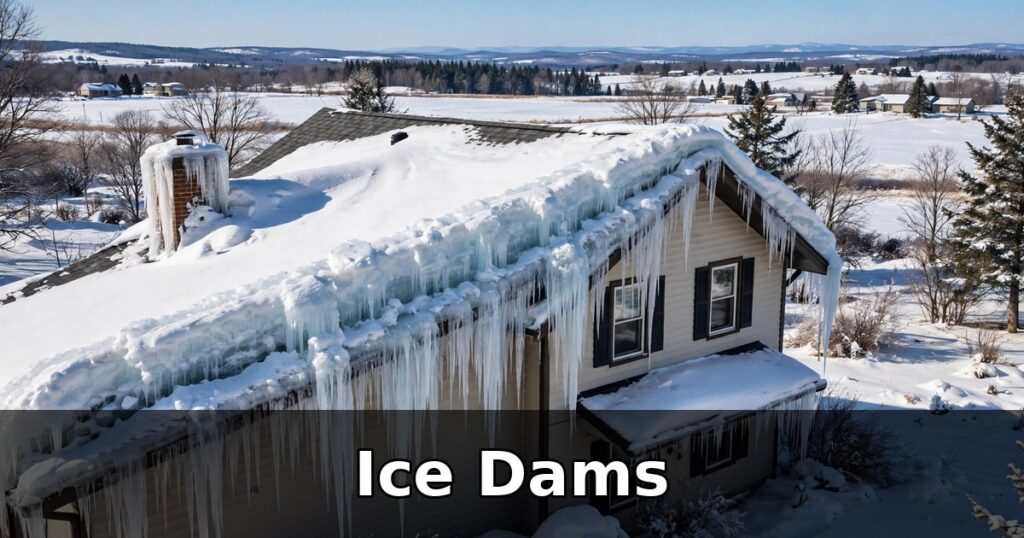
Ice Dams on Your Roof: Why They Form and How to Stop Them
In the middle of winter, a ridge of ice can appear along the lower edge of a roof, sometimes growing thick enough to be visible from the street. Behind that ridge, meltwater pools on the roof surface, and with nowhere else to go it works its way under the shingles and into the house. Stains appear on ceilings, paint peels from walls, insulation becomes soaked, and mould begins to grow in the damp cavities. The Insurance Institute for Business and Home Safety lists ice dams among the most common sources of interior water damage in winter, and notes that they most commonly form on older homes with inadequate attic insulation. The damage is often discovered only after a thaw, when the water that has been pooling for weeks finally finds a path inside.
Key points
- An ice dam is a heat problem, not a roofing problem: heat escaping into the attic warms the upper roof, snow melts, and the water refreezes at the cold eaves.
- Keep the attic cold — the Insurance Institute for Business and Home Safety states the attic temperature should be 30°F or lower whenever the outside temperature is 22°F or lower.
- The Department of Energy recommends attic insulation of R-49 to R-60 in the colder climate zones; loose-fill cellulose needs roughly 14 inches for R-49 and about 17 inches for R-60.
- Many residential roofs are designed for a snow load of about 20 pounds per square foot, and two feet of wet, packed snow can exceed that figure.
- Mould can begin to grow on damp building materials within 24 to 48 hours, so water that gets inside must be dried promptly.
In the middle of winter, a ridge of ice can appear along the lower edge of a roof, sometimes growing thick enough to be visible from the street. Behind that ridge, meltwater pools on the roof surface, and with nowhere else to go it works its way under the shingles and into the house. Stains appear on ceilings, paint peels from walls, insulation becomes soaked, and mould begins to grow in the damp cavities. The Insurance Institute for Business and Home Safety lists ice dams among the most common sources of interior water damage in winter, and notes that they most commonly form on older homes with inadequate attic insulation. The damage is often discovered only after a thaw, when the water that has been pooling for weeks finally finds a path inside.
How an ice dam forms
An ice dam begins with snow on the roof and heat in the attic. The Insurance Institute for Business and Home Safety describes the sequence precisely. Heat escaping from the living space warms the upper portion of the roof deck, because warm air rises inside the structure and collects in the attic. The bottom layer of snow on the warmed upper roof melts, and the meltwater drains down the roof slope toward the eaves. The eaves are colder, because they extend beyond the heated space of the house and receive little warmth from below. When the meltwater reaches the cold eave, it refreezes and a thin layer of ice forms at the edge of the roof.
The cycle then repeats. Each day brings a little more melting on the upper roof and a little more refreezing at the edge, and the ridge of ice grows thicker. The sun contributes to the daytime melting, and the night brings the freezing temperatures that lock the new ice in place. Over time, the dam grows large enough to hold back a pool of liquid water on the roof behind it. Shingles are designed to shed water that flows downward over their surface. They are not designed to hold back standing water, and pooled water finds its way under the shingles, past the sealant strips, and through any gap or nail hole in the roof deck. From there it enters the attic or runs down inside the walls.
The conditions that make ice dams likely
Three conditions must be present for an ice dam to form: snow on the roof, a warm attic, and sustained freezing temperatures. Snow provides the water. A warm attic provides the melting. Freezing temperatures provide the refreezing at the eaves. Remove any one of the three, and the dam cannot form, which is why ice dams are a problem of cold climates with regular snowfall, and why they appear after a heavy snow followed by a spell of cold weather rather than during a single mild day. The worst winters for ice dams are those with repeated cycles of snowfall, daytime melting, and overnight freezing, because each cycle adds another layer to the dam.
Keeping the attic cold: insulation
The permanent cure for ice dams is a cold attic, and the first step toward a cold attic is insulation on the attic floor. Insulation slows the transfer of heat from the living space below into the attic, and the thicker the insulation, the slower the transfer. The United States Department of Energy recommends attic insulation levels that depend on the climate zone, and the figures are expressed as R-values, which measure resistance to heat flow.
| Climate zone | Recommended attic insulation |
|---|---|
| Zones 4–8 (colder regions) | R-60 (ENERGY STAR); DOE recommends R-49 to R-60 in the colder zones |
| Zones 2–3 | R-49 (ENERGY STAR) |
| Zone 1 (warmest) | R-30 (ENERGY STAR) |
These are total values, including any insulation already in place, so an attic with a thin layer of old insulation needs additional material to reach the target. The depth of insulation required is substantial. Loose-fill cellulose at about R-3.5 per inch needs roughly 14 inches to reach R-49 and about 17 inches to reach R-60, while fibreglass batts need a similar depth. Many older homes have far less, sometimes only a few inches, which is why ice dams are so common on them.
Keeping the attic cold: air sealing and ventilation
The Department of Energy recommends sealing air leaks before adding insulation, and the reason is practical: insulation laid over an unsealed gap does little to stop the flow of warm air, while sealing the gap first makes the insulation far more effective. Sealing is done with caulk, expanding foam, or fitted covers, and the work is best done from inside the attic, where the gaps are visible.
Ventilation is the second half of the system. A ventilated attic draws cold outside air in through vents at the eaves and exhausts warmer air through vents at the ridge, which keeps the temperature of the attic close to the temperature outside. The Insurance Institute for Business and Home Safety, in guidance published in 1996 and still cited today, states that the attic temperature should be 30°F or lower whenever the outside temperature is 22°F or lower. That rule is a useful check: if the attic is much warmer than the outside air on a cold day, the insulation or the air sealing is inadequate, or the ventilation is blocked. Ventilation must not be blocked by insulation, and baffles should be fitted at the eaves to keep an air channel open between the insulation and the roof deck. A powered attic fan is not a substitute for insulation and sealing, and in a house with air leaks it can make the problem worse by drawing more warm air into the attic.
The ice and water shield
Even a well-insulated house can develop an ice dam in an unusually severe winter, and the roof covering itself provides a second line of defence. Modern building codes require an ice barrier, commonly called an ice and water shield, along the lower edges of the roof in cold climates. The shield is a self-adhering membrane applied to the roof deck under the shingles, and it seals around the nails that pass through it, so that water pooling behind a dam cannot pass through the deck.
The International Residential Code requires an ice barrier in areas where the average January temperature is low enough for ice to accumulate along the eaves, and the membrane must extend from the lowest edge of the roof to at least 24 inches inside the line of the exterior wall. The Insurance Institute for Business and Home Safety notes that older building codes required ice dam protection in all areas where the January mean temperature was 30°F or less, which covers a large part of the northern United States.
Snow load and the weight on the roof
An ice dam is not the only load that winter places on a roof. Snow itself has weight, and the weight grows as the snow settles, absorbs rain, and refreezes into ice. Fresh, fluffy snow is light, but wet, packed snow is far heavier, and a deep layer of wet snow can approach the load that a roof was designed to carry. Guidance published by the Insurance Institute for Business and Home Safety, as reported in secondary sources, notes that many residential roofs are designed for a snow load of about 20 pounds per square foot, and that two feet of wet, packed snow can exceed that figure. The exact design load varies with the local building code, the age of the house, and the structure of the roof, so the figure is a general guide rather than a limit that applies to every house.
What to do when a dam has already formed
When an ice dam has already formed and water is entering the house, the priority is to limit the damage and to remove the dam safely. The first step is to protect the interior. Buckets and towels catch dripping water, furniture and electronics are moved away from the leak, and wet insulation and drywall are noted for drying and repair. Water that has entered the walls should be dried promptly, because mould can begin to grow on damp building materials within 24 to 48 hours, according to guidance from the United States Environmental Protection Agency. A plumber or a roofing contractor can advise on the extent of the damage, and photographs should be taken for the insurance claim.
Removing the dam itself requires care. The safest method is to melt a channel through the dam with calcium chloride, which is sold as an ice-melt product and as a purpose-made sock or tube that can be laid across the dam. The calcium chloride melts a narrow channel, and the pooled water drains through the channel and off the roof. Rock salt should not be used, because it can damage shingles, gutters, and concrete, and because it is less effective at low temperatures.
A roof rake, used from the ground, can pull snow off the lower part of the roof and reduce the amount of water feeding the dam, but the rake should never be used from a ladder or from the roof itself. Climbing onto an icy roof is extremely dangerous, and chopping at a dam with an axe or a shovel can damage the shingles and the deck, which makes the leak worse. Steam removal by a professional roofing contractor is the safest method for a large dam, because steam melts the ice without damaging the roof covering.
Mistakes that make the problem worse
Several common responses to ice dams make the problem worse rather than better. Heating cables, sometimes called heat tape, laid along the eaves can melt a channel through a dam, and they are sometimes presented as a solution. In practice, heating cables treat the symptom rather than the cause, they consume electricity all winter, and they can create a new dam just beyond the end of the cable, where the meltwater refreezes. The Insurance Institute for Business and Home Safety treats heating cables as a temporary measure at best, and the permanent solution remains insulation, air sealing, and ventilation. A cable that is left in place for years can also damage the shingles underneath it.
What this means
An ice dam is the visible sign of an invisible problem: heat escaping from the living space into the attic and warming the roof deck. The Insurance Institute for Business and Home Safety describes the mechanism without ambiguity, and the remedy follows from the mechanism. Insulation on the attic floor to the level recommended by the Department of Energy for the climate zone, air sealing of the gaps in the ceiling, and ventilation that keeps the attic close to the outside temperature will prevent most ice dams, and will reduce the heating bill at the same time.
Raina





댓글 0
첫 댓글을 남겨보세요.