
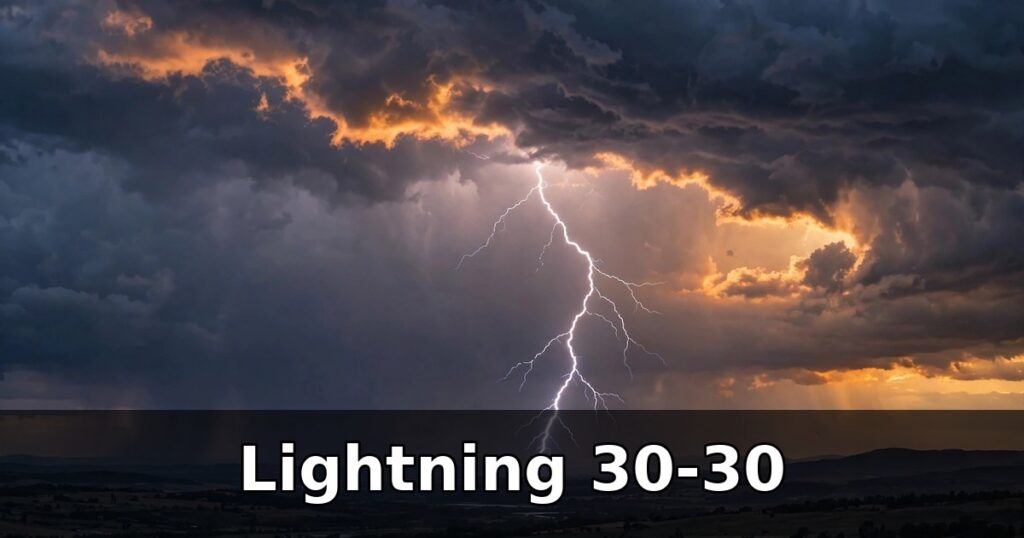
Lightning Nearby: The 30-30 Rule and Where to Shelter
Lightning kills fewer people in the United States than it once did, yet it remains one of the most underestimated weather hazards. The National Weather Service reports an average of about 20 lightning deaths per year in the United States over the recent ten-year period, with several hundred injuries annually, and an estimated 25 million cloud-to-ground flashes striking the country each year. The decline in deaths reflects better awareness and better forecasting, but the hazard itself has not changed: a single bolt can carry enormous energy, can strike far from the rain, and can injure people who believed that the storm had already passed.
Key points
- When the gap between lightning and thunder is 30 seconds or less, the storm is about 6 miles away or closer — seek shelter immediately.
- Wait 30 minutes after the last thunder before going back outside. Every new rumble restarts the clock.
- Lightning can strike more than 10 miles from where rain is falling, under skies that look clear overhead.
- Only a fully enclosed building with wiring and plumbing, or a hard-topped vehicle with the windows closed, counts as safe shelter.
- Lightning kills about 20 people a year in the United States on the recent ten-year average, with several hundred injuries annually — and most victims are struck before or after the peak of the storm, not at its height.
Lightning kills fewer people in the United States than it once did, yet it remains one of the most underestimated weather hazards. The National Weather Service reports an average of about 20 lightning deaths per year in the United States over the recent ten-year period, with several hundred injuries annually, and an estimated 25 million cloud-to-ground flashes striking the country each year. The hazard itself has not changed: a single bolt can carry enormous energy, can strike far from the rain, and can injure people who believed the storm had already passed.
The 30-30 rule is the simplest tool for judging that hazard in the moment. It requires no instrument and no forecast, only a count and a clock. The first thirty is a distance test: when the interval between a flash of lightning and the sound of thunder is thirty seconds or less, the storm is close enough to be dangerous, and shelter should be sought immediately. The second thirty is a waiting test: after the last thunder is heard, thirty minutes should pass before outdoor activity resumes.
The physics in brief
Lightning is a discharge of static electricity within a thunderstorm, between parts of a cloud, between clouds, or between a cloud and the ground. Inside a cumulonimbus cloud, collisions between ice crystals and softer hail pellets separate electric charge, leaving the top of the cloud predominantly positive and the base predominantly negative. When the leader approaches the ground, streamers rise from tall objects to meet it, and a return stroke races upward along the channel, heating the air to around 50,000°F, several times hotter than the surface of the sun, and the rapid expansion of that heated air produces thunder.
Lightning can also strike at a surprising distance from the rain. The National Weather Service warns that lightning can strike more than 10 miles away from the location of rainfall, carried outward by the anvil of the storm or by a bolt that leaves the side of the cloud and travels horizontally before descending. Such strikes, sometimes called bolts from the blue, occur under skies that may look clear overhead. If thunder can be heard, the storm is within striking distance, whatever the sky above may look like.
The flash-to-bang count
The flash-to-bang count works because light and sound travel at very different speeds. Light from a lightning flash reaches an observer almost instantly, while thunder travels at the speed of sound, roughly one mile in five seconds, or roughly one kilometre in three seconds. Counting the seconds between the flash and the thunder therefore gives the distance to the strike.
| Seconds between flash and thunder | Approximate distance |
|---|---|
| 5 seconds | About 1 mile |
| 15 seconds | About 3 miles |
| 30 seconds | About 6 miles — seek shelter now |
The count should begin at the moment the flash is seen and end at the moment the thunder is first heard, not at the loudest part of the rumble. Thunder can roll for many seconds as sound arrives from different parts of a long lightning channel, and the first sound marks the nearest part of the discharge. When several flashes occur in quick succession, the count should follow the most recent flash, and the shortest interval observed is the one that matters, because it corresponds to the nearest strike.
The thirty-second threshold is a rule of thumb rather than a precise safety boundary. Lightning can strike beyond six miles, and the National Weather Service advises that no place outdoors is safe during a thunderstorm, and that shelter should be sought as soon as thunder is heard. A storm at six miles can close the distance quickly: a thunderstorm moving at 40 miles per hour covers six miles in nine minutes, and a storm can also develop overhead, with new cells forming above a location that was clear minutes earlier.
The first thirty: seeking shelter
When the flash-to-bang interval falls to thirty seconds or less, the correct action is to move to a substantial enclosed building or a hard-topped vehicle. The National Weather Service defines a safe building as a fully enclosed structure with wiring and plumbing, which provides two paths for lightning current to reach the ground without passing through a person. A house, a school, an office building or a shop qualifies. A hard-topped vehicle with the windows closed also qualifies, because the metal shell conducts the current around the occupants and into the ground, a principle sometimes described as a Faraday cage effect.
Many structures that look like shelter are not safe. Tents, pavilions, picnic shelters, bus stops and other open-sided structures offer no protection, because lightning can strike through the open sides or travel along the metal supports. Small sheds, garages without wiring, and portable toilets are also unsafe. Trees are particularly dangerous: lightning strikes the tallest object in an area, and a person standing under a tree can be injured by a direct strike to the tree, by current travelling through the ground from the strike point, or by falling branches.
The second thirty: waiting out the storm
The second half of the rule is the waiting period: 30 minutes should pass after the last thunder is heard before outdoor activity resumes. The waiting period exists because lightning danger does not end when the rain stops. The trailing edge of a thunderstorm can still produce strikes, and new cells can develop behind the first line of storms. The National Weather Service observes that a substantial share of lightning deaths occurs after the storm appears to have passed, when people return outdoors too soon and are struck by a bolt from a dissipating cell or from a following storm.
The thirty-minute clock restarts with each new sound of thunder. A rumble heard 20 minutes into the wait resets the clock to zero, and the wait begins again. The rule is strict by design, because the cost of waiting is small and the cost of returning too early can be fatal. For organised outdoor activities, the waiting period should be written into the safety plan in advance, with a designated person responsible for timing the wait and for giving the signal to resume. The plan should also name the shelter in advance, so no time is lost deciding where to go when the storm arrives.
What counts as safe shelter
The distinction between safe and unsafe shelter rests on two features: enclosure and conductive paths to the ground. A substantial building provides both, through its wiring and plumbing, which give lightning current a low-resistance route into the earth. The occupants of such a building should still take precautions. Plumbing and electrical systems can carry current during a strike, so showers, baths and washing dishes should be avoided during a thunderstorm, and corded telephones, computers and appliances should not be handled. The safest place inside a building is an interior room, away from windows, plumbing and electrical equipment.
A hard-topped vehicle provides enclosure and a conductive shell, but it is a second choice rather than an equal one. The vehicle should have the windows fully closed, and occupants should avoid touching metal components. Convertibles, motorcycles, bicycles and golf carts offer no protection and should not be treated as shelter. A vehicle is also vulnerable if it is parked under a tree or near a power line, because a strike to either can affect the vehicle. The vehicle should be used as a refuge while moving toward a substantial building, or as a shelter of last resort when no building is within reach.
When no safe shelter exists
There are situations in which no substantial building or hard-topped vehicle is within reach, and the guidance for those situations is a last resort rather than a safe alternative. The National Weather Service advises that a person caught outdoors should move to lower ground, away from tall isolated trees, water, and metal objects such as fences, power lines and light poles. The person should avoid hilltops, ridges and open fields, and should not cluster in a group, because a strike to one member of a group can injure others through ground current. If the terrain offers a low area, such as a dry ditch or a hollow, that is preferable to high ground, although low areas that may flood should be avoided.
The last-resort posture described by the National Weather Service is to crouch low with feet together, head tucked and ears covered, minimising contact with the ground. Lying flat should be avoided, because it increases the area of contact with the ground and therefore the exposure to ground current, which spreads outward from a strike point through the earth. The posture does not make a person safe; it only reduces the risk slightly, and the person should move to proper shelter at the earliest opportunity.
Indoor risks during a storm
Being indoors greatly reduces the risk from lightning, but it does not eliminate it. About a third of lightning injuries occur indoors, according to estimates cited by lightning safety researchers, and most of those injuries involve contact with plumbing or electrical systems. A strike to a building can travel through water pipes, and a person in a shower or bath, or washing hands at a sink, can receive a shock. The precautions are simple: avoid water and corded devices during a thunderstorm, and wait until 30 minutes after the last thunder before using them.
Common misconceptions
Several persistent beliefs about lightning deserve correction. The first is that lightning never strikes the same place twice. It does, frequently: tall structures such as skyscrapers and radio towers are struck many times each year. The second is that rubber tyres protect the occupants of a vehicle. They do not; the protection comes from the metal shell of the vehicle, and the tyres play no part in it. The third is that a person struck by lightning carries a charge and is dangerous to touch. A lightning victim carries no residual charge, and immediate first aid, including cardiopulmonary resuscitation when needed, is safe and can save a life, because cardiac arrest is the most common cause of death after a strike.
A fourth misconception is that lightning is only dangerous when rain is falling overhead. Bolts from the blue, strikes from the anvil of a storm, and strikes from the trailing edge of a dissipating storm all contradict that belief, and the sound of thunder is the reliable indicator, not the presence of rain. A fifth misconception is that metal objects attract lightning. Metal conducts electricity, and a metal object can provide a path for current, but it does not attract a strike from a distance; the tallest object in an area is the most likely target, whatever it is made of. A sixth misconception is that lying flat on the ground is the safest posture outdoors. It is not: it maximises contact with the ground and exposure to ground current, while the crouch minimises both.
Raina





댓글 0
첫 댓글을 남겨보세요.