
How to Keep a Basement Dry When Heavy Rain Is Forecast
A basement is the lowest room in a house, and water, given any opportunity, flows to the lowest place it can reach. That simple fact explains why basements flood so often, and why the flooding so often surprises the people who live above them. Heavy rain does not need a river nearby or a mapped floodplain to put water in a basement. It needs only a roof that sheds water toward the foundation instead of away from it, a yard that slopes inward instead of outward, a gutter that overflows, a sump pump that fails when the power goes out, or a municipal sewer that fills faster than it can drain. Each of these is an ordinary defect, and each is correctable, but only before the rain arrives. Once water is standing on a basement floor, the options narrow to pumping, cleaning, and documenting damage.
Key points
- As little as one inch of water in a home can cause more than 25,000 dollars in damage, according to the Federal Emergency Management Agency.
- Grading should fall six inches over ten feet (a five percent grade), generally extending six to ten feet away from the foundation.
- A single inch of rain on 1,000 square feet of roof produces more than 600 gallons of water, and downspouts should discharge at least five feet from the foundation.
- A sump pump lasts about ten years on average, and it needs a battery backup because the storms that produce the most groundwater are the same storms that knock out power.
- Flood insurance through the National Flood Insurance Program carries a 30-day waiting period and covers up to 250,000 dollars for the structure and 100,000 dollars for personal belongings, with severely restricted coverage in a basement.
A basement is the lowest room in a house, and water, given any opportunity, flows to the lowest place it can reach. That simple fact explains why basements flood so often, and why the flooding so often surprises the people who live above them. Heavy rain does not need a river nearby or a mapped floodplain to put water in a basement. It needs only a roof that sheds water toward the foundation instead of away from it, a yard that slopes inward instead of outward, a gutter that overflows, a sump pump that fails when the power goes out, or a municipal sewer that fills faster than it can drain.
Three ways water gets in
Basement water arrives by three fundamentally different routes, and confusing them is the most common and most expensive mistake in flood prevention. Identifying which route caused a past flood is the first step in prevention, and the evidence is usually visible: water seeping through walls points to groundwater, water entering around a window or a downspout points to surface runoff, and dirty water rising from a floor drain or a toilet points to the sewer.
| Route | How it enters | When it arrives | The defence |
|---|---|---|---|
| Groundwater | Rain soaks into soil, the water table rises, and water presses against foundation walls and the floor slab; it enters through cracks, the wall-floor joint, porous concrete, and up through the floor | Slowly, hours after the heaviest rain, as the soil saturates; relatively clean water | Drainage and pumping: exterior drain tile, an interior perimeter drain, and a sump system |
| Surface runoff | Rainwater flows across the yard toward the house, collects in a window well, enters around a utility penetration, or returns from a downspout discharging too close to the wall | Quickly, during the heaviest rain, and in large volumes through a single low window or gap | Grading, gutters, downspouts, and sealing |
| Sewer backup | Heavy rain overwhelms the municipal sewer and wastewater is pushed backwards through the lateral pipe, rising through floor drains, toilets, showers, and sinks | During or after the heaviest rain; the water is contaminated and the health risk is serious | A backwater valve on the main sewer line, installed by a licensed plumber |
Reading the forecast
A heavy rain forecast contains more information than the total rainfall figure, and the details determine the basement risk. The rate of rainfall matters as much as the total: two inches of rain spread over twenty-four hours soak into soil and drains at a pace that most systems can handle, while two inches in a single hour overwhelm gutters, saturate the soil surface, and fill storm drains faster than they can empty. The National Weather Service expresses this in its flash flood products, which are issued when rainfall rates threaten to produce flooding within hours, and in its flood watches, which are issued when conditions favour flooding over a longer period. A flash flood warning means flooding is happening or imminent, and it should be treated as an instruction to act immediately rather than as a forecast to monitor.
Grading and gutters first
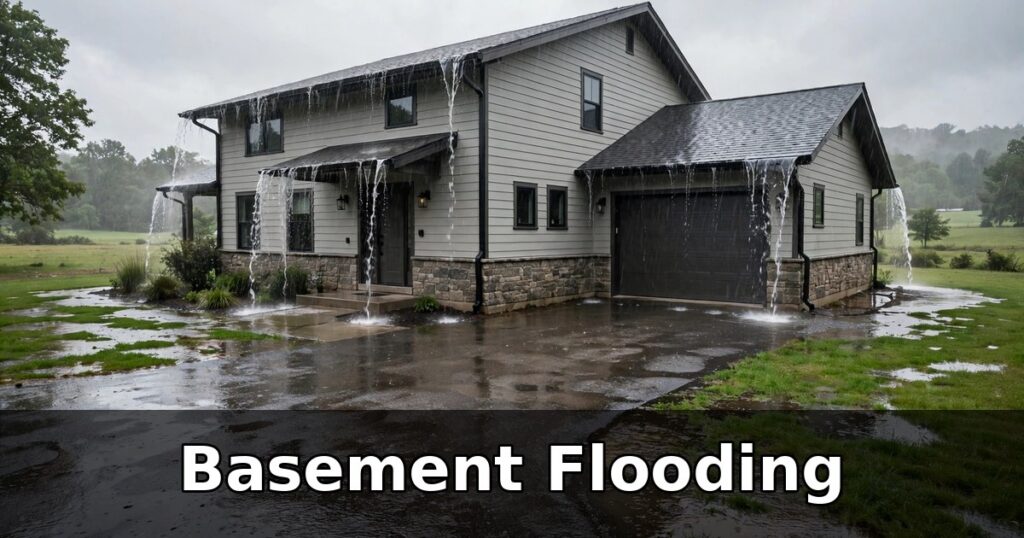
A gutter clogged with leaves overflows during heavy rain, and the overflow falls directly against the foundation, exactly where the grading is supposed to keep water away. A downspout that discharges at the base of the wall returns the entire roof catchment to the foundation, and on a large roof that volume is enormous: a single inch of rain on 1,000 square feet of roof produces more than 600 gallons of water. Downspouts should discharge at least five feet from the foundation, and farther is better, through extensions, splash blocks, or buried drain lines that carry the water to a point where it can soak away or reach a storm drain. The discharge point should be checked during rain, because an extension that has been disconnected, crushed, or buried by landscaping is worse than useless, concentrating the roof water in a single spot against the wall.
The sump pump system
For groundwater, the sump pump is the central defence, and the Federal Emergency Management Agency recommends a primary sump pump for any home in a flood-prone area, with a battery-operated backup. The system has four parts, and each must work for the whole to work. The sump pit collects water from the perimeter drain tile that runs around the inside or the outside of the foundation. The pump, usually a submersible unit sitting in the pit, lifts the water when a float switch rises with the water level. The check valve prevents water in the discharge pipe from flowing back into the pit when the pump stops. The discharge pipe carries the water outside and releases it well away from the foundation, at a point where it cannot flow back toward the house, and where it will not freeze in winter and block the pipe.
Testing the system is simple and should be done twice a year, in spring and in autumn. Pouring water into the pit until the float rises should start the pump, and the pump should empty the pit quickly and shut off cleanly. A pump that runs constantly, that cycles on and off rapidly, that makes grinding or rattling noises, or that fails to lower the water level is a pump that will fail during the storm when it is needed most. The average lifespan of a sump pump is about ten years, and a pump approaching that age should be replaced before it fails rather than after. The discharge pipe should be checked for the same reason: a pipe that discharges against the foundation, or into a drain that is clogged, returns the water to the pit and forces the pump to cycle endlessly.
The battery backup exists because the storms that produce the most groundwater are the same storms that knock out power. A backup pump, powered by a deep-cycle battery, takes over when the main pump loses power or fails mechanically, and the Federal Emergency Management Agency recommends it explicitly for that reason. The backup is useful only if the battery, the charger, the pump, the check valve, and the discharge pipe are compatible and maintained, and the battery must be tested and replaced on schedule, because a battery that has sat unused for years may hold no charge at all.
Stopping sewer backup
A backwater valve is a one-way device installed on the main sewer line, usually where the lateral leaves the house, and it allows wastewater to flow out while blocking reverse flow from an overloaded municipal sewer. It is a sewer-backup control and nothing else: it will not stop groundwater, roof runoff, or water entering through a foundation crack, and a homeowner who installs one expecting it to solve a groundwater problem will be disappointed.
Sealing cracks and waterproofing
Foundation cracks are the most visible entry point for groundwater, and the Federal Emergency Management Agency identifies mortar, masonry caulk, and hydraulic cement as materials that may be used to repair foundation and basement-wall cracks. Hydraulic cement is the appropriate choice for an active leak, because it expands as it sets and can be applied to a wet surface, while epoxy injection is used for structural cracks that must be bonded.
Insurance and the paperwork gap
| Coverage | What it covers | What it does not cover |
|---|---|---|
| Standard homeowners policy | Most household risks | Flood damage; water entering from outside at ground level or below |
| National Flood Insurance Program | Up to 250,000 dollars for the structure and up to 100,000 dollars for personal belongings | Personal property stored in a basement, finished flooring, finished walls, or bathroom fixtures in a basement |
| Water backup endorsement | Backups of sewers, drains, septic systems, and sump pumps | Groundwater or surface water flooding |
Sewer backup occupies a third category, separate from both flood and standard homeowners coverage. A standard policy does not cover it, and a flood policy covers it only when the backup was directly caused by flooding as the National Flood Insurance Program defines it. The protection for an ordinary sewer backup is a water backup endorsement, an optional addition to a homeowners policy that covers backups of sewers, drains, septic systems, and sump pumps, and it is typically available for a modest additional premium.
If water gets in anyway
No system is perfect, and a storm can exceed the capacity of any defence. The first rule when water enters a basement is safety: electricity and water together are lethal, and no one should enter a flooded basement where the water may have reached outlets, appliances, or the electrical panel. If the water is above the level of the outlets, the power should be shut off at the main breaker only if the breaker can be reached without entering the water, and otherwise the utility should be called. Floodwater should be treated as contaminated, because it may contain sewage, chemicals, and debris, and protective clothing, gloves, and boots should be worn for any contact with it. Sewage in a basement is a job for a professional cleanup service, not for a homeowner with a mop.
Pumping should be done in stages over several days, because the Federal Emergency Management Agency advises that draining a basement all at once while the ground outside is still saturated can allow outside water pressure to damage the walls. A portable pump or a wet vacuum can remove the water in stages, and the discharge should be directed well away from the house. Everything that has been soaked should be photographed before it is moved, because the photographs are the basis for any insurance claim, and the wettest items should be removed first, because mould can begin to grow within twenty-four to forty-eight hours in damp conditions, according to the guidance of the Federal Emergency Management Agency and the Centers for Disease Control and Prevention.
Porous materials that have been soaked, including carpet, padding, and drywall, usually cannot be salvaged and should be removed and discarded. The final step is drying: fans, dehumidifiers, and ventilation, continued until the moisture meter or the smell confirms that the space is dry, because a basement that looks dry but remains damp behind the walls will grow mould in the weeks that follow. The storm ends when the rain stops. The recovery ends when the basement is dry, the cause is identified, and the defence that failed has been fixed before the next forecast.
Raina





댓글 0
첫 댓글을 남겨보세요.