
Wildfire Smoke and Your Lungs: A Practical Guide to Bad Air Days
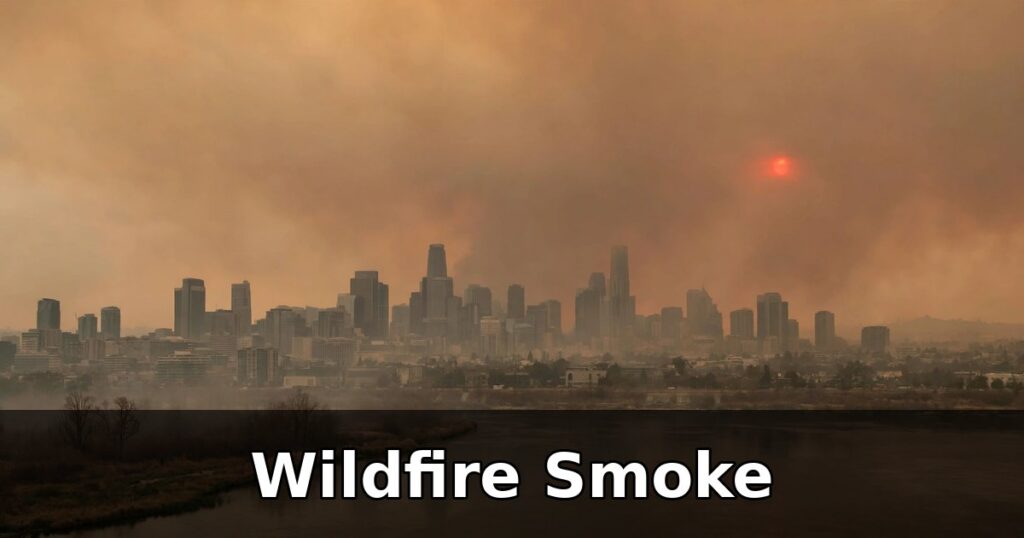
On 7 June 2023, smoke from wildfires burning in Quebec drifted south over the eastern seaboard of North America and turned the sky over New York City orange.
Key points
- On 7 June 2023, smoke from Quebec fires pushed New York City’s Air Quality Index to 484, the highest since measurements began in 1999 — and asthma emergency visits jumped 81% in a day.
- The main threat is PM2.5, particles roughly 30 times thinner than a human hair, small enough to reach deep into the lungs and cross into the bloodstream.
- Staying indoors with windows closed is the most effective protection — but only with filtration: a MERV 13 filter and continuous fan use can cut indoor PM2.5 by about half.
- Only a properly fitted N95 respirator protects outdoors. Cloth masks, surgical masks and bandanas do not protect against PM2.5 at all.
On 7 June 2023, smoke from wildfires burning in Quebec drifted south over the eastern seaboard of North America and turned the sky over New York City orange. By the afternoon, the city’s Air Quality Index had reached 484, the highest value recorded there since measurements began in 1999, and the daily average concentration of fine particulate matter reached 117 micrograms per cubic metre, more than three times the U.S. Environmental Protection Agency’s 24-hour standard of 35 micrograms per cubic metre.
Asthma-related emergency department visits in the city rose from 175 on the previous day to 317, an increase of about 81%. The fires were hundreds of miles away, yet the air in one of the largest cities in the world became hazardous to breathe. That episode illustrates the central fact about wildfire smoke: it is not a local problem confined to the neighbourhoods nearest the flames. Smoke can travel hundreds or even thousands of miles, and a bad air day can arrive in a city with no fire anywhere nearby.
What wildfire smoke is made of
Wildfire smoke is a complex mixture of gases and particles produced when vegetation, and sometimes buildings and their contents, burn. The gases include carbon monoxide, nitrogen oxides, and volatile organic compounds such as formaldehyde, acrolein, and benzene. The particles range from visible ash and soot down to microscopic fragments far too small to see. Of all these components, the one that drives most of the health risk is fine particulate matter, known as PM2.5, which consists of particles 2.5 micrometres or smaller in diameter. According to the EPA, PM2.5 is the main component of wildfire smoke and the primary public health threat it poses.
PM2.5 and why size decides the risk
The reason particle size matters so much is anatomical. The nose and upper airways are reasonably good at trapping larger particles, which are then swallowed or coughed out. PM2.5 particles, by contrast, are roughly thirty times thinner than a human hair, small enough to pass the body’s defences in the nose and throat and travel deep into the lungs, reaching the tiny air sacs where oxygen passes into the blood. Some of the smallest particles can cross from the lungs into the bloodstream. Once deposited, the particles provoke inflammation in the airways and the cardiovascular system.
Short-term exposure to wildfire smoke can cause coughing, wheezing, a scratchy throat, stinging or watery eyes, headaches, tiredness, chest pain, and a fast heartbeat, according to the CDC. For people with asthma, smoke can trigger an attack, and for people with chronic obstructive pulmonary disease, known as COPD, it can cause a flare-up that requires medical attention. The EPA links exposure to particle pollution with aggravated asthma, decreased lung function, irregular heartbeat, nonfatal heart attacks, and premature death in people with heart or lung disease.
Reading the Air Quality Index
The Air Quality Index, or AQI, is the tool the EPA and its AirNow service use to translate pollutant measurements into health information. The scale runs from 0 to 500 and is divided into six categories, each with a colour and a plain-language description of the level of health concern. An AQI value of 100 generally corresponds to the short-term air quality standard set by the EPA, so values above 100 mark the point at which air becomes unhealthy for at least some people.
For PM2.5, the categories are tied to 24-hour average concentrations, and the EPA revised those breakpoints with effect from 6 May 2024, lowering the concentration at which air leaves the Good category.
| AQI category | AQI range | PM2.5, 24-hour average (µg/m³) | Who is affected |
|---|---|---|---|
| Good | 0–50 | 0.0–9.0 | Air quality is satisfactory |
| Moderate | 51–100 | 9.1–35.4 | Acceptable; some risk for unusually sensitive people |
| Unhealthy for Sensitive Groups | 101–150 | 35.5–55.4 | Sensitive groups may experience effects |
| Unhealthy | 151–200 | 55.5–125.4 | Everyone may begin to experience effects |
| Very Unhealthy | 201–300 | 125.5–225.4 | Risk of health effects increased for everyone |
| Hazardous | 301 and above | 225.5 and higher | Emergency conditions; entire population likely affected |
Who faces the highest risk
Smoke affects everyone who breathes it, but the risk is not evenly spread. The CDC identifies several groups that need to be especially careful: children, older adults, people with lung disease such as asthma or COPD, people with heart disease, people with diabetes or chronic kidney disease, people who are pregnant, and people who work outdoors.
Children face a combination of disadvantages. Their lungs are still developing, they breathe more air relative to their body size than adults do, and they tend to spend more time active outdoors, so the dose of particles per kilogram of body weight is higher. Older adults have less physiological reserve and are more likely to live with one of the chronic conditions that smoke aggravates.
Before the smoke arrives
Most of the protection against wildfire smoke is arranged in advance, because the middle of a smoke event is a poor time to shop for equipment or learn how it works. The first step is knowing where to find reliable information. AirNow publishes the AQI and smoke forecasts for the United States, and many state and local air agencies issue alerts by text or email when smoke is expected.
The second step is assembling supplies. A box of NIOSH-approved N95 respirators, sized to fit the adults in the household, is inexpensive insurance, and respirators stored in a drawer are far more useful than respirators bought after the shelves have emptied. A portable air cleaner with a true HEPA filter, or at least a spare filter for one already owned, belongs on the same list, along with a supply of high-efficiency filters for the home heating and cooling system.
Finally, smoke preparation should not be confused with fire preparation. A cleaner air room and a respirator offer no protection against an approaching fire, extreme heat, or carbon monoxide accumulation in an evacuation zone, and evacuation orders always take precedence over smoke precautions.
Making indoor air safer
A central heating and cooling system can help if it is set to recirculate indoor air rather than drawing in outdoor air, and if it is fitted with a high-efficiency filter rated MERV 13 or higher, or the highest rating the system can accommodate. The EPA notes that upgrading to a MERV 13 filter and running the system fan continuously may decrease indoor PM2.5 concentrations by about half.
A portable air cleaner is the most important tool for the room where household members spend the most time. The EPA recommends a unit with a true HEPA filter, which under the U.S. Department of Energy standard removes at least 99.97% of particles at 0.3 micrometres, the most penetrating particle size. Sizing matters as much as the filter itself: the Association of Home Appliance Manufacturers recommends a smoke Clean Air Delivery Rate, or CADR, of at least two-thirds of the room’s floor area in square feet, assuming standard eight-foot ceilings, so a 300-square-foot bedroom calls for a smoke CADR of about 200, and during heavy smoke the same organisation recommends a stronger target, with the smoke CADR roughly equal to the room’s square footage.
The cleaner should run continuously on its highest fan speed during a smoke event, with the door to the room kept closed, and it should be a model that does not produce ozone. The EPA warns that ozone generators sold as air cleaners can produce ozone at levels that harm health and do not effectively remove particles.
Masks and respirators: what works and what does not
For time that must be spent outdoors during a smoke event, a respirator is the only form of face covering that offers meaningful protection against fine particles. A NIOSH-approved N95 respirator is the device named in EPA and CDC guidance, and the designation has a precise meaning: under the NIOSH standard, the filter material captures at least 95% of test particles at 0.3 micrometres, the most penetrating particle size. A P100 respirator, which captures at least 99.97% of test particles, is a further option named in the same guidance.
The filter, however, is only half of the protection. A respirator protects only to the extent that air passes through the filter rather than around its edges, so fit determines real-world performance. A proper fit means the respirator covers the nose and chin, seals snugly against the face, and is held in place by two head straps rather than ear loops. Facial hair breaks the seal, and a user seal check, pressing the edges and breathing in sharply to feel the respirator pull slightly inward, should be performed each time the device is put on.
NIOSH-approved respirators do not come in sizes designed for very young children, and the CDC states that children aged two years and older can wear respirators and masks, while children under two should not wear them. Cloth masks, surgical masks, bandanas, and breathing through a wet cloth will not protect against the fine particles in wildfire smoke, according to the CDC. These coverings have gaps at the edges and filter material that is not designed to capture particles as small as PM2.5.
During a smoke day
On a day when the AQI has moved into the unhealthy range, daily routines need to change in proportion to the reading. At an AQI above 100, members of sensitive groups should reduce prolonged or heavy outdoor exertion, and at an AQI above 150, everyone should consider doing so, with strenuous activity moved indoors or postponed. Exercise is the activity most worth rescheduling, because heavy breathing during a run or a cycling session multiplies the volume of smoky air reaching the deep lung.
After the smoke clears
Smoke can remain in the air for days after a wildfire ends, according to the CDC, so the end of visible flames does not mean the end of precautions. The AQI should be checked before windows are opened and ventilation is resumed. Heating and cooling filters that were loaded during the event should be replaced, and portable air cleaner filters should be checked and changed if they appear dirty.
What this means
Indoor filtered air is the strongest protection. Staying inside with windows closed, a MERV 13 filter running on recirculate, and a properly sized HEPA cleaner in one closed room does more than any mask worn outdoors — because most of a smoke event is spent indoors.
The AQI is the decision tool. Know the number at which outdoor plans change: above 100 for sensitive groups, above 150 for everyone. Check it in the morning and again before outdoor activity, and use the hourly NowCast rather than waiting for the 24-hour average to catch up with the sky outside.
Preparation beats improvisation. Respirators, filters and a cleaner-air room arranged before smoke season are useful; the same items bought mid-event, after shelves have emptied, are not. And when heat and smoke arrive together, cooling takes priority over sealing the house — a public cleaner air space with both filtration and cooling may be the safer option.
Raina





댓글 0
첫 댓글을 남겨보세요.