
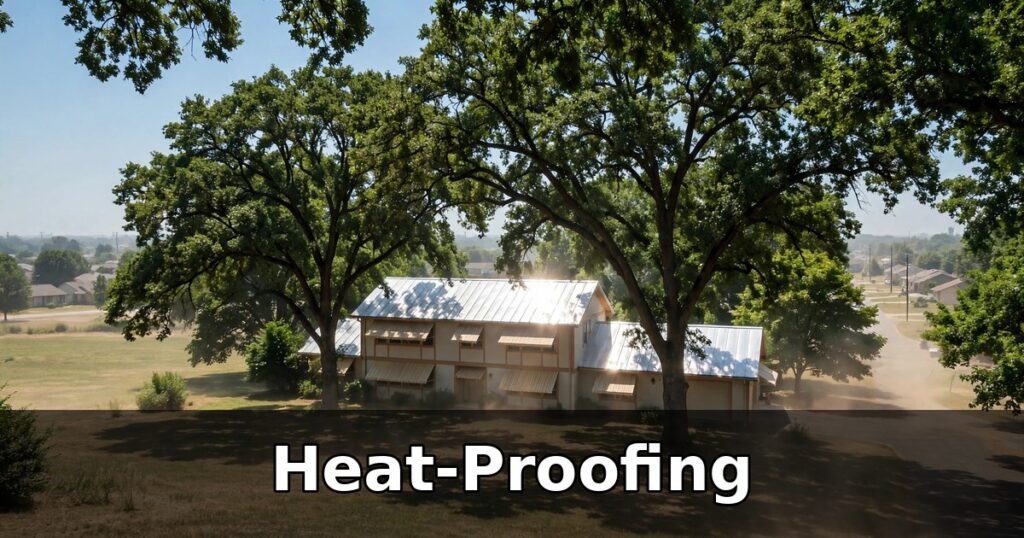
Heat-Proofing Your Home: What Actually Works When the Grid Strains
A house in a heatwave is not a passive shelter. It absorbs solar energy through the roof and windows, stores that energy in walls and floors, and releases it slowly through the night, often when the people inside most need relief.
Key points
- Heat enters through windows, the roof and walls, air leaks, and indoor sources — and windows alone account for roughly 25–30% of residential heating and cooling energy use.
- Exterior shading is the most effective first step: awnings cut solar heat gain by up to 65% on south-facing windows and 77% on west-facing windows.
- Urban areas run 1–7°F warmer by day and 2–5°F warmer at night than surrounding rural land — and the lost overnight recovery is what makes heatwaves dangerous.
- Fans cool people, not rooms. A ceiling fan lets the thermostat be set about 4°F higher without a loss of comfort — but fans should not be relied on above 90°F indoors.
A house in a heatwave is not a passive shelter. It absorbs solar energy through the roof and windows, stores that energy in walls and floors, and releases it slowly through the night, often when the people inside most need relief. When a heatwave also strains the electricity grid, the problem sharpens: air conditioning, the most common defence against indoor heat, depends on the very system that extreme heat can overwhelm. Indoor temperatures then climb through the afternoon and stay high after dark, just as the danger peaks.
Why houses overheat
Heat enters a home through four main routes: solar radiation through windows, which passes through glass and warms floors, furniture, and interior walls directly; conduction through the roof and walls, as the sun heats the outside of the building and that heat migrates inward; air leakage, as hot outdoor air seeps through gaps around windows, doors, ducts, and attic openings; and internal heat from cooking, hot water, lighting, and appliances. According to the Department of Energy, heat gain and heat loss through windows alone account for roughly 25–30% of residential heating and cooling energy use.
Reading the heat: the heat index and when heat becomes dangerous
Outdoor temperature alone is a poor guide to danger, because humidity limits the body’s ability to cool itself through sweating. The National Weather Service combines temperature and relative humidity into the heat index, which describes how hot conditions feel in the shade under a light wind, and sorts it into four bands.
| Heat index | Category | What it means |
|---|---|---|
| 80–90°F | Caution | Fatigue possible during prolonged activity |
| 90–103°F | Extreme Caution | Heat cramps and heat exhaustion possible |
| 103–124°F | Danger | Heat cramps or heat exhaustion likely; heat stroke possible |
| 125°F and above | Extreme Danger | Heat stroke highly likely |
According to the Centers for Disease Control and Prevention, heat exhaustion brings heavy sweating, cold, pale, and clammy skin, a fast and weak pulse, nausea, muscle cramps, dizziness, and fainting. The response is to move to a cool place, loosen clothing, apply cool, wet cloths, and sip water, and to seek medical help right away if vomiting occurs, if symptoms worsen, or if symptoms last longer than one hour.
Heat stroke is a medical emergency: body temperature of 103°F or higher, hot, red, dry or damp skin, a fast and strong pulse, confusion, and loss of consciousness. The guidance is to call emergency services immediately and lower body temperature with cool cloths or a cool bath, without giving anything to drink.
Shading first: trees, awnings, and exterior shades
The most effective place to stop solar heat is outside the glass. Once sunlight passes through a window and strikes an interior surface, its energy has already entered the building, and no interior blind or curtain can send it back out. Exterior shading intercepts the energy first, which is why the Department of Energy describes it as the most effective way to reduce solar heat gain through windows.
Trees are the most powerful form of exterior shade, cooling in two ways at once: a canopy blocks direct sunlight, and leaves release water vapour through transpiration, carrying heat away as the water changes state. The Environmental Protection Agency notes that trees and vegetation can lower peak summer air temperatures by roughly 2–9°F, and its compiled studies found that well-placed shade trees reduced cooling energy use by 7–47%, with the largest savings from trees planted to the west and southwest, the sides that receive the low, intense afternoon sun. The drawback is time: a newly planted tree takes years to cast useful shade, and deciduous species are generally preferred in temperate climates, shading in summer and admitting sunlight in winter.
Awnings deliver the same principle immediately. According to the Department of Energy, window awnings can reduce solar heat gain by up to 65% on south-facing windows and up to 77% on west-facing windows, reflecting the low angle of the afternoon sun. Fixed overhangs work well on south-facing windows, where the summer sun rides high, while awnings and exterior roller shades suit east- and west-facing windows, where the sun sits low. Because awnings can trap hot air against the glass, the Department of Energy recommends designs that allow ventilation around the window. Interior treatments help less than exterior ones, but highly reflective blinds can still reduce heat gain by about 45% when fully closed on a sunny window.
Windows and ventilation: night flushing and cross-ventilation
Ventilation is the cheapest form of cooling available to most households: when the outdoor air is cooler than the indoor air, replacing indoor air with outdoor air removes stored heat. The technique known as night flushing takes advantage of the daily temperature swing by opening windows in the evening, once the outdoor temperature has fallen below the indoor temperature, and closing them again in the morning before the outdoor air warms up. In climates where nights cool substantially, this daily cycle can remove much of the heat that the building absorbed during the day.
Cross-ventilation makes the exchange faster. Opening windows on opposite sides of a building creates a pressure difference that drives air through the interior, and in multi-storey houses the stack effect adds a second force: warm air rises and escapes through upper windows, drawing cooler air in through lower ones. The Department of Energy’s guidance on window fans follows the same logic, recommending exhaust fans in windows facing away from the prevailing wind, with intakes opened in rooms far from the fan.
The attic and the envelope: insulation and air sealing
The attic is the hottest part of most houses in summer, and it sits directly above the rooms where people sleep. Solar energy heats the roof surface, the roof heats the attic air, and the attic heats the ceiling below. Insulation slows that transfer, but it only works when paired with air sealing, because air moving through gaps carries heat far faster than conduction through solid material. The Department of Energy’s Building America guidance sets the sequence: attic ventilation first, then air sealing, then insulation. Fibrous insulation is not an air barrier and cannot substitute for sealing.
The leaks that matter most are invisible from inside the house. Gaps around recessed light fixtures, plumbing pipes, electrical wiring, duct boots, and flues allow hot attic air into the living space, and the attic access hatch or pull-down stairs is often one of the largest single openings. The Department of Energy’s checklist for attic work calls for sealing these gaps with caulk or foam and insulating attic access panels with rigid foam of at least R-10, fitted with gaskets. Chimneys and gas appliance vents require high-temperature-rated sealants and insulation dams made from heat-safe materials. The Department of Energy advises that if attic insulation is below about R-30, adding more after sealing air leaks and making needed repairs is likely to help, with the appropriate target depending on the climate zone.
Fans and air conditioning: what each one actually does
Fans and air conditioners are often treated as interchangeable, but they do opposite things. An air conditioner removes heat and moisture from the air, lowering both the temperature and the humidity of a room. A fan does neither: it moves air across the skin, increasing evaporation and convection from the body, which makes the occupants feel cooler without changing the temperature of the room.
According to the Department of Energy, a ceiling fan can allow the thermostat to be set about 4°F higher without a loss of comfort, because the moving air compensates for the warmer room temperature. Fans that carry the ENERGY STAR label move air about 20% more efficiently on average than standard models, according to the Department of Energy.
Air conditioning remains the most reliable defence in severe heat, and the Department of Energy reports that about three-quarters of homes in the United States have air conditioners. An oversized unit cools the air quickly and shuts off before it has run long enough to remove humidity, leaving the house cool but clammy, while an undersized unit runs continuously without reaching the thermostat setting. A clogged filter restricts airflow, dirty coils reduce heat transfer, and low refrigerant charge reduces capacity. Reducing the load on the system through shading, ventilation, and insulation leaves it a reserve of capacity for the hottest hours.
The roof overhead: cool roofs
The roof receives more direct solar energy than any other part of a house, and its colour and material determine how much of that energy becomes heat. A conventional dark roof absorbs most of the sunlight that strikes it, while a cool roof reflects more sunlight and sheds absorbed heat by emitting thermal infrared radiation. According to the Department of Energy, under the same conditions a reflective roof can stay more than 50°F cooler than a conventional roof. White roofing products stay coolest, reflecting about 60–90% of sunlight, while cool-coloured products typically reflect about 30–60%.
The trade-off is the winter heating penalty: a reflective roof absorbs less sunlight in winter, increasing the need for mechanical heating. In hot climates the summer savings outweigh the winter penalty by a wide margin, while in cold climates the calculation reverses, so the decision depends on the local balance between the cooling and heating seasons. The Energy Star label for roof products was discontinued in 2022, so households now need to compare products by their measured solar reflectance and thermal emittance values, listed in the Cool Roof Rating Council directory.
During a heatwave, and when the power goes out
A heatwave that causes a power outage removes air conditioning at the moment it is most needed, and the Centers for Disease Control and Prevention warns explicitly that heat can cause power outages, advising households to plan in advance for refrigerated medicines and electronic medical devices. The most important step is to get to air conditioning, even for a few hours. The Centers for Disease Control and Prevention advises that a few hours spent in air conditioning at a shopping mall or public library can help, and that cooling centres can be located by dialling 2-1-1 in the United States. Households should identify the nearest cooling centre and the route to it before the heat arrives.
Inside a house without power, the passive measures become the only measures: shades stay closed on the sunny side, and windows open only when the outdoor air is cooler than the indoor air. Fans carry an important limitation that the Centers for Disease Control and Prevention states plainly: they should not be relied on when the indoor temperature is above 90°F, because a fan blowing hot air can increase body temperature rather than lowering it.
What this means
Order matters more than equipment. Shading stops heat before it enters. Ventilation removes the heat that does enter, once the outdoor air is cool enough to carry it away. Insulation and air sealing slow the movement of heat through the building envelope. Fans make the people inside feel cooler without cooling the air, and air conditioning, when available, removes heat and humidity together. A reflective roof lowers the temperature of the sunniest surface, and the cheapest measures — closing shades before midday, opening windows at night, and sealing the largest air leaks — are often the ones that deliver the most.
Raina





댓글 0
첫 댓글을 남겨보세요.