
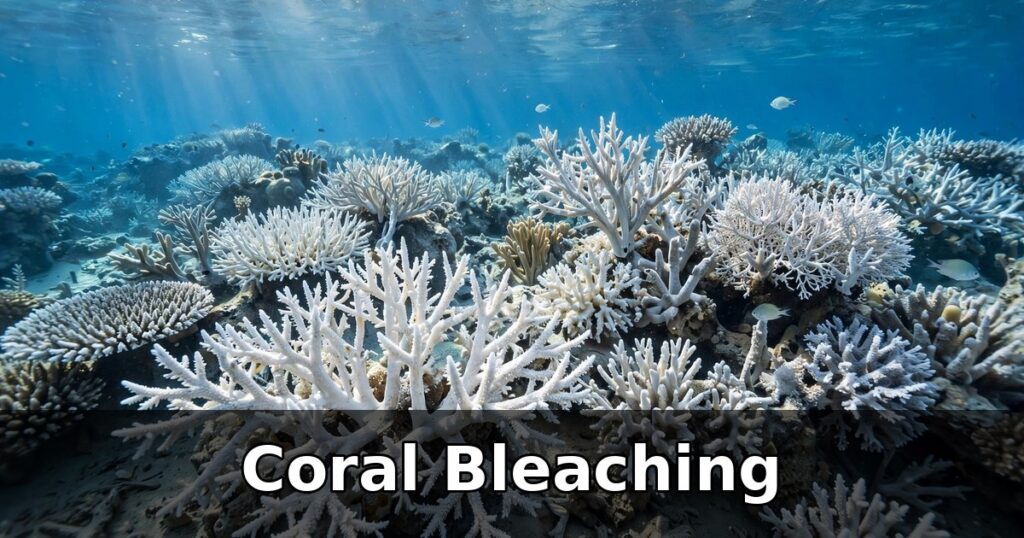
How Did Bleaching-Level Heat Stress Reach 84% of the World’s Coral Reef Area?
How does a single episode of warm water reach almost every coral reef on the planet, from the Caribbean to the Coral Triangle and from the Red Sea to the Great Barrier Reef, and still count as one event rather than a hundred local disasters happening at once?
How does a single episode of warm water reach almost every coral reef on the planet, from the Caribbean to the Coral Triangle and from the Red Sea to the Great Barrier Reef, and still count as one event rather than a hundred local disasters happening at once? That is the question posed by the fourth global coral bleaching event, which, according to NOAA Coral Reef Watch, exposed about 84 percent of the world’s coral reef area to bleaching-level heat stress between early 2023 and mid-2025, with mass bleaching documented in at least 83 countries and territories. The agency’s consolidated status update puts the precise figure at approximately 84.4 percent of reef area for the period from January 2023 through September 2025, a scale that makes this the largest global bleaching event ever recorded. NOAA confirmed the event on 15 April 2024, and later concluded that it had likely ended in mid-2025, after checking that no widespread, large-scale bleaching was reported during the southern hemisphere summer that followed. The headline number therefore describes exposure to dangerous heat, not a claim that 84 percent of all coral died, and that distinction matters for everything that follows, because bleaching is a stress response that can end in recovery, in partial death, or in the loss of whole colonies, depending on how hot the water gets, how long it stays hot, and what condition the reef was in before the heat arrived.
The Partnership That Bleaching Breaks
To understand why heat does this to a coral, it helps to start with the partnership at the heart of reef life. A coral animal builds a limestone skeleton and hosts microscopic algae called zooxanthellae inside its tissues, and those algae photosynthesise and pass energy to their host, giving the coral much of its food and most of its colour. When water temperature rises above the level a coral is accustomed to, that partnership breaks down: the coral expels the algae, its tissue turns transparent, and the white skeleton shows through, which is why the phenomenon is called bleaching. A bleached coral is not yet dead, and if temperatures fall quickly enough it can take algae back in and recover, but while it is bleached it is starving, weakened, and far more vulnerable to disease, storms, and further heat. The risk therefore depends not only on a single hot day but on accumulated stress, and that is exactly what NOAA’s Degree Heating Weeks measure is designed to capture. In plain terms, the measure adds up how far and how long sea surface temperature stays above a local threshold, so that one week at one degree above the threshold and half a week at two degrees above it can produce a comparable score, and scientists can compare reefs in very different oceans on a common scale.
Measuring Heat by Degree Heating Weeks
According to NOAA Coral Reef Watch, the threshold itself is local, not global, which is one of the most important and most misunderstood features of the system. For each reef location, scientists calculate a maximum monthly mean temperature, essentially the warmest month in a typical year, and the bleaching threshold is set one degree Celsius above that mean. Only heat above that threshold counts toward Degree Heating Weeks, and the running total covers the previous twelve weeks, with older heat gradually falling out of the window as time passes. Field observations around the world have shown that when Degree Heating Weeks reach about four degree-Celsius-weeks, significant bleaching can be expected, especially in more sensitive species, and when the value reaches eight, widespread bleaching and significant mortality become likely. At still higher values, NOAA warns, multi-species mortality becomes likely, and at twenty degree-Celsius-weeks or more, near-complete mortality in more than eighty percent of corals is likely. Those thresholds explain why two reefs can sit in water of the same absolute temperature and have entirely different fates: a reef in a naturally warm sea may tolerate water that would devastate a reef accustomed to cooler conditions, and a reef that has already endured repeated heat may have less room left to absorb the next episode.
How One Event Rolled Across Oceans
The fourth global event did not begin everywhere at the same moment, and its geography is part of why it grew so large. NOAA and the International Coral Reef Initiative have described a sequence in which bleaching first appeared in one basin, then spread as seasonal heat peaks arrived in other hemispheres and other oceans, so that by the time heat eased in one region it was intensifying in another. The event was formally confirmed in April 2024, when bleaching had been documented across the Atlantic, Pacific, and Indian Oceans, but heat stress had already been building since early 2023. That rolling pattern is what separates a global event from a regional one: the definition used by NOAA and its partners is not simply that many reefs bleached in the same year, but that mass bleaching was confirmed across multiple ocean basins within a connected period, with satellite heat stress and field reports aligning. In that sense the fourth event was not a single heatwave that swept the globe like a weather front, but a sustained period during which the world’s oceans stayed warm enough, for long enough, in enough places, that the global tally kept climbing month after month.
Larger Than Every Predecessor
The comparison with earlier events shows how unusual that tally is. The first global bleaching event, in 1998, affected about 21 percent of the world’s reef area, according to summaries of NOAA’s record. The second, in 2010, affected about 37 percent. The third, spanning 2014 to 2017, affected about 68 percent and was at the time described as by far the most severe and widespread event on record. The fourth event, at about 84 percent, therefore did not merely edge past its predecessor; it surpassed it by roughly sixteen percentage points and more than doubled the reach of the second event. A peer-reviewed analysis of the third event, based on more than fifteen thousand reef surveys, found that about 51 percent of the world’s reefs suffered moderate or worse bleaching and about 15 percent suffered moderate or worse mortality during that episode, which is a reminder that exposure and death are different measures and that even an event covering two-thirds of reef area did not kill two-thirds of coral outright. The fourth event’s exposure figure should be read in the same way: it tells us how much reef area crossed the heat threshold, while the eventual death toll depends on local Degree Heating Weeks, on species composition, and on whether heat eased in time for recovery.
Warming Plus El Nino
Why did this event beat all previous records in extent? The evidence points to a combination of a long-term warming trend and a short-term climate pattern that pushed already warm oceans further above local thresholds. According to NOAA, global ocean temperatures reached record levels during this period, and marine heatwaves, which are prolonged periods of unusually warm water, became more frequent and more severe in a warming climate. On top of that background warming sat the El Niño that developed in 2023, a phase of the El Niño-Southern Oscillation in which the eastern and central tropical Pacific warm and weather patterns shift worldwide. El Niño does not heat every reef directly, but it redistributes heat and rainfall in ways that can raise sea surface temperatures in many reef regions and suppress the cooling winds and cloud cover that might otherwise offer relief. When background warming has already lifted the baseline close to the bleaching threshold, even a moderate El Niño push can be enough to tip a large number of reefs over it at once, and when that push arrives in different basins in successive seasons, the global total accumulates rather than resetting.
That interaction also explains a paradox that often confuses readers: the oceans can set heat records without every reef experiencing the same peak temperature, and a reef can bleach severely without its local water setting an all-time record. What matters is the gap between the water temperature and the coral’s own threshold, sustained over weeks. A reef that normally peaks at 28 degrees Celsius will begin accumulating stress above 29 degrees, while a reef that normally peaks at 30 degrees may not begin accumulating stress until 31 degrees, yet both can reach four or eight Degree Heating Weeks if the excess persists. In the fourth event, satellite maps showed heat stress building to alert levels in region after region, sometimes lingering for months, which is precisely the pattern that drives Degree Heating Weeks from warning into alert territory. The coordinator of NOAA Coral Reef Watch, Derek Manzello, has emphasised that reefs are now entering an era in which bleaching may occur on a near-annual basis, making it increasingly difficult to define neat beginnings and endings for global events. That observation reframes the fourth event not as a freak anomaly but as a preview of a regime in which the interval between events shrinks below the time reefs need to recover.
Slow and Uneven Recovery
Recovery, when it happens, is slow and uneven, and it depends on factors that satellite heat maps alone cannot show. A coral that survives bleaching must rebuild its algal population, restore its energy reserves, and resume growth and reproduction, a process that can take years, and repeated bleaching in quick succession can interrupt it before it finishes. Reefs that entered the fourth event in better condition, with intact fish populations, good water quality, and diverse coral species, were more likely to survive, according to NOAA’s summary of the event, while reefs already stressed by pollution, overfishing, sediment, or coastal development had less resilience to draw on. Some corals are naturally more heat-tolerant than others, and some individual colonies within a species survive while their neighbours die, which means that even a reef that looks uniformly white at the peak of bleaching may emerge with a changed community, dominated by tougher species and missing the branching corals that provide the most complex habitat for fish. That shift matters beyond the corals themselves, because reefs support roughly a quarter of marine life while covering less than one percent of the ocean floor, and they protect coastlines, sustain fisheries, and underpin tourism livelihoods in many of the same countries where bleaching was documented.
Reefs People Depend On
The human geography of the event is therefore as important as its oceanography. Mass bleaching was documented in at least 83 countries and territories, spanning small island states whose entire economies depend on reef fisheries and tourism, large continental nations with extensive reef systems, and remote atolls where monitoring depends on a handful of observers and satellite data. In places such as the Florida Keys, the Caribbean, the Great Barrier Reef, and Western Australia, bleaching reports arrived in successive seasons, sometimes with local surveys recording severe mortality in sensitive species even as other sites recovered. In the Coral Triangle, the global centre of reef diversity, heat stress threatened species found nowhere else, raising the stakes beyond any single national tally. The global percentage, impressive as it is, can obscure those local differences, and scientists caution against reading it as a uniform catastrophe or, conversely, as a mere statistical artefact. It is a measure of how widely the heat stress system was triggered, and the field evidence beneath it ranges from brief paling that faded within weeks to reefs where large areas of coral died and the structure itself began to erode.
Declaring the End of an Event
What happens after a global event ends is also part of the story, because the end of an event is a scientific judgement, not a moment when the oceans suddenly cool everywhere. NOAA confirmed the likely end of the fourth event only after checking for widespread bleaching during the southern hemisphere summer from December 2025 to February 2026 and finding none at the global scale, even though severe bleaching off Western Australia in early 2025 likely bookended the episode. That cautious method reflects the difficulty of declaring an end while heat can still return in a new season, and NOAA warned at the time that an emerging El Niño could bring widespread bleaching back, with elevated risk flagged for parts of the Pacific, Florida, and the Caribbean later in 2026. The warning does not mean a fifth global event had begun, but it illustrates why the interval between events matters so much: if heat returns before reefs have regained their energy reserves, the next event starts from a weaker baseline, and the same Degree Heating Weeks value can cause more mortality than it would have on a healthy reef.
What the Margin Reveals
The deeper question, then, is not simply how one event reached 84 percent, but what that reach reveals about the margin that remains. In earlier decades, a global event was a rare convergence that required an exceptional El Niño to push many basins over threshold at once. By the 2023 to 2025 period, background ocean warming had narrowed the gap between normal summer peaks and bleaching thresholds in so many places that a strong El Niño, layered onto record ocean heat, was enough to trigger bleaching almost everywhere reefs exist. That is why scientists describe the event as both the largest on record and a sign of a changing baseline, rather than as an outlier that can be dismissed. The Degree Heating Weeks framework makes the mechanism visible: it is not that corals suddenly became more fragile, but that the accumulated heat above their local thresholds kept growing, week after week, basin after basin, until the global tally passed every previous mark. Understanding that mechanism does not by itself save a reef, but it does explain why local protection, while essential for resilience, cannot by itself prevent the next global event if ocean heat continues to rise, and why monitoring, early warning, and rapid local action during heat episodes have become central to reef management.
Seen in that light, the figure of 84 percent is best understood as a map of vulnerability made visible by heat. It shows where the world’s reefs sit relative to their thermal limits, how little additional warming is needed to push them over, and how connected distant reefs have become through a shared ocean climate. It also shows why the distinction between exposure, bleaching, and mortality must be kept clear in public discussion: exaggerating the number into a claim that 84 percent of coral is already dead would misstate the evidence and could breed fatalism, while minimising it as a temporary whitening would ignore the mortality, community change, and lost recovery time documented in many places. The fourth global bleaching event hit 84 percent of reef area because record ocean temperatures and El Niño combined to keep heat above local thresholds for long enough, in enough oceans, to trigger the same stress response almost everywhere at once. Whether the next event is smaller, similar, or larger will depend less on any single season’s weather than on whether that background heat continues to climb and whether reefs are given the years of cooler water they need to rebuild between episodes.
Raina





댓글 0
첫 댓글을 남겨보세요.