
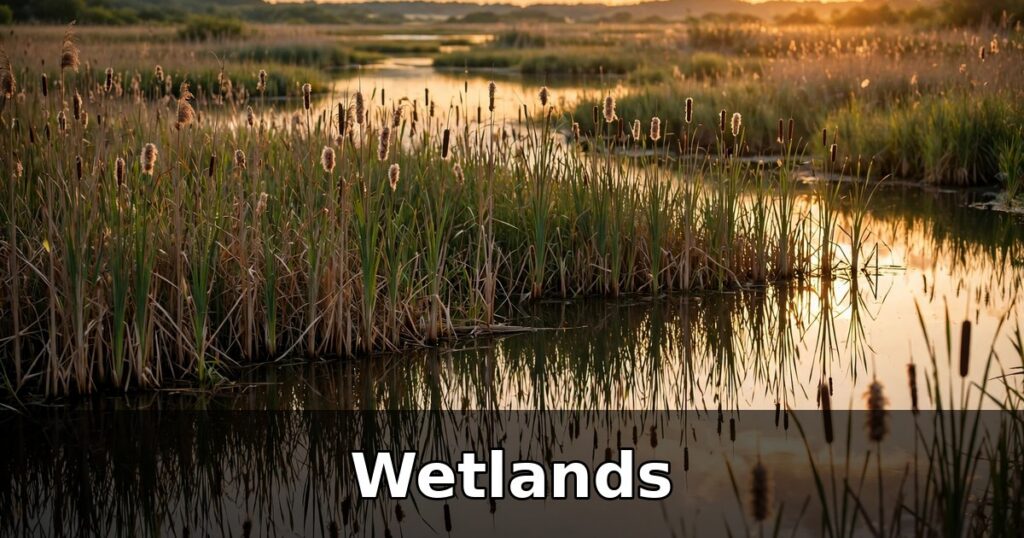
Wetlands: The Overlooked Ecosystems Filtering Water and Holding Back Floods
Wetlands rarely feature on postcards. They are not as dramatic as mountains, as colourful as coral reefs, or as iconic as forests. They are marshes, bogs, fens, swamps, floodplains, lakes, and…
Key points
- 22 percent of the world’s wetlands have been lost since 1970 — at least 400 million hectares — and wetlands are disappearing faster than any other ecosystem.
- Without urgent action, one fifth of the world’s remaining wetlands could vanish by 2050.
- Covering just 6 percent of Earth’s surface, wetlands deliver services valued at up to 39 trillion US dollars annually, more than 7.5 percent of global GDP.
- Reversing the trend would require annual investment of between 275 billion and 550 billion dollars, according to summaries of the Global Wetland Outlook 2025.
Wetlands rarely feature on postcards. They are not as dramatic as mountains, as colourful as coral reefs, or as iconic as forests. They are marshes, bogs, fens, swamps, floodplains, lakes, and estuaries, where water and land meet and the ground is saturated for much of the year. Because they are in-between places, they have often been treated as wasteland, drained for agriculture, filled for development, or ignored in planning. That treatment has been a costly mistake.
A major global report has quantified just how costly. The Global Wetland Outlook 2025, subtitled Valuing, Conserving, Restoring and Financing Wetlands, was released on 15 July 2025, ahead of the 15th Meeting of the Conference of the Contracting Parties to the Ramsar Convention (COP15) in Victoria Falls, Zimbabwe, from 23 to 31 July 2025. The report warns that wetlands are disappearing faster than any other ecosystem, that 22 percent of the world’s wetlands have been lost since 1970 — at least 400 million hectares, some summaries say 411 million — and that without urgent action, one fifth of the world’s remaining wetlands could vanish by 2050. Despite covering just 6 percent of Earth’s surface, wetlands deliver services valued at up to 39 trillion US dollars annually, more than 7.5 percent of global GDP, including water purification, carbon storage, flood protection, and food systems and livelihoods. A quarter of remaining wetlands are in a degraded ecological state, according to the report’s summaries.
What counts as a wetland
The Ramsar Convention, an international treaty for the conservation and wise use of wetlands adopted in 1971 in Ramsar, Iran, uses a broad definition. Wetlands include marshes, fens, and peatlands, whether natural or artificial, permanent or temporary, with water that is static or flowing, fresh, brackish, or salt, including marine water no more than six metres deep at low tide. That breadth recognises wetlands as a family of ecosystems linked by water saturation and hydrology.
Inland wetlands include rivers, lakes, floodplains, marshes, and bogs. Coastal wetlands include estuaries, tidal flats, mangroves, and salt marshes. Human-made wetlands include rice paddies, reservoirs, and fish ponds. Peatlands, where waterlogged conditions slow decomposition and allow organic matter to accumulate as peat over centuries, are especially important for carbon storage, and among the most threatened when drained for agriculture, forestry, or fuel.
What unites these diverse systems is hydrology: the pattern of water flow, depth, duration, and seasonality that shapes soils, vegetation, and animal life. Change the hydrology, by draining, damming, diverting, or filling, and the wetland changes, often irreversibly: a drained peatland becomes a source of carbon dioxide, a floodplain cut off from its river loses its flood storage and fish spawning, and a filled marsh loses its filtration and habitat. Wetland conservation is therefore, at its core, water conservation: protecting the flows, levels, and connections that make a wetland a wetland.
Nature’s water infrastructure
| Service | What wetlands do |
|---|---|
| Flood regulation | Absorb excess water, store it temporarily, release it slowly, reducing peak flows downstream |
| Water filtration | Sediments settle, nutrients are taken up by plants and microbes, some pollutants are broken down or retained |
| Groundwater | Recharge aquifers in some settings, discharge groundwater and maintain streamflow in dry periods in others |
| Food and livelihoods | Fish, waterbirds, rice paddies, floodplain fisheries, reed harvesting, grazing, tourism |
| Carbon storage | Peatlands and coastal wetlands store carbon in waterlogged soils where decomposition is slow |
Wetlands function as infrastructure, though they were never built. Their most celebrated service is flood regulation. Floodplains, marshes, and other wetlands act as sponges, absorbing excess water, storing it temporarily, and releasing it slowly, reducing peak flows downstream. When wetlands are drained or filled, that sponge is removed, and floodwater moves faster and higher downstream. Cities and farms that have lost upstream wetlands often face higher flood damages, and restoring wetlands is increasingly recognised as a cost-effective flood risk measure, complementing levees and drainage.
Wetlands also filter water. As water flows slowly through wetland vegetation and soils, sediments settle, nutrients are taken up by plants and microbes, and some pollutants are broken down. That filtration improves water quality downstream and reduces drinking water treatment costs. Wetlands recharge groundwater in some settings and discharge it in others, maintaining streamflow during dry periods. Draining a wetland can reduce recharge, while protecting it can sustain both surface and groundwater supplies.
Wetlands support food and livelihoods directly: fish and waterbirds harvested for food, tourism and birdwatching, and rice paddies — a human-made wetland system that feeds billions of people, though its methane emissions and water use require careful management. When wetlands degrade, those livelihoods degrade with them, often affecting communities with few alternative income sources.
Wetlands also store carbon, especially peatlands and coastal wetlands, in waterlogged soils where decomposition is slow. When those soils are drained, carbon is released, and a store becomes a source, sometimes for decades after drainage. Restoring drained peatlands by rewetting can reduce emissions, though it does not instantly restore centuries of accumulated carbon, and must be managed to avoid unintended methane increases. The carbon dimension is why wetlands feature in climate policy, but it should not overshadow their water, flood, food, and biodiversity benefits.
Disappearing faster than any other ecosystem
The Global Wetland Outlook 2025’s central finding is stark: wetlands are disappearing faster than any other ecosystem. The loss of 22 percent since 1970, at least 400 million hectares, is not evenly distributed. More recently, Africa and Latin America have experienced the most extensive wetland degradation, due to land-use change, agricultural expansion, urbanisation, infrastructure, and climate stress, compounded by deforestation, mining, hydrological alterations, and weak enforcement in some areas. That shift matters, because the frontier of loss has moved to regions where wetlands are still extensive, biodiverse, and vital for livelihoods, and where governance and finance for protection may be weakest.
The drivers of loss are familiar, and they interact. Agriculture is the largest driver globally, through drainage for crops, conversion to rice paddies or aquaculture ponds in some contexts, and water abstraction for irrigation that lowers water tables. Urbanisation and infrastructure directly fill or fragment wetlands and alter their hydrology. Pollution, from nutrients, pesticides, plastics, and industrial effluents, degrades wetland water quality even where the wetland area remains. Climate change adds pressure through changing rainfall, rising sea levels, increased evaporation, and more frequent extremes, though attributing any particular loss solely to climate change would oversimplify a mix of human pressures and climatic change.
The Outlook’s projection that one fifth of remaining wetlands could vanish by 2050 without urgent action depends on future land-use, policy, and climate pathways. It is intended as a warning about the trajectory if current trends continue, not as a prediction that exactly one fifth will disappear regardless of action. Similarly, the estimate of up to 39 trillion dollars in annual benefits is an economic valuation, not a market price or a budget line. It communicates scale — wetlands covering 6 percent of Earth’s surface provide benefits worth more than 7.5 percent of global GDP — but it is not cash that could be collected or a precise total.
Four pathways proposed by the Outlook
| Pathway | What it means in practice |
|---|---|
| 1. Integrate wetland value in decision-making | Treat wetlands as essential infrastructure in land-use, water, and economic planning |
| 2. Recognise wetlands as key to the global water cycle | Link wetland, water, climate, and disaster risk policy around shared hydrology |
| 3. Embed wetlands in innovative financing | Carbon markets, resilience bonds, and blended finance combining public and private funds |
| 4. Mobilise public and private resources | Fund restoration on the ground and support local communities |
The Outlook outlines four pathways to reversing wetland loss and unlocking nature-positive investment. The first is to integrate wetland value in decision-making, treating wetlands as essential infrastructure in land-use, water, and economic planning. That means including wetland services in cost-benefit analyses for dams, roads, housing, and agriculture, so the benefits of keeping a wetland are weighed against converting it, rather than counted as zero.
The third pathway is to embed wetlands in innovative financing, including carbon markets, resilience bonds, and blended finance, which combine public and private funds to reduce risk and attract investment. The fourth is to mobilise public and private resources for restoration, through partnerships that fund action on the ground and support local communities. Summaries of the Outlook estimate that reversing the trend would require annual investment of between 275 billion and 550 billion dollars, a wide range reflecting uncertainty about costs, methods, and regions, and a gap far above current conservation funding.
Those pathways were discussed at COP15 in Victoria Falls, Zimbabwe, in July 2025, where parties adopted a joint plan for global wetland protection until 2034. Whether that plan translates into on-the-ground protection will depend on national implementation, local governance, and finance that reaches communities. Restoration succeeds when local people have secure rights, livelihood benefits, and a role in management, and fails when it is imposed from above or counted only in hectares restored, without regard to hydrology, species, and maintenance.
Protecting wetlands where you live
Wetlands may seem distant, but most people live near one — a river floodplain, a marsh, a pond, a bog, or a coastal estuary. Protecting them starts with recognition: learning where local wetlands are, what they do, and what threatens them. Supporting local wetland reserves, volunteering for monitoring or restoration, and advocating for wetland protection in planning decisions are practical steps, though restoration itself should be guided by ecologists and hydrologists.
For farmers, land managers, and developers, wetland-friendly practices include maintaining buffer zones, avoiding drainage of peatlands, and managing nutrient runoff.
What is still uncertain
The 39 trillion dollar valuation is not cash. It is an economic valuation of ecosystem services, not a market price or a budget line, and many wetland benefits — cultural values, spiritual significance, existence values for species — are difficult or impossible to monetise. Different valuation methods produce different totals.
What this means
The most valuable land is the land treated as wasteland. Wetlands cover 6 percent of Earth’s surface and deliver services worth more than 7.5 percent of global GDP. The in-between status that made them easy to drain is what makes them irreplaceable: they connect land and water, flood and drought, carbon and food, in a single system.
What should change
Close the finance gap with local delivery. Between 275 billion and 550 billion dollars a year is needed, and the COP15 plan runs to 2034. Finance must reach communities with secure rights and a role in management.
Protect hydrology, not just hectares. Restoration counted only in hectares fails if the water flows, levels, and connections that make a wetland a wetland are not restored with it.
The overlooked ecosystem doing essential work
Wetlands have been overlooked precisely because they are in-between, neither land nor water, neither wilderness nor farm. That in-between status is their strength: they connect land and water, flood and drought, carbon and food, in a single system. Losing them would cost far more than the land they occupy, in higher floods, dirtier water, scarcer food, and carbon released rather than stored. Protecting them is one of the most cost-effective investments available, not because wetlands are cheap to restore, but because the services they already provide for free would be enormously expensive to replace with concrete, pipes, and treatment plants. The overlooked ecosystem, it turns out, was doing essential work all along.
Raina





댓글 0
첫 댓글을 남겨보세요.