
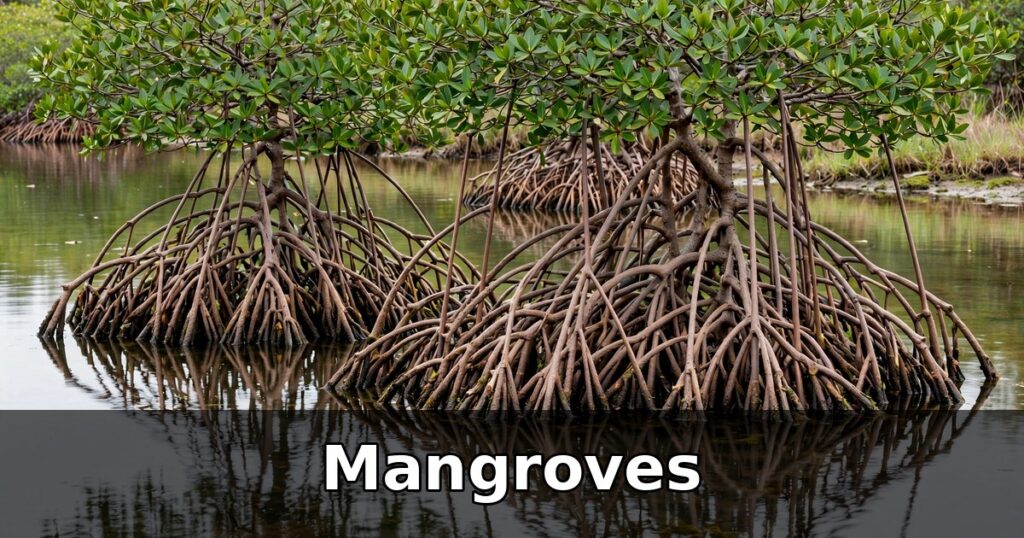
Mangroves: The Coastal Forests That Protect Millions
Walk along a tropical shoreline at low tide and you may find yourself in a forest that seems to grow out of the sea itself. Tangled roots arch above mud and shallow water, crabs scuttle between them,…
Key points
- Worldwide mangrove cover grew by a net 477 square kilometres across 108 countries from 1985 to 2025 — a slight net increase of 0.3 percent over 40 years.
- India added 1,180 square kilometres, leading global growth, while Indonesia lost about 2,043 square kilometres and Myanmar lost about 1,458 square kilometres.
- Indonesia’s net decline has slowed significantly since 2010, placing it among the three countries with the most mangrove growth since 2015.
- Indonesia alone holds about a fifth of the world’s mangroves, so changes there weigh heavily in global totals.
Walk along a tropical shoreline at low tide and you may find yourself in a forest that seems to grow out of the sea itself. Tangled roots arch above mud and shallow water, crabs scuttle between them, fish shelter in their shade, and birds nest in the canopy above. These are mangroves, trees and shrubs specially adapted to live where land meets salt water, in the intertidal zone that is flooded and drained by the tide each day.
According to Global Mangrove Watch data released in July, worldwide mangrove areas expanded by 477 square kilometres across 108 countries from 1985 to 2025, representing a slight net increase of 0.3 percent over the 40-year span. The research, by experts at Aberystwyth University as part of Global Mangrove Watch, found a net gain of 47,720 hectares of mangrove cover worldwide between 1985 and 2025, using satellite data and advanced analysis techniques to track areas of loss, recovery, and stability.
Scientists have given the news a cautious welcome, and caution is the right word, because the global net gain masks major declines in some countries and does not mean every mangrove forest is recovering.
What makes a mangrove different
Mangroves are not a single species. The term describes a diverse group of trees and shrubs, from several plant families, that have independently evolved similar adaptations to salty, waterlogged, oxygen-poor soils. Their roots are the most famous adaptation. Some species send out stilt roots that arch above the mud and stabilise the tree in soft sediment. Others send up pencil-like breathing roots, called pneumatophores, that poke above the mud at low tide and allow the tree to breathe when its underground roots are submerged in oxygen-poor soil.
Many mangroves can exclude salt at their roots or excrete it through glands on their leaves, allowing them to thrive in water that would kill most trees.
These adaptations allow mangroves to occupy a niche that few other forests can: the shifting boundary between land and sea. That boundary is harsh, but it is also productive. Nutrients washed from land mix with marine nutrients, sunlight is abundant, and the sheltered waters among roots provide nursery habitat for fish, crabs, prawns, and other species. A mangrove forest is therefore not just trees. It is a nursery, a feeding ground, a buffer, and a storehouse, all at once.
Protection you can stand behind
The most tangible benefit of mangroves for coastal residents is protection from storms and erosion. Their dense root systems and trunks dissipate wave energy, trap sediment, and stabilise shorelines. During a storm surge, a wide belt of mangroves can reduce the height and force of waves reaching homes, roads, and fields behind it.
The effect is not magic, and it is not unlimited. A narrow strip of degraded mangroves will not stop a major cyclone, and no ecosystem can replace evacuation and sound building standards. But as a first line of defence, mangroves reduce damage, buy time, and lower the cost of engineered coastal defences that would otherwise need to be larger and more expensive.
Carbon stored in mud
Mangroves are also disproportionately important for carbon storage. Like other coastal ecosystems, they store carbon not only in their trunks and leaves but also, and more importantly, in the waterlogged soils beneath them, where decomposition is slow and carbon can accumulate over centuries. When mangroves are cleared and soils are drained or disturbed, that stored carbon can be released as carbon dioxide, turning a carbon store into a source.
Conversely, when mangroves are protected or restored, they can continue to sequester carbon, though restoration takes time and does not instantly replace centuries of stored soil carbon.
The Global Mangrove Watch findings underline that distinction: gains in some areas are linked to both restoration efforts and natural processes, according to Dr. Pete Bunting of Aberystwyth University, whose research contributed to the development of Global Mangrove Watch. Natural expansion, where mangroves colonise new sediment or recover after a disturbance without planting, can be as important as deliberate planting, and sometimes more durable.
A global gain that hides local losses
The headline net gain of 477 square kilometres, or 0.3 percent, over four decades is modest, and it should not be read as a victory. It is the balance of much larger gains and losses.
| Country | Change since 1985 |
|---|---|
| India | +1,180 sq km (led global growth) |
| Indonesia | About −2,043 sq km (led global declines) |
| Myanmar | About −1,458 sq km |
| Australia, Pakistan, Senegal, Philippines | Expansions |
| Malaysia, Nigeria, Cuba | Net declines |
India led global growth by adding 1,180 square kilometres of mangroves over the study period, alongside expansions in Australia, Pakistan, Senegal, and the Philippines, according to reporting on the Global Mangrove Watch data. India’s turnaround has been attributed to strict government protections, engineering projects, and local livelihood programmes, including, in states such as Andhra Pradesh and Tamil Nadu, fish-bone canals dug from the late 1980s onward to enhance soil chemistry and tidal circulation, alongside programmes offering firewood alternatives and paying residents to plant trees.
On the other side of the ledger, Indonesia registered losses of about 2,043 square kilometres since 1985, leading global declines, while Myanmar followed with losses of about 1,458 square kilometres, alongside net declines in Malaysia, Nigeria, and Cuba.
Indonesia’s story is more nuanced than the total suggests: its net decline has slowed significantly since 2010, placing it among the three countries with the most growth in mangrove cover since 2015, according to the same reporting. That slowing is encouraging, but it does not erase the earlier loss, and it does not guarantee continued recovery, especially where pressures from aquaculture, agriculture, and coastal development remain strong.
How the new numbers were measured
The new Global Mangrove Watch update is notable for its methods as well as its results. Researchers tracked mangrove gains and losses across 108 countries using 10-metre resolution satellite imagery and machine learning models, in the third update from the initiative, spanning a 39-year window from 1985 to 2024, extending far beyond previous tracking that began in 1996.
Higher resolution and a longer baseline allow researchers to distinguish real change from mapping error more reliably, and to see where losses have slowed, stabilised, or reversed. Lammert Hilarides, programme lead at Wetlands International, has emphasised that precise tracking data is the foundation of any real defence, because accurate information is needed to halt loss, protect, and restore mangroves successfully.
That point matters for policy: without reliable maps, governments cannot know whether a restoration programme is working, where enforcement is failing, or where natural recovery is already happening and should simply be protected.
Why restoration fails, and what works instead
Mangrove restoration has a mixed record, and the failures are instructive. Many early projects planted large numbers of seedlings, often of a single fast-growing species, in locations where mangroves had never grown or where the hydrology had been altered so that seedlings could not survive. Survival rates were low, and even where trees grew, the resulting plantation often lacked the diversity, structure, and ecological function of a natural forest. Planting became a photo opportunity rather than an ecosystem recovery.
More successful approaches start with the conditions mangroves need, not with the number of seedlings planted. They ask why mangroves disappeared from a site in the first place: was it clearing, altered tidal flow, blocked freshwater, pollution, or erosion? They restore tidal circulation, remove barriers, and allow natural regeneration where seed sources remain, supplementing with planting only where needed and with species appropriate to the site’s elevation and salinity.
Mangroves in a warming, rising sea
Mangroves face a new set of pressures from climate change itself, even where direct clearing stops. Rising sea levels can drown mangroves if they cannot migrate inland or accumulate sediment fast enough to keep pace. Where coastlines are hardened with seawalls, roads, or development, mangroves may be squeezed between rising water and a barrier, a phenomenon known as coastal squeeze, with nowhere to retreat.
These are projections and risks, not certainties for any particular forest, and they vary greatly by location, sediment supply, and tidal range. A mangrove forest on a sediment-rich delta with room to migrate inland faces a different future from one on a sediment-starved island with a seawall behind it. That local variation is why global totals, while useful, cannot substitute for local assessment. A global net gain does not mean a particular village’s mangroves are safe, and a global loss in one country does not mean restoration is impossible elsewhere.
What this means
What the new data do suggest is that loss is not inevitable. Where protections are enforced, where hydrology is restored, and where communities are partners rather than bystanders, mangroves can recover, sometimes naturally and sometimes with help. The recovery is slow, uneven, and modest in global terms, but it is real, and it demonstrates that policy choices matter.
The alternative, continued clearing, would trade storm protection, fisheries, and carbon storage for short-term gains that often prove fleeting when the shoreline erodes or the pond fails.
Mangroves will never be as famous as rainforests or coral reefs, and they will never be as photogenic in the conventional sense. Their beauty is functional: roots in mud, fish in shade, a shoreline that holds. For the millions of people who live behind them, that function is the point. Protecting mangroves is not about preserving a picturesque wilderness. It is about preserving a working coastal system that protects homes, feeds families, and stores carbon, and the recent evidence that such protection can work, in at least some places, is a reason to expand it rather than to declare the job done.
Raina





댓글 0
첫 댓글을 남겨보세요.