
Home Insurance in a Warmer World: Who Pays for Climate Disasters?
Home insurance is one of those things most people think about only when they need it: after a flood, a fire, or a storm, when the damage is done and the question becomes who will pay to rebuild. In a…
Key points
- The January 2025 Palisades and Eaton fires in Los Angeles killed 31 people and destroyed more than 16,000 structures.
- State Farm paid $5.7 billion on 13,700 claims related to those fires; projected insured losses for the fires as a whole were estimated at $20 to $45 billion.
- Insured losses are only part of total losses. Total economic losses — including uninsured damage, infrastructure, business interruption and health costs — are larger, often much larger.
- Climate strains insurance at every point: historical data predict the future less well, losses are larger and more correlated, and rebuilding costs keep rising.
Home insurance is one of those things most people think about only when they need it: after a flood, a fire or a storm, when the damage is done and the question becomes who will pay to rebuild. In a warmer world, that question is becoming harder to answer, and more consequential. As climate-related disasters become more frequent and more costly, insurers face larger losses, homeowners face higher premiums or loss of coverage, and governments face pressure to step in.
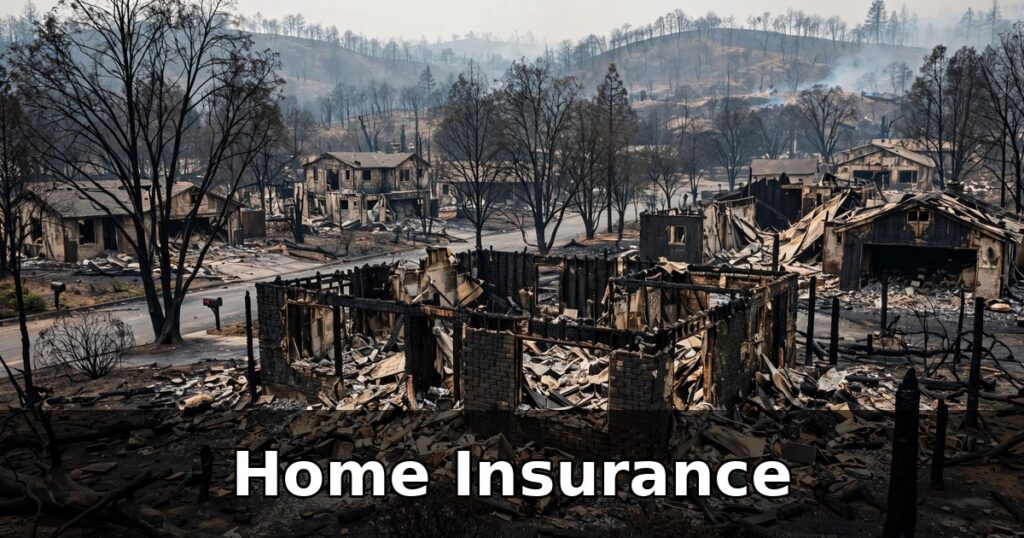
The January 2025 fires in Los Angeles provide a stark example. The Palisades and Eaton fires killed 31 people and destroyed more than 16,000 structures. State Farm, one of the largest insurers in California, paid 5.7 billion dollars on 13,700 claims related to those fires. Projected insured losses from the fires as a whole were estimated at 20 to 45 billion dollars.
It is important to be clear about what insured losses mean. Insured losses are the portion of total losses covered by insurance policies. Total economic losses, including uninsured damage, infrastructure damage, business interruption, health costs and the value of lives lost, are larger, often much larger. When projected insured losses reach tens of billions of dollars, total losses are higher still, and a significant share falls on households, businesses and governments that were not insured, were underinsured, or faced deductibles and exclusions that left them bearing much of the cost themselves.
| Figure | Amount | Status |
|---|---|---|
| People killed, Palisades and Eaton fires | 31 | Reported |
| Structures destroyed | More than 16,000 | Reported |
| State Farm payments | $5.7 billion on 13,700 claims | Reported |
| Projected insured losses, all insurers | $20–45 billion | Estimate / projection, not final |
How home insurance is supposed to work — and why climate strains it
Home insurance works by pooling risk. Many homeowners pay premiums, and the premiums of the many pay for the losses of the few who suffer damage in a given year. For that model to work, losses must be reasonably predictable, premiums must reflect risk, and insurers must hold enough reserves and reinsurance — insurance for insurers — to pay claims after a major disaster without going bankrupt. Climate change strains each part of that model.
First, predictability is declining. Historical loss data, which insurers traditionally used to price risk, are becoming a less reliable guide to future losses when the climate is changing. A neighbourhood that rarely flooded in the past may flood regularly in the future. A wildfire zone that burned once a generation may burn every few years. When the past no longer predicts the future, pricing becomes harder, and insurers may either underprice risk, leading to large losses, or overprice it, making insurance unaffordable.
Second, losses are becoming more concentrated and more correlated. In a traditional model, losses in one place are offset by quiet years elsewhere. Climate-related disasters can affect large areas at once — a wildfire that destroys thousands of homes, a hurricane that floods an entire coastline, a heatwave and drought that increase fire risk across a region — producing losses that are large, simultaneous and difficult to diversify away. Reinsurance, which spreads risk globally, helps, but when disasters occur in many places in the same year, reinsurance itself becomes more expensive, and those costs are passed on to homeowners through higher premiums.
Third, the cost of rebuilding is rising. Labour, materials and construction costs have increased, and rebuilding to higher standards — fire-resistant materials, elevated foundations, stronger roofs — costs more upfront, even if it reduces future risk. When a disaster destroys thousands of structures at once, demand for builders and materials surges, pushing costs higher still, a phenomenon known as demand surge. Insurers must account for those higher rebuilding costs in premiums, which further increases the price of coverage.
The Palisades and Eaton fires: a case study in scale
The January 2025 Palisades and Eaton fires, which killed 31 people and destroyed more than 16,000 structures, were not an isolated anomaly in California’s fire history, but they were exceptional in their impact on densely populated, high-value areas. Wildfires in California have long threatened homes at the wildland-urban interface, where houses meet vegetation. The Palisades and Eaton fires affected communities where many homes were built close to brush, on slopes and along narrow roads that complicate evacuation, and where property values are high, so that even a single destroyed home represents a large insured loss.
State Farm’s payment of 5.7 billion dollars on 13,700 claims illustrates both the scale of individual insurer exposure and the fragmentation of the market. No single insurer covers all homes in an area, so total insured losses are spread across many companies, but each company faces a substantial bill. The projected range of 20 to 45 billion dollars in insured losses for the fires as a whole reflects uncertainty about total claims, about the value of destroyed structures, about business interruption and additional living expenses, and about how many claims will ultimately be paid.
It would be a mistake to attribute any single fire, including the Palisades and Eaton fires, solely to climate change. Wildfires are caused by a combination of ignition sources, vegetation, weather and human factors, including land-use decisions and fire suppression history. What climate change does is increase the conditions that make large, destructive fires more likely: hotter, drier conditions, longer fire seasons and vegetation that dries out more quickly.
A single fire cannot prove that climate change caused it, just as a single quiet fire season cannot prove that it did not. The trend toward larger, more destructive fires in many regions, combined with more homes built in fire-prone areas, is what drives the insurance crisis, not any one event alone.
When insurance becomes unaffordable, or unavailable
For homeowners, the most immediate consequence of rising climate risk is higher premiums. In high-risk areas, premiums have risen sharply in recent years, in some cases doubling or more, straining household budgets and making homeownership less affordable. For lower-income homeowners, higher premiums can mean choosing between insurance and other necessities, or dropping coverage altogether and bearing the risk themselves. For renters, higher insurance costs for landlords can translate into higher rents, even though renters do not directly buy home insurance.
More troubling than higher premiums is loss of availability. In some high-risk areas, insurers have stopped writing new policies, or have withdrawn from the market altogether, citing unsustainable losses and regulatory constraints on pricing. Homeowners who lose coverage may be forced into state-run insurance plans of last resort, which are often more expensive and offer less coverage, or they may be unable to obtain a mortgage, since lenders typically require insurance as a condition of a loan.
Who should pay? The fairness question at the heart of insurance
The question in the title — who pays for climate disasters? — has no single, technical answer. It is a question about fairness, about how risk is distributed across society, and about who benefits from development in risky places and who bears the costs when disasters strike. Several principles compete, and different societies balance them differently.
Another principle is solidarity: that risk should be shared broadly, through government backstops, cross-subsidies or public insurance, so that no household faces ruin from a disaster it could not prevent. Solidarity protects vulnerable people, but it can also subsidise risky development if it allows building in floodplains or fire zones without bearing the full cost. If taxpayers broadly subsidise insurance in high-risk areas, developers and homeowners may have less incentive to build safely or to avoid the riskiest locations, creating moral hazard.
A third principle is that those who contributed most to climate change, or who profited from development in risky areas, should bear a larger share of the cost. That principle points toward climate liability, toward fossil fuel companies, toward developers and toward governments that approved risky development. In practice, assigning liability for a specific disaster to specific emitters is legally and scientifically complex, and it does not provide immediate relief to a homeowner who needs to rebuild.
Reducing risk, not just paying for it
Insurance alone cannot solve the climate disaster problem, because insurance pays after damage occurs; it does not prevent damage. Reducing risk requires investment before disasters, in measures that make homes and communities less vulnerable. For wildfires, that includes creating defensible space around homes, using fire-resistant materials, hardening roofs and vents against embers, maintaining vegetation and planning evacuation routes.
There is also a need for honesty about limits. Some places may become too risky to insure or to rebuild in the same way, even with mitigation. In those cases, managed retreat — supporting people to move to safer locations, with dignity and adequate compensation — may be less costly and less traumatic in the long run than repeated rebuilding after repeated disasters. Retreat is politically difficult and personally painful, and it should not be imposed without consent and support, but ignoring it as an option can lead to a cycle of damage, insurance payout, rebuilding and damage again, paid for by everyone, while the people most affected continue to live in danger.
What this means
The January 2025 Palisades and Eaton fires, with 31 lives lost, more than 16,000 structures destroyed, 5.7 billion dollars paid by State Farm on 13,700 claims, and projected insured losses of 20 to 45 billion dollars, are a warning about the scale of climate-related losses that insurance systems must now absorb. They are not a prediction that every future fire will be as costly, nor a proof that insurance as a system has failed. They are evidence that the system is under strain, that premiums and availability are changing, and that the question of who pays is becoming more urgent and more contested.
Home insurance in a warmer world will not look like home insurance in a cooler, more stable climate. Premiums will reflect higher and more uncertain risk. Some areas will become harder or more expensive to insure. Governments will play a larger role, whether as backstop, regulator or funder of risk reduction. And households will face difficult choices about where to live, how to protect their homes and whether they can afford coverage.
Raina





댓글 0
첫 댓글을 남겨보세요.