
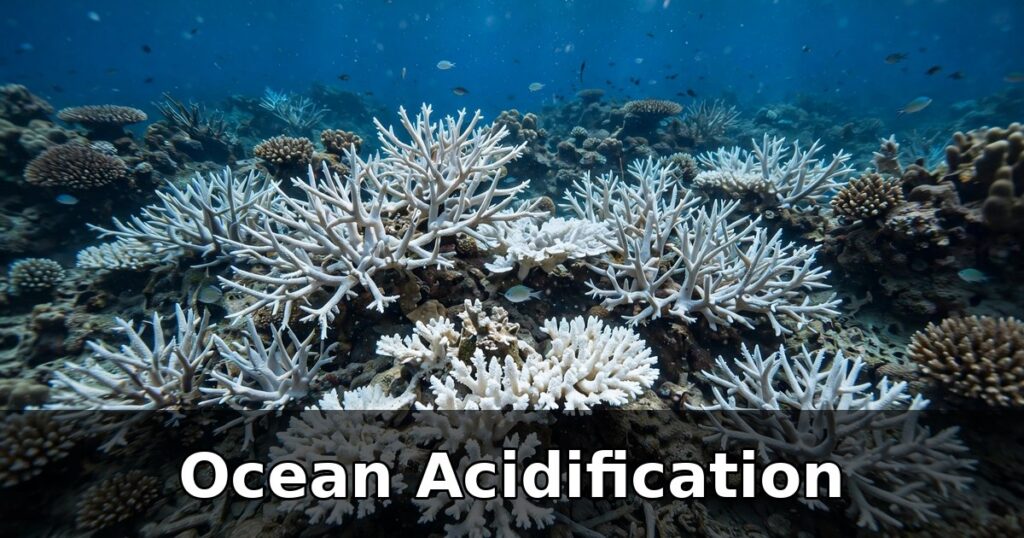
Ocean Acidification: The Other Carbon Problem
When carbon dioxide is discussed, the conversation usually focuses on warming: greenhouse gases trapping heat, raising temperatures, and changing weather. That focus is justified, but it misses a…
Key points
- In June 2025, an international study involving NOAA participants found acidification had compromised 40% of the global surface ocean and 60% of the subsurface ocean down to 200 metres.
- Tropical and subtropical coral reefs had lost 43% of their suitable habitat — conditions in a large share of reef areas no longer support healthy reef growth.
- Acidification reduces carbonate ions, which shell-building organisms need. A small fall in pH means a large rise in hydrogen ion concentration, because pH is measured on a logarithmic scale.
- Cutting carbon dioxide emissions is the only way to slow and eventually stabilise the chemical change on a global scale. Local measures can help, but cannot offset it if emissions keep rising.
When carbon dioxide is discussed, the conversation usually focuses on warming: greenhouse gases trapping heat, raising temperatures and changing weather. That focus is justified, but it misses a second, equally direct consequence of rising carbon dioxide. A substantial share of the carbon dioxide released by human activities is absorbed by the ocean, and when it dissolves in seawater, it changes the ocean’s chemistry, making it more acidic.
The scale of the change became clearer in June 2025, when an international study involving NOAA participants found that acidification had compromised forty percent of the global surface ocean and sixty percent of the subsurface ocean down to two hundred metres. The same study found that tropical and subtropical coral reefs had lost forty-three percent of their suitable habitat.
Those figures are stark, and they deserve careful explanation. Compromised, in this context, does not mean the ocean has become like vinegar, or that all marine life in those areas has died. It means that ocean chemistry has shifted beyond a threshold that scientists consider safe for key organisms and ecosystems, particularly those that build shells and skeletons from calcium carbonate. The loss of suitable habitat for coral reefs means that conditions in a large share of reef areas are no longer within the range that supports healthy reef growth, even if reefs still exist there in degraded form.
The chemistry: a small pH change with large consequences
Understanding ocean acidification requires understanding a basic chemical process, and why a seemingly small change in acidity can matter so much. Seawater is naturally slightly alkaline, not acidic, and it has remained within a relatively narrow range for a long time. When carbon dioxide dissolves, it forms carbonic acid, which releases hydrogen ions and lowers pH, a measure of acidity.
The ocean’s pH has already declined measurably since the industrial era began, and even a small decline in pH represents a substantial increase in hydrogen ion concentration, because pH is measured on a logarithmic scale. More importantly, the process reduces the availability of carbonate ions, which many marine organisms need to build shells and skeletons. For those organisms, acidification is not an abstract chemical shift, but a direct threat to their ability to grow, reproduce and survive.
How acidification affects shells, skeletons and reefs
Many of the ocean’s most important organisms build hard structures from calcium carbonate. Corals build reef frameworks that support an extraordinary diversity of life. Oysters, clams, mussels and other shellfish build shells that protect them. Tiny plankton, including coccolithophores and pteropods — small, swimming snails sometimes called sea butterflies — build shells that form the base of food webs. When carbonate availability declines, these organisms must expend more energy to build and maintain their structures, and in more acidic conditions, existing shells and skeletons can even begin to dissolve.
Coral reefs illustrate the problem vividly. A healthy reef is not just a collection of corals, but a complex structure built over centuries, providing habitat for fish, protecting coastlines from waves, and supporting fisheries and tourism that sustain millions of people. When acidification slows coral growth and weakens reef frameworks, reefs become more vulnerable to other stresses, including warming, which causes coral bleaching, storms, which break weakened structures, and pollution, which further stresses reef organisms.
The June 2025 finding that tropical and subtropical coral reefs had lost forty-three percent of suitable habitat does not mean forty-three percent of reefs have disappeared overnight. It means that, across a large share of reef areas, chemical conditions are no longer suitable for the healthy growth and maintenance that reefs need to persist over time. A reef can survive in marginal conditions for a while, but it is less able to recover from bleaching or storm damage, and over time it may degrade from a complex, living reef to a flattened, algae-dominated habitat with far less biodiversity.
Shellfish and plankton face similar pressures, with consequences that ripple upward. Pteropods are a food source for fish, seabirds and whales in cold waters, and laboratory studies have shown that their shells can dissolve in more acidic water. If pteropod populations decline, animals that depend on them may struggle to find alternative food. Oyster larvae are particularly sensitive to acidification, and oyster hatcheries in some regions have already experienced die-offs linked to acidic water conditions, forcing them to monitor water chemistry and adjust operations. These are not hypothetical future effects. They are early signs of how a chemical change in the ocean translates into biological and economic consequences.
Acidification is not warming — but the two interact
It is important to distinguish acidification from warming, while recognising that they interact. Warming and acidification are both caused by increased carbon dioxide, but they act through different mechanisms. Warming raises water temperature, which can cause bleaching, shift species ranges and reduce oxygen levels. Acidification changes chemistry, affecting shell-building and other physiological processes.
Why surface and subsurface matter differently
The June 2025 study’s distinction between surface and subsurface ocean is important. Forty percent of the global surface ocean compromised, and sixty percent of the subsurface ocean to two hundred metres compromised, tells us that acidification is not confined to a thin surface layer. The surface ocean is where most photosynthesis occurs, where many plankton live, and where carbon dioxide from the atmosphere first enters the ocean.
The subsurface, down to two hundred metres, includes waters that many organisms inhabit or migrate through, and waters that can upwell to the surface, bringing their chemical signature with them. In some regions, particularly along west coasts where deep, naturally more acidic water upwells to the surface, acidification can be especially pronounced, because human-caused acidification adds to a naturally lower baseline.
| Ocean layer | Share compromised (June 2025 study) | Why it matters |
|---|---|---|
| Surface ocean | 40% | Most photosynthesis and plankton; first point of CO2 entry |
| Subsurface to 200 m | 60% | Habitat and migration zone; upwelling brings acidic water up |
| Tropical and subtropical coral reef habitat | 43% lost as suitable | Reefs can persist degraded, but cannot grow and recover normally |
Acidification, food and coastal livelihoods
For people, ocean acidification matters through food, livelihoods and coastal protection. Fisheries depend on healthy marine food webs, from plankton to fish. If plankton populations shift, fish populations that depend on them may shift too, affecting catches and food security, particularly in countries where fish are a primary source of protein. Shellfish aquaculture, which provides jobs and food in many coastal regions, is directly vulnerable to acidification, especially at the larval stage when shells are thinnest and most sensitive.
Oyster, mussel and clam farmers may face higher costs for monitoring, for buffering water chemistry, or for relocating operations, and in some cases may face losses that threaten their businesses. Coral reefs support fisheries, tourism and coastal protection for hundreds of millions of people, particularly in tropical regions. A degraded reef provides less habitat for fish, less attraction for tourists, and less protection against waves and storms.
As with other climate impacts, acidification does not affect everyone equally. Small island states, coastal communities in developing countries, and Indigenous peoples who depend on marine resources for food and culture face disproportionate risks, with fewer resources to adapt. An oyster farmer who can afford to monitor water chemistry and adjust hatchery operations may cope, at least for a time. A small-scale fisher whose catch declines because reef habitat degrades may have no alternative livelihood. Addressing acidification therefore requires attention to equity, to support for vulnerable communities, and to the preservation of marine ecosystems that sustain them.
What can be done about acidification
Unlike some ocean problems, acidification has a clear primary cause and a clear primary solution: reducing carbon dioxide emissions. Because acidification is driven directly by carbon dioxide dissolving in seawater, cutting emissions is the only way to slow and eventually stabilise the chemical change on a global scale. Local measures, such as reducing nutrient pollution that can worsen acidity in coastal waters, restoring seagrass beds and mangroves that can locally buffer chemistry, and protecting reefs from overfishing and pollution, can help ecosystems cope and can improve local conditions, but they cannot offset global acidification if emissions continue to rise.
Monitoring is also essential. Ocean acidification is invisible to the eye, and its effects can be subtle until they reach a tipping point for a particular species or ecosystem. Expanding monitoring networks, particularly in regions where data are sparse, and sharing data openly, can help scientists track change, help shellfish farmers make decisions, and help policymakers understand where action is most urgent. Research into which species are most vulnerable, how organisms might adapt over generations, and how ecosystems respond to multiple stresses can inform conservation and fisheries management.
What is still uncertain
They mean that reefs, shellfish and plankton face a chemical environment different from the one in which they evolved, and that their ability to cope will depend on both global emissions and local protection. How far individual species can adapt over generations, and how ecosystems reorganise as sensitive species decline, remain open questions that monitoring and research are still working to answer.
The other carbon problem, in plain terms
Ocean acidification is called the other carbon problem because it is easy to overlook when the focus is on temperature. Warming is felt in heatwaves, in melting ice, in changing weather. Acidification is felt in the chemistry of seawater, in the thinning shells of tiny snails, in the slower growth of corals, and in the declining suitability of reef habitat — changes that are less dramatic in a single moment, but profound over time.
The ocean has absorbed a large share of human carbon dioxide emissions, buffering the atmosphere from even greater warming. That service has come at a cost, paid in ocean chemistry. Recognising that cost, and acting to reduce it, is not only about protecting corals or shellfish, although those matter in their own right. It is about protecting the food webs, fisheries, coastlines and livelihoods that depend on a healthy ocean, and about acknowledging that carbon dioxide has consequences beyond temperature. The other carbon problem is, in the end, the same carbon problem, seen from beneath the waves.
Raina





댓글 0
첫 댓글을 남겨보세요.