
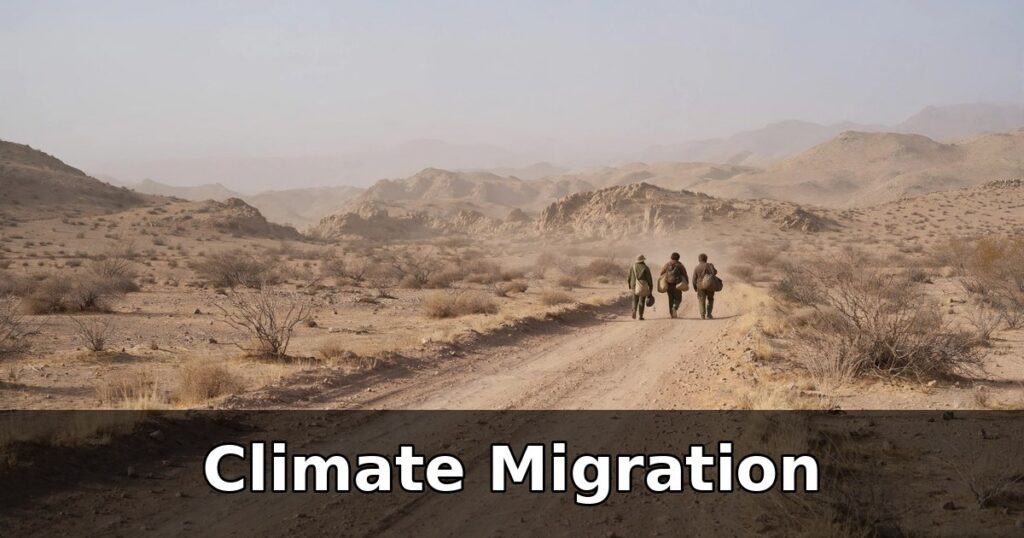
Climate Migration: When Home Becomes Unlivable
Migration is one of the oldest human responses to a changing environment. People have always moved when water ran out, when crops failed, when floods destroyed homes, or when the land could no longer…
Key points
- 117 million people were displaced by war, violence and persecution by mid-2025 — and three in four of them were living in countries with high-to-extreme exposure to climate hazards.
- About 250 million weather-related internal displacements were recorded over the past ten years — a count of displacement events, not unique individuals, since many people were displaced more than once.
- Climate is rarely the only reason people move. It acts as a threat multiplier, worsening existing vulnerabilities until staying becomes impossible.
- Most weather-related displacement is internal, within a person’s own country — not international movement toward wealthier countries.
Migration is one of the oldest human responses to a changing environment. People have always moved when water ran out, when crops failed, when floods destroyed homes, or when the land could no longer support them. What is new is not movement itself, but the scale, the speed, and the combination of pressures now pushing people to move — and the fact that, for many, movement is no longer a choice made in search of opportunity, but a necessity imposed by conditions at home.
According to a report from the United Nations High Commissioner for Refugees, 117 million people were displaced by war, violence and persecution by mid-2025. Three in four of those displaced people were living in countries with high-to-extreme exposure to climate hazards. That statistic does not mean climate change alone caused their displacement. Most were displaced by conflict and persecution, not directly by weather.
Alongside conflict-related displacement, weather itself directly displaces people. Over the past ten years, about 250 million weather-related internal displacements have been recorded — people forced to move within their own country because of storms, floods, droughts, wildfires and other weather-related events. That figure counts displacement events, not unique individuals. A family flooded out of its home, who returns and is flooded again, may be counted multiple times. Even with that caveat, the scale is staggering: hundreds of millions of forced moves within a decade, driven not by choice, but by weather that made staying impossible, at least temporarily, and sometimes permanently.
Why people move — and why climate is rarely the only reason
It is tempting to speak of climate migrants as a single, distinct category, as if a person either moves because of climate or for another reason. In reality, decisions to move are almost always multi-causal. A farmer whose crops fail after a drought may also face falling prices, debt, lack of irrigation and a government that cannot provide support. A family flooded from its home may also face unemployment, poor housing and a lack of insurance.
The most accurate framing is that climate change increasingly influences migration decisions, sometimes as the immediate trigger, such as a flood or storm, and sometimes as a slow pressure, such as declining rainfall, rising salinity or repeated heat, that gradually erodes livelihoods until staying is no longer viable.
Sudden shocks and slow pressures
The distinction between sudden and slow-onset events is important. Sudden events — hurricanes, floods, wildfires — displace people quickly and visibly, often with dramatic images that attract attention and aid. Slow-onset events — drought, desertification, sea-level rise, salinisation of farmland — displace people gradually, often without a single dramatic moment.
A family may not leave on a particular day, but over years, as wells run dry, as crops yield less, as land becomes saltier, they may send one member to a city to earn money, then another, until the household has effectively relocated, even if no one describes it as migration. Slow-onset displacement is harder to count, harder to attribute, and often harder to address with emergency aid, but it may ultimately affect more people over longer periods.
| Type of event | How displacement happens | Why it is hard to address |
|---|---|---|
| Sudden: hurricane, flood, wildfire | Quick, visible, often large numbers at once | Emergency aid fits, but return may be impossible |
| Slow-onset: drought, desertification, sea-level rise, salinisation | Gradual, over years, often one household member at a time | Harder to count and attribute; emergency aid does not fit |
When home becomes unlivable: thresholds, not just trends
Home becomes unlivable not at a single global temperature, but at local thresholds where the combination of heat, water, food and safety breaks down. A coastal village may become unlivable when high tides regularly flood homes and contaminate drinking water, even if the village is not permanently underwater. An inland farming community may become unlivable when rainfall becomes too unreliable to support crops, even if rain still falls sometimes.
That is why climate migration is also a justice issue: the people most likely to be forced to move are often those who contributed least to climate change and have the fewest resources to adapt in place or to move safely. Recognising that inequality is essential to any fair response.
There is also a difference between moving and being displaced. Moving, in the sense of planned, voluntary migration, can be a form of adaptation: a household diversifies income by sending a member to work elsewhere, or a community plans a gradual relocation to safer ground with support and consent. Displacement, by contrast, is forced, often sudden and often traumatic, with loss of home, livelihood, community and cultural ties.
The overlap of conflict, climate and displacement
The UNHCR figure — 117 million displaced by war, violence and persecution by mid-2025, with three in four in countries with high-to-extreme climate hazard exposure — highlights a dangerous overlap. Conflict displaces people into areas that may themselves be vulnerable to climate hazards, such as camps in floodplains or arid regions with limited water. Climate hazards, in turn, can worsen conflict by straining resources, disrupting livelihoods and increasing competition for water and land.
What the law does — and does not — protect
International law, as it currently stands, offers limited protection specifically for people displaced by climate change. The Refugee Convention protects people fleeing persecution, not people fleeing floods or droughts, even when those events make life impossible. People displaced within their own country — the majority of weather-related displacement — fall under national responsibility, with international support varying widely.
Internal displacement: the larger, less visible story
Much public discussion focuses on international migration, particularly movement toward wealthier countries. The data tell a different story about scale: most weather-related displacement is internal, within a person’s own country. The figure of about 250 million weather-related internal displacements over the past ten years refers to movements within national borders, often over short distances, from a flooded rural area to a nearby town, or from a coastal village to a safer inland settlement.
Rural areas, meanwhile, may lose working-age people, leaving older residents and children behind, and may see agricultural land abandoned or degraded. Both sending and receiving areas need support, not only the displaced people themselves. Urban planning that anticipates climate-related growth, rural investment that helps people adapt in place where possible, and social protection systems that support people during and after displacement are all part of a coherent response.
It is also important to note that not everyone can move, even when home becomes dangerous. The poorest, the elderly, people with disabilities, and people without social networks or resources may be trapped in place, unable to afford transport, unable to find housing elsewhere, or unwilling to leave family, graves or cultural sites. Trapped populations are among the most vulnerable to climate hazards, because they face the risk without the option of leaving. Policies that focus only on managing migration, without addressing the needs of those who cannot move, will miss a critical part of the problem.
Adaptation in place, planned movement, and dignity
The most humane responses to climate migration start from a simple principle: people should have the choice to stay safely where they are, or to move safely if staying is no longer possible, and that choice should be supported, not imposed. Adaptation in place includes measures such as flood defences, drought-resistant crops, improved water storage, early warning systems, and social protection that helps households cope with shocks without selling assets or pulling children from school.
Where adaptation in place is no longer feasible, planned relocation — carried out with the consent and participation of affected communities, with adequate funding, livelihood support and respect for cultural ties — is preferable to forced, chaotic displacement after a disaster. Examples of planned relocation, where they have been carried out well, share common features: early engagement with communities, not top-down decisions; attention to livelihoods, not just housing; recognition of cultural and spiritual ties to place; and long-term support, not just a one-off move.
International cooperation also matters. Climate change is a global problem, and its displacement consequences cross borders, even when most displacement is internal. Wealthier countries, which have contributed most to historical emissions, have a responsibility to support adaptation and loss-and-damage funding for vulnerable countries, to provide humanitarian aid, and to create legal pathways for people who need to move. That responsibility is not only moral, but practical: unmanaged, chaotic displacement is more costly and more destabilising, for everyone, than planned, supported movement.
What is still uncertain
Projections of future climate migration vary widely, because they depend on emissions, on adaptation, on development, and on political choices that are not yet made. A projection is not an observed fact, and it should not be presented as a precise forecast of how many people will move by a particular year. What can be said with confidence is that, if warming continues and adaptation is insufficient, more people will face conditions that make staying difficult or impossible, and displacement, both internal and across borders, is likely to increase.
What this means
Climate migration is often framed as a future threat, but the figures for the recent past show it is already a present reality: 117 million displaced by conflict and persecution by mid-2025, many in climate-exposed countries, and about 250 million weather-related internal displacements over the past decade. Those numbers represent people, not abstractions: families who left homes that flooded, farmers whose wells ran dry, coastal residents whose land turned salty, and communities whose options narrowed until leaving was the only viable choice.
When home becomes unlivable, the question is not whether people will move — they will, because survival requires it — but whether they will move with dignity, support and choice, or in chaos, danger and loss. That distinction is shaped by policy, by investment, and by whether the world treats climate migration as a shared challenge to be managed humanely, or as a problem to be ignored until it arrives at someone else’s border. The time to make that choice is now, while adaptation in place is still possible for many communities, and while planned movement can still be a form of resilience rather than a last resort.
Raina





댓글 0
첫 댓글을 남겨보세요.