
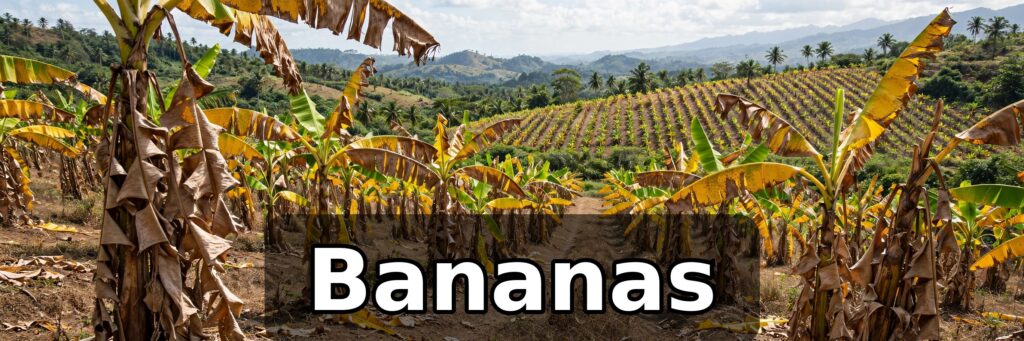
Can Climate Stress and Plant Disease Put a Global Staple Food at Risk?
The Guardian reports that climate stress and new diseases threaten banana growers and supply chains — and researchers are racing to develop disease-resistant varieties before a staple food is put at wider risk.
Key points
- Bananas are a daily staple for hundreds of millions of people and a major income source across Latin America, Africa and Asia — and they are under threat from climate stress and plant disease arriving together.
- The bananas sold worldwide are overwhelmingly one variety, the Cavendish, and Cavendish plants are genetically almost identical clones, so a disease that can attack one can attack them all.
- Panama disease has no cure once a plantation is infected, and the fungus can persist in the soil for decades.
- Climate stress makes disease worse and disease removes resilience to climate stress — the two pressures compound each other.
Bananas are so familiar that it is easy to forget how extraordinary their position in the world food system is. They are one of the most widely eaten fruits on the planet, a daily staple for hundreds of millions of people, and a major source of income for farming communities across Latin America, Africa and Asia.
They are also under threat from a combination that is becoming depressingly familiar: climate stress and new plant diseases, arriving together and reinforcing each other. The question is whether a fruit that seems so ordinary could become a casualty of a changing climate — and what is being done to prevent that.
The banana’s vulnerability begins with its biology. The bananas sold in supermarkets around the world are overwhelmingly a single variety, the Cavendish, and Cavendish bananas are genetically almost identical. They are propagated not from seed but from cuttings, which means that every plant is effectively a clone of every other.
That uniformity is a commercial advantage — consistent size, taste and ripening — but it is also a profound weakness. A disease that can attack one Cavendish plant can attack them all, because there is almost no genetic variation to slow it down.
The disease threat: Panama disease
The most feared banana disease is a fungal infection known as Panama disease, and in particular a strain that has spread across continents in recent decades. The fungus lives in the soil, enters the plant through its roots, and blocks the vessels that carry water and nutrients upward. An infected plant wilts, its leaves yellow and collapse, and it eventually dies.
There is no cure once a plantation is infected, and the fungus can persist in the soil for decades, making it extraordinarily difficult to replant the same land. Quarantine measures, clean planting material and restrictions on moving soil and equipment can slow it, but they cannot stop it entirely, especially in regions where smallholder farmers lack the resources for strict biosecurity.
This is not a new story. An earlier strain of Panama disease destroyed the banana industry’s previous dominant variety, the Gros Michel, in the middle of the last century, forcing the switch to the Cavendish, which happened to resist that strain. The current strain overcomes the Cavendish’s resistance, and its spread to new regions has been a slow-moving emergency for the banana industry.
The history carries a warning: today’s resistance can be overcome by tomorrow’s strain, as the history of the Gros Michel and the Cavendish already demonstrates. A resistant variety is not a permanent victory, because pathogens evolve.
Other diseases add to the pressure
Panama disease is the most feared threat, but it is not the only one. Leaf spot diseases reduce the plant’s ability to photosynthesise, weakening it and cutting yields. Bacterial wilts attack other banana varieties that are staples in Africa, where bananas are not a snack but a core food.
| Disease | How it attacks | Effect |
|---|---|---|
| Panama disease (current strain) | Soil fungus enters roots, blocks water and nutrient vessels | Wilting, collapse, death; no cure; fungus persists in soil for decades |
| Leaf spot diseases | Damage leaves and reduce photosynthesis | Weakened plants and lower yields |
| Bacterial wilts | Attack banana varieties that are African staples | Losses in a core food crop, not only an export fruit |
The overall picture is of a crop under attack from multiple directions, with limited genetic defences. Diversifying the varieties grown in a region reduces the risk that a single disease can wipe out everything — but the commercial system is built on uniformity, and changing that is slow work.
How climate stress makes disease worse
Climate change does not create these diseases, but it creates conditions in which they thrive and in which plants are less able to resist them. Higher temperatures can accelerate the growth and spread of fungal pathogens. Changes in rainfall can create the wet conditions that favour infection, or the drought conditions that stress plants and make them more susceptible.
Extreme weather events can turn a contained outbreak into a regional one. Floods spread contaminated soil, and storms damage plants and open wounds for infection. A contained problem becomes a moving one when water and wind carry the pathogen with them.
Heat and drought stress the banana plant directly as well. Bananas are thirsty plants that evolved in warm, humid conditions, but they have limits. Prolonged heat reduces growth and fruit quality, and water stress during critical growth stages cuts yields. A plant already weakened by climate stress is less able to fight off infection, and a plantation already thinned by disease is less able to withstand a drought.
The two pressures compound, each making the other worse. This interaction is the heart of the threat. It is not only that bananas face a disease and a changing climate as separate problems. It is that the climate problem amplifies the disease problem, and the disease problem removes the resilience that might have helped the crop survive the climate problem. A banana industry that could perhaps cope with either challenge alone finds itself facing both at once.
Who bears the risk
The consequences extend far beyond the price of a banana in a supermarket. In many parts of Africa, cooking bananas and plantains are staple foods, providing a large share of daily calories, and they are grown by smallholder farmers for their own families as well as for local markets. If disease and climate stress reduce those harvests, the result is not a more expensive smoothie; it is hunger.
In Latin America, banana exports support entire regional economies, employing workers in growing, packing and shipping, and a collapse in production would devastate communities that have few alternative sources of income. Consumers in wealthy countries would feel the effect differently, as higher prices and possibly reduced availability, but the severity of that effect would depend on how much of the global supply is affected and how quickly alternatives can be found.
Bananas are traded globally, so a crisis in one region can raise prices everywhere, even where local production is unaffected. The globalisation that makes bananas cheap and ubiquitous also makes their supply chain fragile.
The search for resistant varieties
The most promising response is also the most fundamental: developing banana varieties that can resist the diseases threatening the Cavendish. Researchers around the world are working on this from several directions.
Conventional breeding crosses resistant wild banana relatives with commercial varieties, a slow process made harder by the banana’s unusual genetics — commercial bananas are sterile, which complicates breeding enormously. Genetic research aims to identify the genes that confer resistance and introduce them into commercial varieties more directly. Gene editing offers a faster route to the same goal, by modifying the plant’s own DNA to strengthen its defences.
None of these approaches is quick or simple, and none is a guaranteed solution. Breeding a new banana that is resistant to disease, productive, transportable and acceptable to consumers — who expect a banana to look and taste a particular way — takes years of trials. Regulatory approval for genetically modified or gene-edited crops varies by country and can add further years.
| Approach | How it works | Obstacle |
|---|---|---|
| Conventional breeding | Crossing resistant wild relatives with commercial varieties | Slow; commercial bananas are sterile, complicating breeding |
| Genetic research | Identifying resistance genes and introducing them directly | Years of trials to prove a variety is productive and acceptable |
| Gene editing | Modifying the plant’s own DNA to strengthen defences | Regulatory approval varies by country and can add years |
Other responses matter alongside breeding. Improving soil health, water management and farm hygiene slows disease spread. Supporting smallholder farmers with clean planting material, training and early-warning systems helps contain outbreaks before they become epidemics. Reducing the climate pressures themselves — through emissions cuts and adaptation measures — addresses the root cause that is amplifying the disease threat.
What is still uncertain
No resistant variety is ready and proven at scale. Every approach takes years of trials, and regulatory approval can add further years. A laboratory result is not a plantation solution.
Resistance may not last. Pathogens evolve, and the Gros Michel’s replacement by the Cavendish shows how a strain can overcome resistance that once looked secure.
Quarantine can slow the fungus, not stop it. Clean planting material and restrictions on moving soil and equipment help, but smallholder farmers often lack the resources for strict biosecurity, and the fungus persists in soil for decades.
Consumer acceptance is part of the test. A new variety must look and taste like the banana people expect, as well as surviving transport. A resistant banana nobody wants to eat does not solve the problem.
What this means
Uniformity is the vulnerability. A crop was standardised around a single variety for commercial convenience, creating a weakness that disease and climate stress together are now exposing. The banana is not the only crop facing this combination of threats, but it is one of the clearest examples.
The threat is twofold, and so is the cost. For export regions, the risk is economic collapse in communities with few alternatives. For African smallholders, the risk is hunger, because cooking bananas and plantains are a core food rather than a snack.
The response must be as combined as the threat. Breeding alone is not enough without diversified varieties, better farm hygiene, clean planting material for smallholders, early warning, and action on the climate pressures that amplify disease.
What should change
Fund resistant-variety research on a timescale shorter than the problem. Breeding, genetic research and gene editing all need investment now, because each takes years from trial to plantation.
Diversify what is grown. Regions that depend on a single clone should grow more varieties, so one disease cannot wipe out everything at once.
Support the farmers with the fewest defences. Smallholders need clean planting material, training and early-warning systems, not only the large export plantations that can afford biosecurity.
Treat the banana as a warning, not only a fruit. The same pattern — uniformity, disease, climate stress — can arrive for another staple. Learning how to protect the staples that hundreds of millions of people depend on starts with protecting this one.
A staple worth protecting
Whether bananas remain abundant and affordable will depend on whether resistant varieties can be developed and deployed in time, whether farming practices adapt to a more hostile climate, and whether the world treats the banana’s vulnerability as a warning about the dangers of uniformity in the food system.
Protecting it is not only about saving a fruit. It is about learning how to protect the staples that hundreds of millions of people depend on, before the next combination of climate stress and disease arrives for another crop.
Raina





댓글 0
첫 댓글을 남겨보세요.