
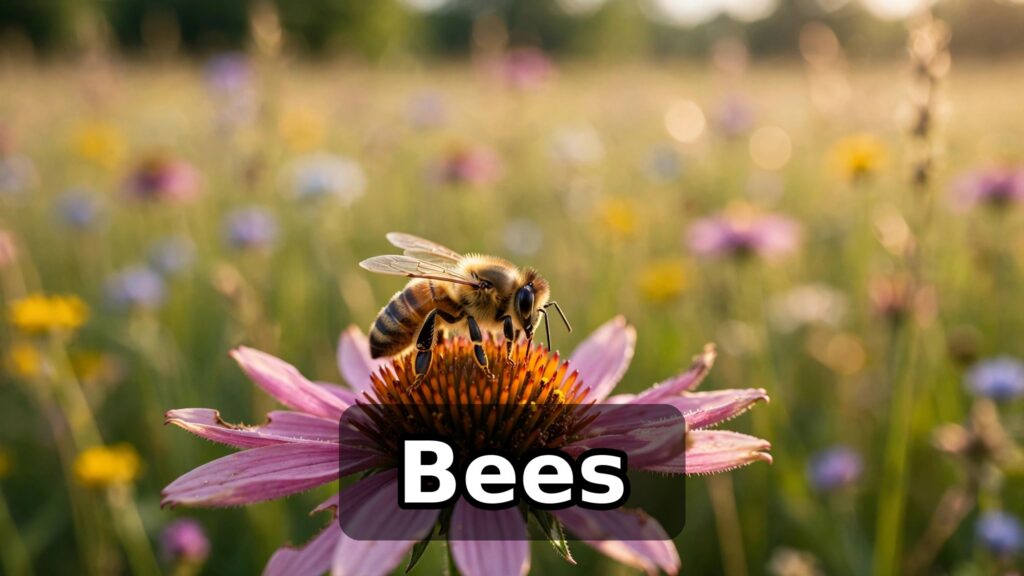
Can One Heat Wave Affect Next Year’s Bees—and the Crops They Pollinate?
A study covered by the Guardian suggests high temperatures affected reproduction in some bees, raising the possibility that one heat wave could ripple into next year's pollination and crop quality, though the effect is hedged, species-specific, shaped by habitat and other pressures, and not a proven guarantee of crop failure.
Key points
- A study covered by the Guardian found that extreme heat affected reproduction in some bees — not necessarily all bees, and not in every place or condition.
- Adult bees may survive a heat wave while the next generation is already diminished, so damage can be hidden until the following season.
- Reproduction links one season to the next: fewer young bees can mean fewer pollinators when flowers open the following year.
- Managed bees cannot fully replace wild bees, which are active at different times, in different weather, and on different flowers.
- The finding points to a possibility, not a guaranteed outcome — a risk worth preparing for, not a prediction of a failed harvest.
A heat wave is usually remembered for what it does in the moment. People seek shade, crops wilt, and daily life slows down until cooler weather returns. A study covered by the Guardian raises a quieter and longer-lasting question: could extreme heat also affect the bees that will be needed next year, and through them, the crops those bees pollinate?
The idea is not that every bee disappears after a hot summer, or that a single heat wave will immediately cause a food crisis. The study points to something more subtle. High temperatures affected reproduction in some bees. If fewer young bees are produced, or if reproduction is weakened in ways that carry into the following season, then the effects of one hot period could linger long after the weather has cooled. That possibility is what makes the research worth taking seriously, even while keeping its limits firmly in view.
What the study suggests
At its core, the research connects heat with the reproductive lives of bees. Reproduction is the bridge between one generation and the next. Adult bees may survive a heat wave, at least in the short term, but if heat interferes with mating, egg production, or the development of young bees, the population may not simply bounce back when temperatures fall. The damage, in other words, could be hidden in the generation that has not yet emerged.
This distinction matters because it changes how we judge the impact of extreme heat. A landscape can look busy with bees during a hot summer and still face a quieter season the following year. Pollination depends not only on the bees that are flying today, but on the bees that will be flying when flowers open in the months ahead. If reproduction is disrupted, the timing of that disruption could matter as much as its size.
It is important to keep the wording careful here. The study covered by the Guardian found effects in some bees, not necessarily in all bees, and not necessarily in every place or under every condition. Bees are a diverse group. Different species live in different habitats, have different life cycles, and may respond to heat in different ways. A finding about some bees is a reason for attention and further research, not a blanket claim about all pollinators everywhere.
Why reproduction is especially vulnerable
Reproduction is a sensitive process in many animals, and bees are no exception. It involves timing, energy, and delicate stages of development. When temperatures rise well beyond what a species is adapted to, those stages can be stressed in ways that are not always visible from the outside.
For example, heat can affect the ability of bees to find mates, to produce viable offspring, or to care for developing young. It can also interact with other pressures, such as limited food, habitat loss, or exposure to chemicals. A bee that is already struggling to find enough flowers may have fewer reserves to cope with heat. A bee that survives heat but produces fewer offspring may leave a smaller population to face the next set of challenges.
There is also a timing problem. Many bees and many flowering plants have evolved to be active at roughly the same time of year. If heat shifts when bees emerge, when they reproduce, or when plants flower, the overlap between bees and flowers could narrow. Even a small mismatch could reduce pollination, not because bees or flowers have vanished, but because they are no longer in the right place at the right time.
These are possibilities, not certainties. The study suggests a mechanism through which heat could have delayed effects. It does not prove that every heat wave will lead to a pollination failure, or that the effect will be the same in every landscape.
Immediate survival is not the whole story
One of the most useful lessons from this research is that counting survivors can be misleading. After a heat wave, it is natural to look around, see bees visiting flowers, and conclude that the population has come through unscathed. Reproductive effects complicate that reassuring picture. A population can appear intact while its future is already diminished.
This slow, compounding pattern is harder to notice than a sudden die-off, and harder to explain in a headline. It requires monitoring over more than one season, and attention to population trends rather than to a single snapshot. That is part of why delayed effects deserve more attention than they usually receive in public discussion of heat waves.
Diversity: why some bees may cope better than others
Bee diversity complicates any simple story, in both directions. On one hand, diversity can be a buffer. If some species are more heat-tolerant than others, or are active at different times of year, then pollination may continue even when one group of bees is affected. A landscape with many kinds of bees is less dependent on any single species, and therefore less fragile when conditions change.
On the other hand, diversity means that losses may be uneven and hard to see. A common, heat-tolerant species might remain abundant while a rarer, more specialised species declines. To a casual observer, bees would still seem plentiful. To the plants that depend on the declining species, however, the loss could matter a great deal. Some flowers are best pollinated by particular bees, with particular body shapes, behaviours, or seasonal timing. Replacing one bee with another is not always a simple substitution.
Habitat also shapes vulnerability. Bees living in shaded, flower-rich, varied landscapes may have more options for shelter, food, and nesting than bees in simplified landscapes dominated by a single crop or by paved surfaces. A heat wave in a diverse landscape may therefore have different consequences than the same heat wave in a landscape with few resources. Place matters, and general conclusions should be treated with care.
From fewer bees to crops: a chain, not a straight line
The next step in the argument is the link to crops. Many flowering crops depend, at least in part, on insect pollination. When pollinators visit flowers, they help plants produce fruit and seed. If pollinator numbers fall, or if pollinators are less active during flowering, pollination could become less reliable. That, in turn, could affect yields, fruit quality, or the consistency of harvests from year to year.
But this chain has several links, and each link can weaken or strengthen the final effect. Farmers may use managed pollinators as well as wild bees. Some crops are more dependent on pollination than others. Some landscapes still offer diverse habitats that support many kinds of pollinators, while others offer very little. Weather in the following year also matters. A cool, flower-rich spring could help a bee population recover, while another hot or dry season could make recovery harder.
That complexity is a reason to avoid simple headlines. One heat wave does not automatically mean a failed harvest next year. What it could mean is a greater risk, or a smaller margin for error, in systems that already depend on healthy pollinator populations. The difference between a risk and a certainty is important, both for farmers deciding how to plan and for readers trying to understand what the science actually says.
Managed bees, wild bees, and the limits of substitution
When wild bees are under pressure, it is tempting to assume that managed bees can simply fill the gap. Managed pollinators are an important part of many farming systems, and they can be moved to crops when flowering begins. But substitution has limits.
Managed and wild bees do not always do the same work. They may be active at different times of day, visit flowers in different ways, or thrive in different conditions. Wild bees often provide pollination alongside managed bees, improving overall pollination even when managed bees are present. If wild bees decline, managed bees may compensate in part, but they may not fully replace the diversity and timing that wild bees provide.
What this means for farmers, gardeners, and land managers
For farmers, the practical message is not panic, but precaution. Pollinator health is already a reason to protect diverse habitats, leave flowering plants available through the season, and reduce unnecessary pressures on bees where possible. If heat can affect reproduction, then providing shade, water, and varied food sources may become even more valuable, although no single action can guarantee protection against extreme heat.
What is still uncertain
The Guardian’s coverage should be read as a report on a study, not as a final verdict on the future of bees or farming. Studies of this kind often focus on particular species, conditions, or time periods. Their results may not apply equally to all bees, all climates, or all farming systems. More research is needed to understand the size of the effect, its variation across species and places, and its interaction with other pressures such as habitat loss and disease.
It is also worth remembering that heat is only one of many pressures on bees. Habitat loss, intensive land use, disease, and chemicals all shape pollinator health. Heat may interact with these pressures, making them worse together than any one of them would be alone. Untangling those interactions is difficult, and honest science will often leave questions open rather than offering a simple answer.
That uncertainty should not be mistaken for unimportance. A possibility that is not yet fully proven can still be worth preparing for, especially when the stakes include food production and the health of ecosystems. The responsible response is to take the finding seriously, to support further research, and to avoid overstating what it proves.
A question that reaches beyond one summer
The most useful way to think about this research may be as a question about time. We are used to thinking of weather as temporary: a hot week passes, and life returns to normal. The study suggests that for some bees, the effects of heat may not follow that simple pattern. Reproduction links one season to the next, and a disruption in that link could carry the influence of a heat wave forward into a year when the weather itself looks ordinary.
If that possibility holds up in further research, it would change how we think about resilience. Protecting pollinators would not only mean helping them survive heat in the moment. It would also mean protecting their ability to reproduce, to recover, and to be present when crops need them in the future. That is a longer and more patient kind of care, but it may be exactly what a warming world requires.
For now, the careful conclusion is this: one heat wave could affect next year’s bees, and through them, the crops they pollinate, but the evidence points to a possibility in some bees, not a guaranteed outcome for all. Keeping that distinction clear is not a weakness in the story. It is what makes the story trustworthy, and it is what should guide how farmers, policymakers, and the rest of us respond. A risk that is understood honestly is a risk that can be prepared for, without exaggeration and without complacency.
Raina





댓글 0
첫 댓글을 남겨보세요.