
Heat, Wildfires, Drought, and Floods: What Did the World’s Weather Reveal in 2026?
The WMO summarized July 2026 as around the warmest July on record, with heat waves, drought, wildfires, heavy rain, and floods across regions — making 2026 a revealing starting point, not a conclusion, for a year-in-review of a climate in which extremes increasingly arrive together.
Key points
- July 2026 reached around the warmest July on record, according to the World Meteorological Organization (WMO).
- Much of 2026’s story can be told as one chain: heat dried soils, drought turned forests and grasslands into fuel, and that fuel burned.
- The same year also brought the opposite extreme: heavy rain and floods in regions unconnected to the droughts — drought and flood are not a contradiction, but the signature of a water cycle moving more violently.
- A year of many disasters does not only damage buildings and crops. It widens the gap between those who can cope and those who cannot.
Every year has its weather. But some years feel like a turning point, when the pattern of disasters stops looking like a series of accidents and starts looking like a message. For 2026, the World Meteorological Organization (WMO) offered a summary that does exactly that: July 2026 reached around the warmest July on record, and across regions, heat waves, drought, wildfires, heavy rain, and floods followed one after another. Taken together, these events make 2026 a useful starting point for a year-in-review — not because any single disaster was unprecedented, but because so many kinds of disaster arrived in the same year.
This post is deliberately framed as a starting point, not a conclusion. A single summary, however authoritative, cannot capture the full texture of a year: the individual towns that flooded, the farms that withered, the forests that burned, the warnings that worked and the ones that did not. What a summary can do is sketch the shape of the year, so that a closer look — disaster by disaster, community by community — has a frame to fill in. That is the purpose here: to lay out what the WMO summary suggests about 2026, to trace the connections among its different extremes, and to name the questions that a fuller year-in-review will need to answer.
A July that set the tone
July is often the year’s hottest month in the Northern Hemisphere, and July 2026 stood out even by that standard. The WMO’s summary placed it around the warmest July on record, a level that reflects not one heat wave in one place but warmth spread across much of the planet. When a single month reaches that level, it is a sign that the background climate has shifted: the baseline against which every heat wave, drought, and storm now plays out is hotter than it used to be.
A record-warm month is sometimes dismissed as a statistic, a ranking on a chart. That dismissal misses what a monthly record means in practice. A month does not become the warmest on record because of a single hot day. It becomes the warmest because warmth persists, day after day, across a wide area, with nights that do not cool enough to offer relief and with heat that accumulates rather than dissipating. A record-warm July is therefore not an abstraction. It is weeks of sustained heat, experienced by millions of people, crops, animals, and ecosystems at the same time.
Why a record-warm July matters practically
A record-warm month also has practical consequences. Heat that arrives in July, when it is already hot, pushes further into dangerous territory than the same heat arriving in a cooler month. Crops, already stressed by summer, wither faster. Power grids, already strained by cooling demand, have less margin. And people, especially those without cooling, face longer stretches in which their bodies cannot recover overnight.
Crops illustrate the point clearly. A plant in July is not at the start of its growth. It is in the middle of it, often at a sensitive stage — flowering, fruiting, or filling grain — when heat stress does disproportionate damage. A few days of extreme heat at the wrong stage can reduce a yield far more than the same heat would have earlier in the season. When heat persists for weeks, as in a record-warm July, the plant has no recovery period: it is stressed, it remains stressed, and its ability to produce is progressively undermined. For farmers, this is not a theoretical loss. It is a harvest that comes in smaller, of lower quality, or not at all, with consequences for income, for local food availability, and for prices far beyond the farm.
Heat, drought, and fire: one chain
| Link in the chain | What happens | What it sets up next |
|---|---|---|
| Heat | Evaporates moisture from soil and vegetation | Dry soils and stressed plants |
| Drought | No rain replenishes what heat has taken; drying deepens and spreads | Forests and grasslands become fuel |
| Fire | Dry vegetation ignites easily, spreads faster, burns hotter | Slopes stripped of vegetation |
| Flood | Rain on bare, burned earth runs off instead of soaking in | Erosion, swollen streams, flooded valleys |
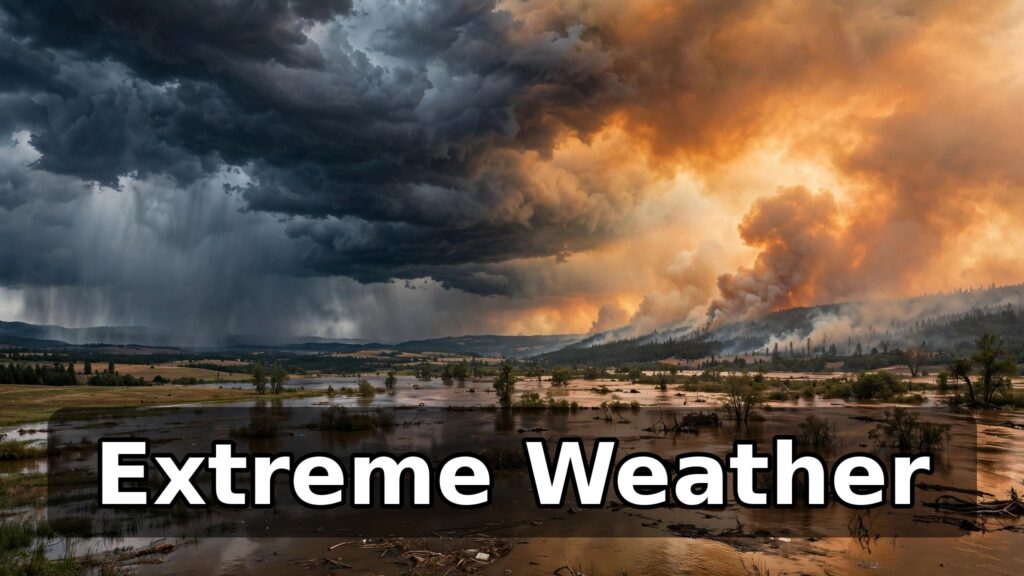
Much of 2026’s story can be told as a single chain. Heat waves dried out soils. Dry soils deepened drought. Drought turned forests and grasslands into fuel. And that fuel burned. The wildfires that made headlines in Europe were not isolated accidents. They were the end of a chain that began with heat and ran through dry earth.
This chain is important because it shows how one kind of extreme weather creates the next. A heat wave alone is dangerous. A heat wave followed by drought is more dangerous. A heat wave followed by drought followed by fire is a catastrophe that touches health, homes, agriculture, and air quality all at once. In 2026, that chain ran in multiple regions, which is why the year’s weather felt so relentless: each disaster seemed to set up the next one.
The other face: rain that arrives all at once
If half of 2026’s story was too little water, the other half was too much, arriving too fast. Heavy rain and floods struck regions that had no connection to the droughts elsewhere, sometimes in the same season. This is the other face of a warming climate: warmer air holds more moisture, so when rain does fall, it can fall harder. Rivers that handled ordinary storms overflowed. Towns that had never flooded found water in their streets.
The coexistence of drought and flood in the same year is not a contradiction. It is a signature of a climate system in which water moves more violently — longer dry spells punctuated by more intense downpours. For water managers, this is the hardest combination to plan for, because it demands both conservation for the dry times and defences for the wet ones, often with the same limited budget.
The connected-system view
Stepping back, what did 2026’s weather actually reveal? First, that extremes are no longer rare. A year in which heat waves, drought, wildfires, heavy rain, and floods all feature prominently is no longer an outlier year. It is the kind of year that a warming climate produces with increasing regularity.
Second, it revealed how connected these disasters are. Heat causes drought, drought causes fire, fire degrades the land that might have absorbed the next rain, and the next rain, arriving on damaged land, causes flooding. Treating each disaster as a separate event misses the system that links them — and the system is what needs to be addressed.
Who bears the costs unequally
Third, it revealed who bears the cost. The same weather hits wealthy and poor communities differently. Those with insurance, infrastructure, and savings recover faster. Those without them fall further behind with each disaster. A year of many disasters therefore does not only damage buildings and crops. It widens the gap between those who can cope and those who cannot.
The inequality operates at every scale. Within a town, a household with air conditioning, insurance, and savings can endure a heat wave, repair a flooded home, and evacuate ahead of a fire. A household without those resources cannot, and each disaster depletes what little buffer it had, making the next disaster harder to survive. Between towns, a wealthy municipality can invest in drainage, cooling centres, and fire protection, while a poor municipality cannot, so the same storm causes a manageable disruption in one place and a lasting crisis in another. Between countries, wealthy nations can fund large-scale adaptation and recovery, while poorer nations, which have contributed least to warming, face disasters with fewer resources and less international support.
Open questions for a closer look
The open questions for that closer look can be grouped into three families, each of which will shape how societies prepare for the next year like 2026. The first family concerns warnings: which warnings worked, and which did not? A warning is not successful merely because it was issued. It is successful if it reached the people at risk, if they understood it, if they trusted it, and if they were able to act on it. In 2026, some warnings will have met all four tests, and some will have failed at one or more of them. Understanding those failures — whether they were failures of technology, of communication, of trust, or of the practical ability to evacuate, to cool, or to protect property — is essential to designing warnings that work for the next extreme.
The second family concerns recovery: which communities recovered quickly, and why? Recovery is not a single event but a process, and its speed depends on more than the scale of damage. It depends on insurance coverage, on savings, on social networks, on the capacity of local government, and on whether outside help arrived promptly and stayed long enough. Some communities in 2026 will have recovered quickly despite severe damage, because those factors aligned in their favour. Others will have recovered slowly despite moderate damage, because one or more factors were missing. Comparing those cases — not to rank suffering, but to identify what enables recovery — can guide investment toward the factors that matter most, rather than toward the most visible forms of aid.
The pattern to watch
If 2026 teaches one lesson, it is that the world’s weather can no longer be treated as a series of isolated stories. Heat, wildfires, drought, and floods are chapters of the same story, written by a climate that is warming and a water cycle that is intensifying. The year did not reveal a single new threat. It revealed that many threats, arriving together, are becoming the normal condition.
The question for the years ahead is not whether another year like 2026 will come. It is whether societies will be better prepared when it does — with early warnings that reach everyone, infrastructure built for both drought and flood, and a clear-eyed understanding that the weather of the past is no longer a reliable guide to the weather of the future. The world’s weather in 2026 has delivered its message. What happens next depends on who listens.
Listening, in this context, means more than acknowledging the summary. It means funding the warnings, the infrastructure, and the recovery systems that a closer look will show to be necessary. It means designing for the connected system — heat, drought, fire, and flood together — rather than for each disaster in isolation. It means addressing the inequality that makes the same weather a setback for some and a catastrophe for others. And it means treating 2026 not as an exceptional year to be filed away, but as a starting point for understanding what the coming years will demand. A year-in-review that does that work will not merely record what happened. It will help determine what happens next.
Raina





댓글 0
첫 댓글을 남겨보세요.