
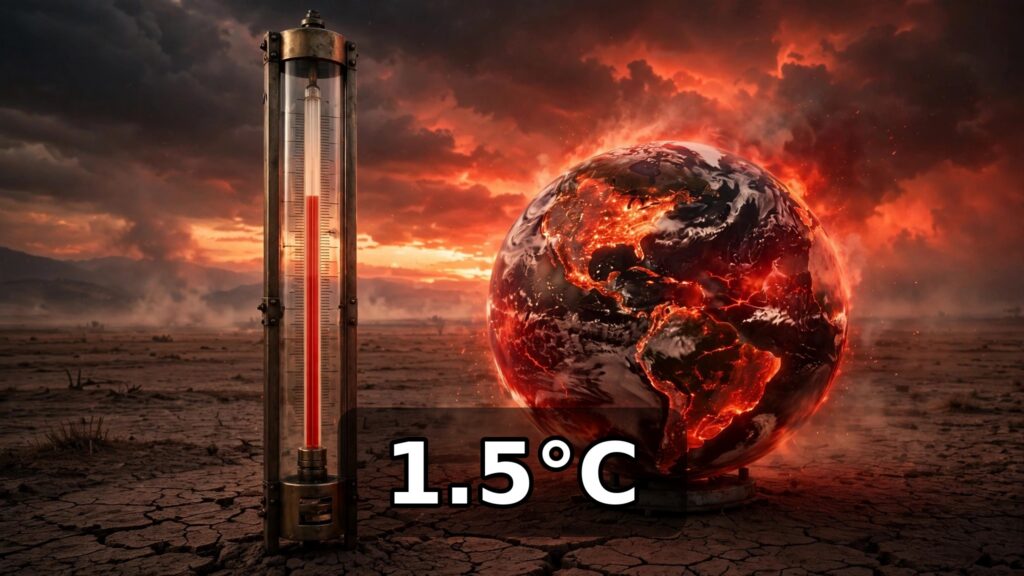
Even the Best Climate Scenario Could Overshoot 1.5°C—What Happens Next?
Reuters cited a 2026 UN report warning that even the best climate scenario could overshoot 1.5°C for a while — a finding that requires distinguishing a single year's average above 1.5°C from the long-term warming level itself, and that makes faster emissions cuts more urgent, not less.
Key points
- A 2026 United Nations report, cited by Reuters, says even the best scenario could see the world overshoot 1.5°C for a while.
- A single hot year above 1.5°C is not the same as the long-term average settling above the threshold — the second is the measure that matters for the Paris Agreement’s goal.
- The height and duration of an overshoot decide how much damage it does, and some losses — glaciers, species, coral reefs — cannot be undone by a later return.
- Returning requires deep emissions cuts plus carbon removal, and neither can substitute for the other.
For years, 1.5°C has served as the world’s most important climate number. It is the threshold that countries pledged to try not to cross, the line that separates dangerous warming from far more dangerous warming. Now Reuters, citing a 2026 report from the United Nations, has reported something that complicates that picture: even under the best scenario, the world could overshoot 1.5°C for a while. The news is unsettling, but it is also widely misunderstood. Understanding what overshoot actually means — and what it does not mean — is essential to understanding what happens next.
The confusion begins with the number itself. To most people, 1.5°C sounds like a temperature on a thermometer, a single reading that can be checked on a given day. In climate policy, it is something more specific and more subtle: a measure of how much warmer the planet has become compared with the pre-industrial period, understood as a long-term average, not as a reading on any particular day or in any particular year. Much of the misunderstanding around overshoot comes from blurring that distinction, and from treating a temporary path above the threshold as if it were the same as abandoning the threshold altogether. It is not, and the difference matters enormously for what societies should do next.
One year is not the same as a long-term level
| Single year above 1.5°C | Long-term level above 1.5°C | |
|---|---|---|
| What it is | One year’s average temperature crosses the threshold | The average over many years settles above the threshold |
| Has it happened? | Yes, in recent years, driven by natural variability on top of human-caused warming | Not yet — the long-term average is still approaching the threshold |
| What it means | A warning sign, but not proof the long-term goal is breached | The climate system itself has shifted into a hotter state |
| Can it reverse quickly? | Yes — a hot year can be followed by a cooler one | No — it stays above unless the underlying drivers change substantially |
A single hot year is influenced by natural fluctuations — the state of the oceans, the pattern of winds, the presence or absence of particular weather phenomena in that year — layered on top of the steady warming caused by greenhouse gases. It can spike above the threshold and then fall back, without the long-term average having changed. The long-term level, by contrast, reflects the accumulated effect of greenhouse gases over decades. It moves slowly, it does not spike and fall back with a single year’s weather, and once it settles above a threshold, it stays there unless the underlying drivers change substantially.
This distinction protects against two opposite misreadings. On one side, a single year above 1.5°C is sometimes reported as if the goal were already lost, breeding a sense of futility that undermines action. On the other side, a year below 1.5°C after a year above it is sometimes reported as if the danger had passed, breeding complacency. Both misreadings come from treating a yearly reading as if it were the long-term level. Keeping the two apart allows for a steadier, more accurate view: the long-term level is rising, it is approaching the threshold, and the question is whether its path will cross the threshold temporarily and return, or cross it and remain above it.
What overshoot means: a path, not a moment
Overshoot describes a path, not a single moment. In an overshoot scenario, temperatures rise above 1.5°C for a period and then, if emissions fall deeply enough and carbon is removed from the atmosphere, come back down. The key word is “if.” Overshoot is not a guarantee of return. It is a scenario in which the world misses the target temporarily and then works its way back — a path that depends on action that has not yet been taken.
Why duration and height matter
The duration and height of the overshoot matter enormously. A brief, small overshoot is a very different prospect from a long, large one. The longer temperatures stay above 1.5°C, and the further above it they go, the more damage accumulates: more coral bleaching, more ice loss, more extreme weather, and more stress on the ecosystems and communities least able to cope. Some of that damage, such as the loss of certain glaciers or species, may not be reversible even if temperatures later fall.
Irreversible losses during overshoot
Some losses during an overshoot cannot be reversed by a later return to lower temperatures, and naming them is essential to an honest account of what overshoot means. Ice is the clearest example. Glaciers and ice sheets that melt during a warm period do not simply regrow when temperatures fall, because regrowth requires centuries of snowfall under cold conditions, and because the landscape itself changes when ice is lost. A small glacier that disappears during an overshoot is gone, even if the world later cools. Its water-tower function, its ecosystem, and its landscape are lost with it.
Species loss is similarly irreversible. A species driven to extinction during an overshoot does not return when temperatures fall. A coral reef that dies after repeated bleaching does not spontaneously reappear. An ecosystem that transitions from forest to savanna, or from wetland to dry land, during a prolonged warm period may not transition back, because the soil, the seed bank, and the community of species that sustained the original ecosystem have changed. These are not temporary inconveniences. They are permanent subtractions from the living world, and they accumulate during every year spent above the threshold.
Why even the best scenario overshoots
It may seem strange that the best scenario still overshoots. The reason is that a great deal of warming is already locked in by past emissions, and the world’s current trajectory is far from the best case. Greenhouse gases already in the atmosphere will continue to warm the planet, and the infrastructure built around fossil fuels does not disappear overnight. Even if countries moved as fast as the most optimistic scenario assumes, the momentum of the system makes a temporary overshoot likely.
Locked-in warming is often misunderstood as fatalism. It does not mean that future warming is entirely predetermined, or that action now makes no difference. It means that the greenhouse gases already emitted will continue to exert a warming influence for a long time, because they remain in the atmosphere for decades to centuries, and because the oceans, which absorb heat slowly, will continue to warm and to influence the climate even after emissions fall. The planet is thus committed to some further warming from past emissions alone, and that commitment, combined with the time needed to transform energy, transport, and industry, makes a temporary exceedance likely even on the most ambitious path.
What happens during an overshoot
An overshoot period would not be a pause in climate impacts. It would be a period in which the risks associated with higher temperatures become more frequent and more severe. Heat waves would become more common. Sea levels would continue to rise as ice melts and ocean water expands. Ecosystems already under stress would face additional strain, and the communities most vulnerable to climate impacts — low-lying island nations, arid farming regions, crowded coastal cities — would bear the heaviest costs.
The two requirements for return
Returning from an overshoot requires two things. The first is deep and rapid cuts in greenhouse gas emissions, so that the atmosphere stops accumulating additional warming. The second is the removal of carbon dioxide already in the atmosphere, whether through natural means such as restoring forests and soils, or through technological approaches that are still being developed. Both are difficult. Neither is impossible. But neither happens automatically, and neither can substitute for the other.
Deep emissions cuts are the primary requirement, and their depth and speed determine the shape of the overshoot. Every year of delay adds to the peak temperature and to the duration above the threshold, and therefore to the irreversible damage incurred. Deep cuts mean more than incremental efficiency improvements. They mean transforming how energy is generated, how transport moves, how industry produces, and how buildings are heated and cooled. The longer those decisions are postponed, the deeper the cuts must later be to achieve the same return — and at some point, cuts alone, however deep, may not be enough to bring temperatures back within a reasonable time.
Carbon removal is the second requirement, and it is often misunderstood. Removing carbon from the atmosphere means taking carbon dioxide that is already there and storing it durably, whether in forests, soils, oceans, or geological formations. Natural removal — restoring forests, protecting wetlands, improving soil health — offers real benefits, and it supports ecosystems and livelihoods at the same time. But its scale is limited by land availability, by the time trees take to grow, and by the vulnerability of restored ecosystems to future fire, drought, and heat. Technological removal — capturing carbon dioxide directly from the air and storing it underground — is being developed, but it remains expensive, energy-intensive, and unproven at the scale that an overshoot return would require.
Why overshoot is a reason to act faster, not delay
This is where the overshoot debate often goes wrong. Some treat overshoot as permission to delay action, on the grounds that temperatures can always be brought back down later. That is a dangerous misreading. The longer the delay, the larger the overshoot, and the harder — and possibly impossible — the return becomes. Overshoot is a reason to act faster, not slower.
The delay argument rests on a false premise: that the future will have more options than the present. In reality, delay narrows options. It locks in more fossil-fuel infrastructure, it allows more ice loss and species loss to become irreversible, and it increases the amount of carbon removal that would later be required — removal that may not be available at that scale. Delay also increases the adaptation burden during the overshoot, forcing societies to cope with hotter conditions for longer, with fewer resources, because those resources have been consumed by repeated disasters.
What happens next depends on now
The UN report’s message, as cited by Reuters, is ultimately a message about urgency. Even the best path forward now includes a period above 1.5°C. That fact should sober anyone who hoped the target could still be met without a temporary breach. But it should not be read as a declaration that the target is dead. A temporary overshoot that is followed by a return is still a fundamentally different future from one in which warming runs away.
What happens next will be decided by the choices of the coming years: how fast emissions fall, how much carbon is removed, and how well societies adapt to the hotter conditions of the overshoot itself. The 1.5°C goal was never a cliff edge beyond which nothing matters. It was a guardrail, and guardrails matter most precisely when a vehicle is at risk of going over them. The world is approaching that guardrail now. Whether it scrapes along it for a while or crashes through depends on what happens next — and “next” means now.
Raina





댓글 0
첫 댓글을 남겨보세요.