
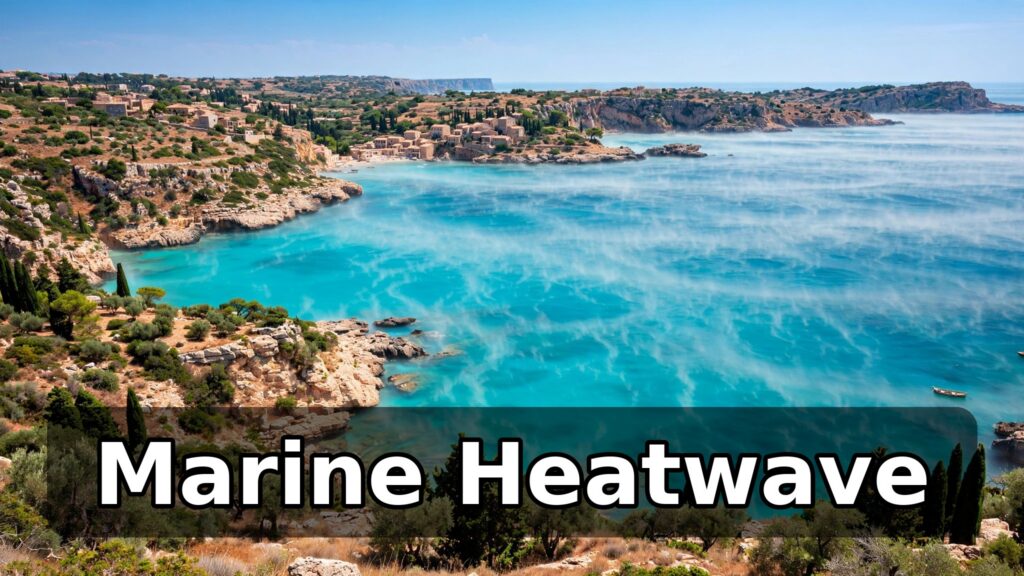
How Did Carbon Pollution Expand Europe’s 2026 Marine Heat Waves?
The Guardian covered a study comparing observed sea temperatures with climate models, finding that human-caused warming contributed to the expansion of 2026 marine heat waves in some European seas — not all, and not everywhere equally — a reminder that carbon pollution heats the ocean as surely as it heats the air, and that which seas are changing fastest matters for the planners and fishing communities who must adapt.
Key points
- In 2026, parts of Europe’s seas grew unusually warm for extended periods — marine heat waves that spread further than they otherwise would have.
- A study covered by The Guardian found that human-caused warming contributed to the expansion of marine heat waves in some European seas.
- The ocean absorbs the overwhelming majority of the extra heat trapped by greenhouse gases, raising sea temperatures degree by slow degree.
- Warmer seas shift fish, kill stationary shellfish, wither seagrass, and leave coastal livelihoods more uncertain — and enclosed seas are especially prone to prolonged heat.
The sea does not show its fevers the way land does. There are no cracked fields or wilted crops to photograph, only water that looks much as it always has. Yet in 2026, parts of Europe’s seas grew unusually warm for extended periods — marine heat waves that spread further than they otherwise would have. The Guardian covered a study that compared observed sea temperatures with climate models, and the study’s conclusion was clear: human-caused warming contributed to the expansion of marine heat waves in some European seas.
The question is how carbon pollution, released far from the shore, ends up heating the sea. That question has several layers. There is the physical layer: what a marine heat wave is, and why water holds heat in ways that make these events so persistent. There is the scientific layer: how researchers can distinguish a human influence from natural variability, and why the phrase “some seas” is not a hedge but a finding. And there is the human layer: what warmer seas mean for fish, shellfish, seagrass, fisheries and the coastal communities that depend on them.
What a marine heat wave is
A marine heat wave is a prolonged period of unusually warm ocean water in a particular region. Unlike a hot day on land, which passes quickly, a marine heat wave can persist for weeks or months, because water holds heat far longer than air. During such an event, the sea surface stays well above its normal range for that time of year, and the warmth can extend deep below the surface.
These events are not new. The oceans have always had warm spells. What has changed is their frequency, duration and extent. Warmer baseline ocean temperatures mean that a warm spell that once would have been unremarkable can now cross the threshold into a heat wave — and a heat wave that once would have stayed local can now spread further.
A marine heat wave is a relative concept: unusually warm for that place, at that time, for a sustained period. Water that is warm for a tropical sea in summer may be normal, while the same temperature in a temperate sea in spring may be extreme. That relativity is why baseline warming matters so much. As the baseline rises, the threshold for what counts as extreme is crossed more often, and warm spells that once fell short of the threshold now exceed it.
Why water holds heat, and why that matters
The sea’s heat storage has consequences that go beyond duration. Because the ocean absorbs and retains heat, it acts as a memory of past warming. Heat absorbed in one year does not fully dissipate before the next year’s heat is added. Over years and decades, the ocean accumulates heat, raising its baseline temperature. That accumulated heat is the reason marine heat waves are becoming more frequent and more extensive: they are occurring on top of a warmer ocean, not on top of the ocean of the past.
How scientists trace the human fingerprint
The study covered by The Guardian used a method that has become central to climate science: comparing what actually happened with what models say would have happened without human influence. Researchers take observed sea temperatures and set them against simulations of a world without greenhouse gas emissions from human activity. When the observed warming and expansion of marine heat waves go beyond what the no-human-influence simulations produce, scientists can attribute part of the change to human-caused warming.
This is not guesswork, and it is not a claim that every warm patch of sea is caused by people. Natural variability still plays a role in ocean temperatures. But the comparison allows researchers to separate the background influence of warming from the noise of natural variation. In the case of Europe’s 2026 marine heat waves, the study found that human-caused warming contributed to their expansion in some European seas — making them larger than they would have been in a world without carbon pollution.
Uncertainty remains, and responsible attribution acknowledges it. Models are imperfect. Observations have gaps. The precise contribution of human influence to a particular sea in a particular year may be difficult to quantify exactly. But uncertainty about the precise magnitude is not the same as uncertainty about whether there is a human influence at all.
From smokestacks to sea temperatures
The chain from carbon pollution to a warm sea is straightforward, even if it takes time to play out. Burning fossil fuels releases carbon dioxide and other greenhouse gases into the atmosphere. These gases trap heat that would otherwise escape into space, warming the air. The oceans absorb the overwhelming majority of that extra heat. Over years and decades, that steady absorption raises sea temperatures, degree by slow degree.
This is why marine heat waves cannot be understood as purely ocean events. They are the ocean’s memory of everything the atmosphere has absorbed. A factory, a power plant, or a car fleet may be far from the Mediterranean or the Atlantic coast, but the heat they help trap eventually finds its way into the sea. The expansion of a marine heat wave is, in that sense, the visible edge of a global process.
What warmer seas do to marine life
Marine life is adapted to the temperature range of its home waters, and many species have little room to adjust. When the sea stays too warm for too long, fish move toward cooler waters, disrupting fisheries that depend on them being in familiar places. Shellfish and other stationary species cannot move at all, and prolonged heat can kill them outright. Seagrass meadows, which shelter young fish and store carbon, can wither. Coral-like organisms in European waters, though less famous than tropical reefs, also suffer when temperatures exceed their tolerance.
Seagrass meadows are a third, often overlooked victim. Seagrass is a flowering plant that grows in shallow coastal waters, forming meadows that shelter young fish, stabilise sediment, and store carbon. Seagrass is sensitive to temperature, and prolonged heat can cause it to wither and die back. When seagrass is lost, the shelter it provided is lost with it, sediment becomes more mobile, clouding water and further stressing remaining seagrass, and carbon stored in seagrass sediments can be released when meadows degrade.
Fisheries, livelihoods and coastal economies
The ecological effects of marine heat waves translate quickly into human effects, because so many coastal livelihoods depend on predictable marine ecosystems. Fisheries are the most direct link. When fish move, catches change. A fisher who has fished the same grounds for years may find those grounds empty, while new species appear that they have no market for or no gear to catch. Processing plants, markets and restaurants built around particular species face supply disruptions.
Aquaculture faces similar risks, with an added dimension: farmed species cannot move at all. A fish farm or shellfish farm in a location that experiences a marine heat wave may lose its entire stock, with no ability to relocate in time. The financial consequences can be severe, especially for small-scale operators without insurance or reserves. Repeated heat waves can make aquaculture in a given location unviable, forcing operators to relocate, change species, or leave the industry.
The cumulative effect on coastal economies is uncertainty. Fishing, aquaculture and tourism all depend on predictability: knowing what species will be available, when, and in what quantity. Marine heat waves introduce unpredictability, making planning harder, investment riskier, and livelihoods less secure. That uncertainty is itself a cost, even in years when a heat wave does not cause a catastrophic loss.
Why enclosed seas are more prone
Europe’s seas differ in depth, currents and exposure to the Atlantic, and those differences shape how each one responds to warming. Enclosed or semi-enclosed waters, where warm water is less easily flushed away, can be especially prone to prolonged heat.
An enclosed sea has limited exchange with the open ocean. Its water circulates within a basin, with only narrow straits or channels connecting it to larger waters. Warm water that enters or is heated within the basin stays there longer, because it is not quickly flushed out by open-ocean currents. The basin can therefore accumulate heat over a season, reaching higher temperatures and sustaining them longer than an open coastline exposed to ocean currents would. Shallow enclosed seas are particularly vulnerable, because a smaller volume of water warms faster and has less thermal buffer.
Why “some seas” matters
The study’s wording deserves attention: human-caused warming contributed to the expansion of marine heat waves in some European seas. Not all seas, not everywhere, and not to the same degree. This nuance is a strength of the finding, not a weakness. It shows that researchers are mapping where the human influence is clearest rather than making blanket claims.
Specificity matters for planning. It allows resources to be targeted. A coastal authority with limited funds for adaptation — for monitoring, for fisheries support, for habitat protection — can prioritise the seas and coastlines where human-caused expansion is clearest and where risks are rising fastest, rather than spreading resources thinly across all waters equally. Fisheries management can be tailored: catch limits, seasonal closures and aquaculture siting can be adjusted for the specific seas where fish movement and shellfish mortality are most likely.
A warmer sea is a different sea
The expansion of Europe’s 2026 marine heat waves is a reminder that climate change is not only a story about air temperatures and land. The oceans, which cover most of the planet and absorb most of the extra heat, are changing in ways that are less visible but no less consequential. A sea that is warmer for longer behaves differently: it supports different species, stores heat differently, and interacts with weather systems differently.
Understanding the role of carbon pollution in that change is not about assigning blame for its own sake. It is about recognising that the heat in the sea has a source, and that the source is something societies can control. Emissions released today will shape the temperature of Europe’s seas for years to come.
That warning has a practical implication. Because ocean warming lags behind emissions, and because heat already absorbed will continue to affect seas for years, adaptation is necessary even if emissions are reduced. Coastal communities, fisheries and aquaculture operators need to plan for warmer seas, more frequent marine heat waves, and shifting species, regardless of future emission pathways. Monitoring, flexible fisheries management, habitat protection and diversified livelihoods are the tools that allow coastal societies to live with a sea that is already changing.
At the same time, mitigation remains essential, because the extent of future change depends on future emissions. Every increment of warming adds to ocean heat, increases the likelihood and extent of marine heat waves, and narrows the options for adaptation. The marine heat waves of 2026 show what has already been set in motion. What happens next depends on whether societies treat that warning as a reason to act, on both adaptation and emissions, before the sea changes further.
Raina





댓글 0
첫 댓글을 남겨보세요.